
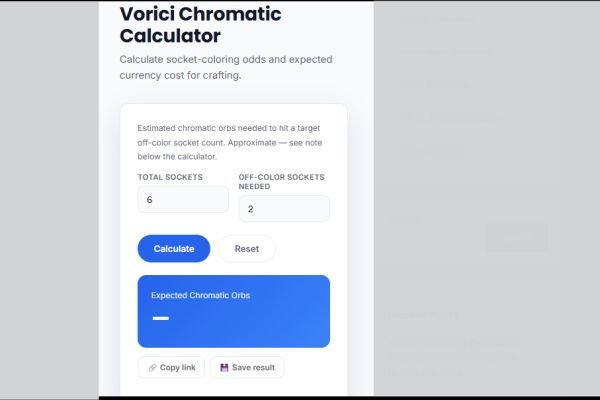
Getting the right color combination on an item in Path of Exile can be a surprisingly expensive part of preparing a build. The challenge becomes more noticeable when a valuable item needs several colors that do not naturally match its attribute requirements. Rather than repeatedly spending Chromatic Orbs without knowing the likely investment, players can use a poe vorici calc to estimate the expected number of Orbs needed for a chosen off color requirement. This provides a useful starting point for evaluating crafting costs and deciding how much currency to reserve.
Understanding Chromatic Orb Coloring
Chromatic Orbs allow players to change the colors of sockets on equipment. Although the process is random, the probability of receiving different colors is influenced by the item's attribute requirements.
Strength generally favors red, Dexterity favors green, and Intelligence favors blue. This means equipment naturally has different tendencies depending on its attributes.
For ordinary color combinations, these tendencies may not create a major problem. The situation changes when a build requires several colors that are less favored by the chosen item. A piece of equipment can have excellent statistics but still require substantial currency before its gem setup becomes practical.
What Makes Off Color Results Difficult
An off color is a color that is less naturally favored by an item's attributes. It is still possible to obtain, but its lower probability can increase the expected number of attempts.
The number of off colors required is also important. Achieving one unusual color is a different probability problem from obtaining several specific colors within the same configuration.
For example, a Strength oriented item may naturally produce red more frequently. If the build requires several blue results, the player may need considerably more attempts than they would for a mostly red configuration.
This makes the complete color requirement more important than simply considering individual sockets.
Why Expected Currency Matters
Chromatic Orbs are commonly available crafting currency, but difficult coloring projects can consume them quickly. The cost of one attempt may appear insignificant, yet hundreds of attempts can represent a meaningful investment.
An expected currency estimate helps players look at the project as a whole. Instead of focusing only on individual rolls, they can consider the approximate amount of currency that may be required to reach the desired configuration.
This becomes particularly useful with expensive equipment. If the expected coloring cost is substantial compared with the item's value, the player may want to consider another base or alternative crafting method.
How Probability Helps With Crafting Decisions
Random crafting always involves uncertainty. A probability estimate cannot tell a player exactly when the desired colors will appear, but it can establish a useful statistical expectation.
For example, one player may achieve the required configuration after a small number of attempts, while another may spend significantly more than the expected amount. Both outcomes are possible because individual results naturally vary.
An expected value should therefore be treated as a planning benchmark rather than a guarantee. Its purpose is to help players understand the potential scale of the investment before they start spending currency.
The Role of Item Attributes
The item's attribute requirements have a major influence on coloring probability.
Strength based equipment generally has a stronger tendency toward red, Dexterity based equipment favors green, and Intelligence based equipment favors blue. Items with mixed attributes can produce a more varied distribution.
This means that the same target configuration can have different expected costs depending on the equipment base.
When choosing between similar items, players should consider not only their defensive or offensive statistics but also how naturally their attributes support the desired color setup.
Considering Total Sockets and Off Colors
The total number of sockets is another important factor when evaluating a coloring project.
A configuration requiring one unusual color is generally less restrictive than one requiring several specific colors. As more conditions are added, the number of acceptable outcomes becomes smaller.
Players should identify the complete color requirement before beginning. Knowing the total number of sockets and the number of off colors required provides a clearer basis for estimating the potential currency commitment.
This can also prevent players from underestimating the difficulty of a particular gear upgrade.
Evaluating the Real Cost of Equipment
An item's purchase price is not always its final cost.
If substantial currency is required to achieve the desired colors, that investment should be included when comparing equipment options. An item that appears cheaper initially may become more expensive after coloring, while a slightly more expensive item with favorable attributes could prove more economical overall.
This is especially important for high value endgame gear. Considering the complete preparation cost can lead to better decisions when purchasing or crafting equipment.
Random Rolling and Controlled Crafting
Random Chromatic Orb rolls are often suitable for straightforward color combinations. When several difficult off colors are required, players may want to consider crafting methods that provide greater control.
The best approach depends on the item's value, required configuration, available currency, and willingness to accept randomness.
Rather than automatically choosing one method, players can compare the expected resource requirements first. This allows them to select an approach that fits both the item and their available budget.
Building a Sensible Crafting Budget
A predefined budget can make difficult coloring projects easier to manage.
Before beginning, players can identify the required colors, examine the item's attributes, determine the number of off colors involved, and estimate the potential currency commitment.
If the expected investment is too high, another equipment base may provide better value. If the cost is reasonable, the player can proceed knowing the approximate scale of the project.
This approach reduces impulsive spending and makes gear preparation more deliberate.
Understanding the Limits of Estimates
Probability based calculations are estimates rather than guarantees. Random outcomes can vary significantly between individual crafting sessions.
A player may get lucky and achieve the desired result quickly, while another may experience an unusually expensive sequence of attempts. These differences are a natural part of random crafting.
The most effective way to use an expected value is as a budgeting and decision making tool. It provides context without suggesting that the exact number of attempts can be predicted.
Frequently Asked Questions
What affects Chromatic Orb probability?
An item's attribute requirements influence the likelihood of different colors appearing. The total number of sockets and the desired color configuration also affect the difficulty.
What is an off color?
An off color is a socket color that is less naturally favored by the item's attribute requirements.
Does an expected Orb count guarantee success?
No. It represents a statistical estimate, while actual results can vary considerably because the coloring process is random.
Why estimate the cost before crafting?
An estimate helps players understand the potential currency commitment and determine whether an item is worth modifying.
Can a different item reduce coloring costs?
Yes. An equipment base whose attributes naturally favor the required colors can often be easier and less expensive to prepare for a particular build.






