
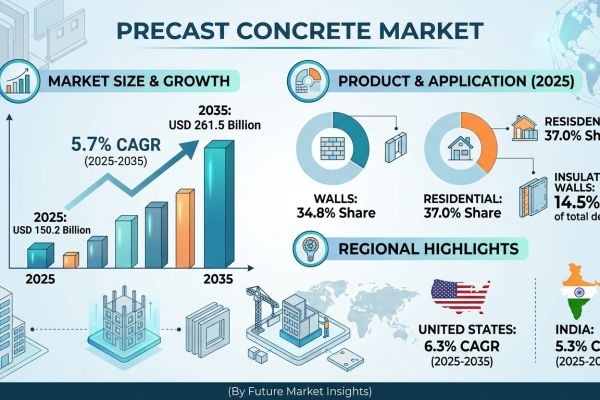
The global precast concrete market is projected to witness strong expansion over the next decade, supported by tightening project timelines, escalating labor costs, and a worldwide shift toward off-site modular manufacturing. The market is expected to grow steadily, reaching approximately USD 261.5 billion by 2035, up from USD 150.2 billion in 2025, registering a compound annual growth rate (CAGR) of 5.7%, according to the latest analysis by Future Market Insights (FMI).
Market growth is being shaped by increasing government mandates for green building, growing developer awareness regarding construction waste reduction, and rapid adoption of advanced factory automation. Precast concrete components have evolved from simple architectural panels into essential structural building blocks across residential, commercial, and infrastructure sectors. While traditional wall and slab configurations continue to dominate installations, manufacturers are increasingly integrating advanced systems such as insulated wall panels to comply with modern energy efficiency expectations and improve thermal performance outcomes.
Precast Concrete Market Snapshot (2025–2035)
Market size outlook toward 2035: USD 261.5 billion Forecast CAGR: 5.7% Dominant product category: Wall systems (34.8% share) Fastest-growing applications: Modular residential housing Key growth countries: United States (6.3% CAGR), India (5.3% CAGR) Primary demand channel: Off-site manufacturing & construction integration
Momentum in the Market
Beginning from steady regional adoption levels, the global precast concrete market demonstrates accelerated growth throughout the forecast period as structural safety and quality compliance become mandatory across multiple countries. Between 2025 and 2030, expanding urban development and rising middle-class housing ownership are expected to significantly boost demand for integrated modular safety systems. During this technology adoption phase, the market is set to expand from USD 150.2 billion to USD 198.4 billion, adding USD 48.2 billion in value as builders transition from conventional cast-in-place methods to factory-controlled precast networks.
Increasing urbanization and higher traffic density are encouraging governments and developers to prioritize rapid infrastructure technologies capable of slashing project timelines by 40% to 50%. From 2030 to 2035, innovation in digital twin platforms and integration with low-carbon concrete formulations is expected to further strengthen market expansion. This second wave of growth will push the market to its ultimate valuation of USD 261.5 billion, capturing an additional USD 63.1 billion. Smart precast units capable of serving multiple architectural layout configurations are emerging as key differentiators in new commercial and residential projects.
The Reasons Behind the Market’s Growth
Demand for precast concrete is rising due to multiple structural and technological factors reshaping the global construction ecosystem.
Compelling Operational Timelines Developers are turning to factory-made components to eliminate traditional weather delays and minimize on-site labor dependencies, enabling tight construction schedules to be met reliably.
Growing Infrastructure Investment Rapid expansion of transportation infrastructure, including bridge replacements and mass transit networks, is driving large-scale engineering adoption of highly durable precast components.
Stringent Environmental Regulations Sustainability mandates and green building codes are prioritizing materials that reduce embodied carbon and minimize physical waste, driving demand for specialized precast systems.
Urban Housing Shortages The rise of affordable housing initiatives and smart city programs requires scalable, repeatable building solutions tailored to rapid high-rise deployment.
Top Segment Application Type
Residential Projects Lead Market Demand Residential applications account for the majority of precast concrete installations globally, capturing a 37.0% share in 2025, heavily supported by the increasing adoption of multi-family modular homes and rapid urbanization frameworks.
Product Segment Analysis Wall systems: Dominates with a 34.8% market share, driven by versatility and installation speed. Insulated walls: Accounts for 14.5% of total demand, growing rapidly as builders prioritize thermal envelopes. Infrastructure components: Holds a 30.0% share, supported by bridge beams, highway barriers, and utility tunnels. Commercial & Industrial: Combines for a 33.0% share, fueled by warehouse, logistics hub, and data center buildouts.
Regional Development: Manufacturing Ecosystems Drive Expansion
The global precast concrete industry is evolving through optimized regional manufacturing footprints designed to lower transportation costs and overcome site handling limitations.
United States Leading developed market expansion with a projected 6.3% CAGR, heavily fueled by public financing under the Infrastructure Investment and Jobs Act and federal housing affordability initiatives.
India Expanding at a swift 5.3% CAGR, driven by large-scale government programs targeting smart cities, rail transit networks, and affordable urban housing blocks.
Asia Pacific Holds a commanding 47.0% regional market share, serving as the primary growth engine for high-rise residential and industrial facility manufacturing.
Challenges, Trends, Opportunities, and Drivers
Drivers
- High-speed modular construction schedules
- Global infrastructure modernization funding
- On-site labor shortage pressures
- Advancements in factory quality control
Opportunities
- Insulated panels hitting passive house standards
- Low-carbon binders and circular aggregate concrete
- Digital twin software integration for automated casting
- Federal transportation and public works programs
Trends
- Shift toward zero-emission precast manufacturing
- AI-enabled automated sorting and curing networks
- Increased reliance on multi-component prefabricated modules
- Architectural customization via advanced finish molds
Challenges
- High transportation and specialized logistics costs over long distances
- Capital-intensive initial manufacturing facility setups
- Access constraints on tight urban job sites
Country Growth Outlook
The market’s growth trajectory is closely tied to infrastructure investment programs and public urbanization mandates across leading national economies:
- United States: High growth via bridge replacement and federal funding integration.
- India: Expanding rapidly through localized smart city construction.
- China & Southeast Asia: Scaled production for high-density public housing.
- Western Europe: Market leadership focused on strict eco-performance and low-carbon compliance.
The Competitive Environment
The global precast concrete market is moderately consolidated, with major building material providers competing through supply chain localization, specialized design support, and sustainable product differentiation. Leading companies include:
- LafargeHolcim
- CRH plc
- Cemex S.A.B. de C.V.
- Heidelberg Materials
These players are investing heavily in automated production networks, low-emission binders, and enhanced structural components while forming long-term partnerships with regional developers to secure consistent supply lines and accelerate off-site project engineering.
Future Outlook: Toward Sustainable and Faster Construction
The precast concrete market is entering a transformative decade shaped by automation, carbon-neutral goals, and digitization. Future precast installations are expected to function as highly engineered modules, arriving on site with built-in insulation, digital tracking tags, and pre-installed utility channels. As global construction demands accelerate alongside stricter sustainability regulations, precast concrete will remain central to delivering durable, efficient, and smarter infrastructure ecosystems worldwide.
For a comprehensive strategic outlook and detailed analysis of technological developments shaping the industry, readers can explore the full report on the official Future Market Insights website: https://www.futuremarketinsights.com/reports/precast-concrete-market






