
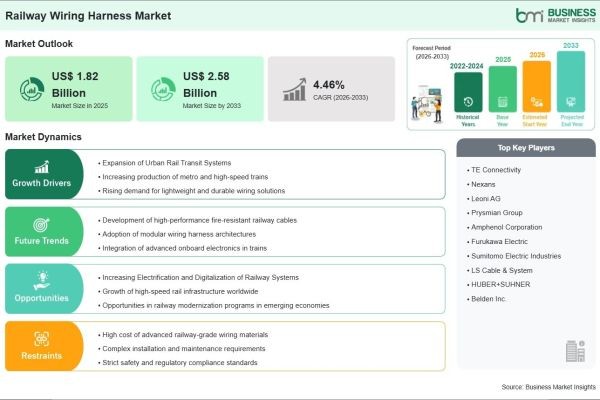
A critical operational and structural modernization is reshaping global rail networks, fueled by the technical necessity to integrate advanced wiring harness frameworks that can safely support rapid urbanization and high-capacity, sustainable transit systems.
Based on market intelligence from Business Market Insights, the global Railway Wiring Harness Market is anticipated to reach US$ 2.58 billion by 2033, mounting from its 2025 value of US$ 1.82 billion at a projected CAGR of 4.46% from 2026 to 2033.
Recent shifts toward predictive maintenance, automated train operations, and high-speed rail expansions are fundamentally altering market dynamics. Leading cable and harness manufacturers are aggressively developing specialized halogen-free, low-smoke materials and integrating optical fibers to handle the massive data loads required by modern passenger infotainment and Communication-Based Train Control (CBTC) systems.
Download Sample Report : https://www.businessmarketinsights.com/sample/BMIPUB00034257
What Is a Railway Wiring Harness?
A railway wiring harness is a systematically organized set of wires, cables, terminals, and connectors designed specifically for rolling stock. Unlike standard commercial wiring, railway harnesses must meet exceptionally stringent safety, fire-retardant, and durability standards. They are engineered to withstand extreme continuous vibrations, harsh weather conditions, severe electromagnetic interference (EMI), and highly demanding operational lifecycles that often span several decades.
These harnesses are vital for distributing power from the locomotive engine or overhead electrified lines to various onboard subsystems. They securely link the traction motor, HVAC (Heating, Ventilation, and Air Conditioning) units, braking sensors, lighting configurations, and complex passenger information displays into one cohesive operational grid.
Market Drivers
The primary driver accelerating the Railway Wiring Harness Market is the massive global expansion of high-speed rail (HSR) and urban metro networks. As megacities battle intense traffic congestion and air pollution, governments are heavily investing in expanding their metropolitan rapid transit systems. High-speed bullet trains and modern monorails require incredibly intricate and heavily shielded wiring systems to support their advanced aerodynamics, automated doors, and specialized propulsion systems.
Furthermore, stringent government mandates for railway electrification are acting as a powerful market catalyst. To hit zero-emission targets, countries (particularly across Europe and Asia) are aggressively transitioning away from diesel locomotives to fully electrified rail grids. This massive fleet conversion directly translates into high demand for highly conductive, high-voltage power cables and associated harness assemblies.
Additionally, the integration of advanced electronics and passenger-centric amenities continues to propel market demand. Today's passengers expect seamless Wi-Fi connectivity, electronic ticketing, and modern digital displays. Simultaneously, operators are deploying hundreds of IoT sensors across the train to monitor brake wear and axle temperatures in real-time. Wiring all these new digital endpoints requires dense, high-bandwidth data transmission harnesses.
Market Segmentation
By Material Type
- Copper
- Aluminum (and Copper-Clad Aluminum)
- Optical Fiber
- Others
By Component
- Wires and Cables
- Connectors
- Terminals
By Train Type
- High-Speed Rail / Bullet Train
- Metro / Monorail
- Light Rail Transit (LRT)
- Conventional Passenger & Freight Trains
By Application
- Traction System Harness
- HVAC Harness
- Infotainment & Communication Harness
- Braking System Harness
- Engine & Lighting Harness
The Copper segment holds the absolute majority of the material market share due to its unparalleled electrical conductivity and flexibility. However, the Optical Fiber segment is expected to witness the fastest growth rate as trains become essentially "rolling data centers." By train type, the High-Speed Rail and Metro segments dominate the market, heavily fueled by rapid urban infrastructure development. In terms of application, the Traction System holds the largest share, while Infotainment & Communication is rapidly expanding as train operators prioritize the commuter experience.
Regional Insights
- Asia-Pacific commands the largest market share and is the fastest-growing region globally. This absolute dominance is anchored by massive state-backed railway investments in China, India, and Japan. China's relentless expansion of its high-speed rail network and India's aggressive rail electrification and metro-city projects make APAC the undisputed revenue engine for global wiring harness manufacturers.
- Europe maintains a highly mature, technically advanced market position. Growth is propelled by rigorous environmental regulations and the European Union's push for sustainable, cross-border train travel. The presence of major rolling stock manufacturers (like Alstom and Siemens) drives a continuous, high-volume demand for premium, halogen-free wiring solutions that meet strict European fire safety standards.
- North America holds a steady market presence characterized by the modernization of its extensive freight rail network and renewed investments in urban passenger transit. Growth is supported by government funding aimed at upgrading aging subway systems in major metropolitan areas like New York and Chicago, requiring thousands of miles of replacement wiring.
- Middle East & Africa and South America are exhibiting emerging growth. Nations in the Middle East, such as the UAE and Saudi Arabia, are rapidly constructing ultra-modern rail and metro systems from scratch to diversify their economies and support tourism, generating lucrative contracts for specialized harness suppliers.
Top Players in the Railway Wiring Harness Industry
The competitive landscape features a mix of massive global cable manufacturers and highly specialized railway component suppliers. Key industry participants are heavily focused on lightweighting their products and securing long-term supply contracts with major rolling stock OEMs.
- TE Connectivity Ltd.
- Leoni AG
- Nexans S.A.
- Prysmian Group
- Furukawa Electric Co., Ltd.
- HUBER+SUHNER AG
- Motherson Group
- NKT A/S
- Hitachi Metals, Ltd.
- LS Cable & System
To sustain market dominance, these leaders are aggressively investing in R&D to create highly modular, pre-assembled harness units that can be installed quickly on the factory floor, significantly reducing the manufacturing time for new train cars.
Technological Innovations
Technological innovations in Copper-Clad Aluminum (CCA) cables are revolutionizing weight management in modern trains. Historically, pure copper was exclusively used, but thousands of miles of copper wire add immense weight to a train, decreasing its energy efficiency. Manufacturers are increasingly utilizing CCA, which combines the superior conductivity of copper on the outside with the extreme lightness of an aluminum core. This transition drastically reduces the overall weight of the wiring harness without compromising electrical performance.
Furthermore, the development of Halogen-Free, Flame-Retardant (HFFR) Insulation is transforming passenger safety. In the event of a tunnel or cabin fire, traditional PVC wiring insulation releases thick, toxic, and highly corrosive smoke that impairs evacuation and damages delicate electronics. Modern railway harnesses are now strictly coated with advanced HFFR polymers. If ignited, these materials self-extinguish and emit virtually no toxic fumes, drastically increasing survival rates during emergencies.
Future Market Outlook
The long-term trajectory for the Railway Wiring Harness Market is highly promising, thoroughly intertwined with the global push for smart, autonomous public transit. As rail operators edge closer to fully driverless trains (Grade of Automation 4), the redundancy and reliability requirements for the wiring harnesses controlling the braking and signaling systems will become exponentially stricter.
Moving forward, the industry will see a complete integration of "Smart Cables." Manufacturers are beginning to embed micro-sensors directly into the wiring harnesses to detect voltage drops, insulation wear, or overheating. These smart harnesses will feed real-time data to AI-driven predictive maintenance platforms, allowing operators to replace a deteriorating wire weeks before it fails, completely eliminating costly, unplanned train delays.
Frequently Asked Questions (FAQs)
Why is copper the most common material used in railway wiring harnesses?
Copper is the industry standard because it offers an unbeatable combination of excellent electrical conductivity, high tensile strength, and superior ductility (the ability to bend without breaking). This makes it highly reliable in a train environment where wiring is subjected to constant vibration and movement.
How does a railway wiring harness differ from an automotive wiring harness?
While both serve similar functions, railway harnesses are significantly more robust. They must meet much stricter international fire safety standards (producing zero toxic smoke), endure much higher voltages (for traction systems), and are designed for a lifecycle of 30 to 40 years, whereas an automotive harness is typically designed for 10 to 15 years.
Why is the demand for optical fiber increasing in trains?
Modern trains require massive amounts of data transfer for high-definition passenger infotainment, onboard Wi-Fi, CCTV security cameras, and automated train control signals. Optical fiber can transmit gigabits of data per second with zero electromagnetic interference, which is critical in an electrically noisy environment like a train.
What role does the HVAC system play in wiring harness demand?
Passenger comfort is a top priority for modern rail operators. High-capacity HVAC (Heating, Ventilation, and Air Conditioning) units require complex, heavy-duty power and control wiring harnesses to efficiently regulate temperatures across long train carriages, directly driving segment growth.
Browse More Reports:
https://www.businessmarketinsights.com/reports/silicon-carbide-electronics-market
https://www.businessmarketinsights.com/reports/silicone-fabrics-market
https://www.businessmarketinsights.com/reports/skin-packaging-market
About Us
Business Market Insights is a market research platform that provides a comprehensive subscription service for targeted industry and company intelligence reports. Our research team has extensive professional expertise across dynamic industrial domains such as Electronics & Semiconductor; Aerospace & Defense; Automotive & Transportation; Energy & Power; Healthcare; Manufacturing & Construction; Food & Beverages; Chemicals & Materials; and Technology, Media, & Telecommunications.
Contact Us
If you have any questions about this report or would like further information, please contact us:
Contact person: Ankit Mathur
Email: sales@businessmarketinsights.com
Phone: +16467917070






