
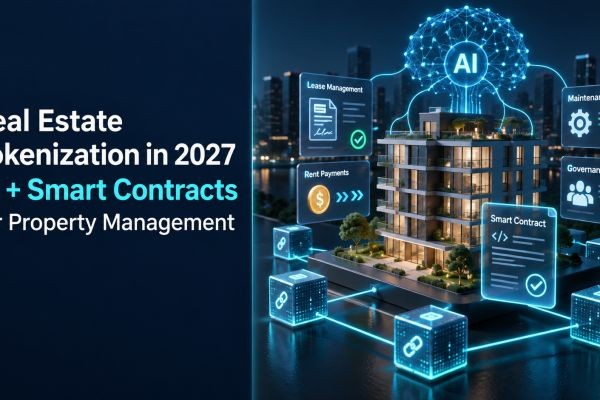
Real estate tokenization has moved from a niche blockchain concept toward a model that can connect property ownership with digital assets. By representing property interests through blockchain-based tokens, property firms, investors, and asset managers can create digital records for ownership, transfers, distributions, and other activities. As the market develops toward 2027, artificial intelligence and smart contracts could become closely connected within property management systems.
AI can process large amounts of property information, identify patterns, monitor operational data, and support decision-making. Smart contracts, meanwhile, can execute predefined actions when specific conditions are met. When these technologies operate together, a tokenized property platform could handle several routine management activities with less manual intervention.
The combination does not mean that every property management task will become fully automated. Legal requirements, human approvals, property inspections, tenant relationships, and financial decisions can still require people. Instead, AI and smart contracts could divide responsibilities based on what each technology does well. This approach could become an important area for Real estate tokenization development in 2027.
What Does Real Estate Tokenization Mean for Property Management?
Real estate tokenization refers to representing ownership rights, economic interests, or participation in property-related assets through blockchain tokens. Depending on the legal structure, these tokens may represent an interest in a property, a property-holding entity, a fund, or another form of real estate investment.
Traditionally, property management involves rent collection, maintenance coordination, financial reporting, tenant communication, inspections, compliance activities, and distribution of income. Many of these tasks depend on information coming from several systems. Tokenization could connect selected property records and financial activities with blockchain-based ownership records.
For a real estate asset tokenization company, this creates opportunities to develop systems where property data, investor records, payment activities, and token ownership can interact. AI could analyze incoming information, while smart contracts could carry out predefined transactions after required conditions are satisfied.
How Could AI Support Tokenized Property Management?
Property managers may have access to information such as rental payments, occupancy rates, maintenance records, utility usage, property valuations, and operating expenses. AI systems can process these datasets and identify unusual patterns or recurring issues.
For example, an AI system could detect that maintenance costs for a particular building have increased over several months. It could compare current expenses with historical records and generate a report for the property manager. The smart contract would not necessarily make the maintenance decision itself. Instead, it could execute a payment after an authorized person confirms the required action.
AI could also assist with rental forecasting. If occupancy data, rental history, seasonal patterns, and local market information are available, an AI model could estimate possible rental trends. Property managers could use these insights while reviewing pricing or budgeting decisions.
How Could Smart Contracts Handle Property Operations?
Smart contracts are blockchain programs that perform predefined actions when specified conditions are met. Within tokenized real estate, they can be used for activities such as rent distribution, investor payments, token transfers, voting processes, and compliance-related restrictions.
Suppose a property generates rental income each month. Once the relevant payment is received and the required accounting conditions are satisfied, a smart contract could distribute funds according to predefined ownership records. This could reduce the amount of manual calculation required for recurring payments.
A similar approach could be applied to maintenance payments. A property manager might approve an invoice after reviewing a service report. The approved information could trigger a smart contract that releases the payment according to predefined rules. AI could help review the invoice and identify unusual amounts, while the smart contract would handle the payment after approval.
AI and Smart Contracts Could Follow a Shared Workflow
A possible 2027 property management system could divide the process into several stages.
Method 1: Collect Property Data
The platform receives information from accounting systems, property management software, IoT devices, tenant systems, payment providers, and other approved sources. Data may include rent receipts, maintenance requests, occupancy information, energy consumption, and operating expenses.
The data should be checked before it is used by an AI model or connected with a smart contract. Reliable data sources are important because blockchain automation can only operate according to the information supplied to it.
Method 2: Let AI Analyze the Information
AI reviews the incoming data and identifies patterns that may require attention. It could detect late rental payments, unusual maintenance costs, sudden changes in occupancy, or differences between expected and actual expenses.
The AI system could then produce a recommendation or alert rather than directly making a financial decision. This keeps human oversight within the property management process.
Method 3: Apply Predefined Smart Contract Rules
Once an authorized condition has been confirmed, the smart contract can perform the relevant action. This could include distributing rental income, recording a transaction, updating token balances, or releasing an approved payment.
The contract follows rules written into its code. It does not independently understand whether a property decision is commercially sensible. Its role is to execute the conditions that have already been defined.
Method 4: Record the Activity
The completed transaction can be recorded on the blockchain. Investors and authorized property managers can use the platform to review relevant records according to their access permissions.
This combination creates a workflow where AI handles data analysis and smart contracts handle predefined execution.
Could AI Improve Maintenance Management?
Maintenance is one area where AI and smart contracts could work together in practical ways. Property managers often receive maintenance requests through different channels. AI could classify these requests according to urgency, property type, previous incidents, and estimated costs.
For instance, repeated air-conditioning problems in a building could be identified through historical service records. The AI system could notify the property manager and suggest an inspection. After the manager approves the work, a smart contract could process the related payment once the required service documentation is submitted.
IoT devices could also provide information about temperature, water usage, electricity consumption, or equipment performance. AI could analyze this data to identify unusual patterns. Smart contracts could then be connected to approved maintenance workflows.
Could Tokenized Ownership Affect Property Management Decisions?
Tokenized ownership can introduce multiple investors into a single property or property-related asset. As the number of token holders increases, property management systems may need efficient methods for handling investor rights and financial distributions.
Smart contracts can record token balances and apply predefined rules to distributions or voting. For example, a property-holding entity may allow eligible token holders to participate in certain decisions. The platform can calculate voting rights according to the governing agreement and token records.
AI could assist by summarizing proposals, analyzing financial information, or presenting different operational scenarios to authorized participants. However, the legal rights associated with tokens would still depend on the legal structure of the investment and the rules governing the asset.
What Could Real Estate Tokenization Platforms Offer in 2027?
Real estate tokenization platform development could increasingly focus on property operations rather than only token issuance. A complete platform may include investor onboarding, token creation, ownership records, property data, payment management, compliance functions, reporting, and property administration.
A Real estate tokenization development company may also integrate AI modules into the platform for financial analysis, maintenance monitoring, document classification, forecasting, and anomaly detection. Smart contracts could manage token transfers, income distributions, voting, and other predefined activities.
For a Real estate tokenization platform development company, this creates a broader product environment. The platform is no longer only a place where property tokens are issued. It can become a digital environment connecting investors, property managers, asset owners, service providers, and financial records.
What Role Could AI Play in Rent Collection?
Rent collection can involve recurring invoices, payment reminders, late-payment tracking, reconciliation, and investor distributions. AI could monitor payment patterns and identify accounts that frequently make late payments. Property managers could receive alerts before an issue becomes more serious.
Once rent is received, smart contracts could apply predefined distribution rules. For example, rental income could be divided among property expenses, reserves, management fees, and eligible token holders according to the governing agreement.
This process could reduce repetitive administrative work while keeping the financial rules recorded in software. Human review would still be useful when disputes, unusual transactions, or legal questions arise.
Could AI Help With Property Valuation?
Property valuation is another area where AI could provide analytical support. An AI model can process historical transactions, rental income, occupancy levels, expenses, location information, and other available data to produce valuation estimates.
These estimates could be displayed within a tokenized property platform for investors and managers. However, an AI-generated estimate should not automatically be treated as an official valuation. Professional valuation standards, local regulations, market conditions, and asset-specific factors may require additional review.
For a Real estate asset tokenization company, combining valuation analytics with token ownership data could provide investors with more information about the assets represented within their portfolios.
What Could Compliance Look Like?
Real estate tokenization involves legal and regulatory considerations that differ between jurisdictions. Investor eligibility, securities rules, property ownership structures, taxation, reporting, and identity verification may all need attention.
AI could assist with document review, transaction monitoring, and identification of unusual activity. Smart contracts could apply predefined restrictions to certain token transfers when the applicable legal rules have been translated into suitable technical conditions.
However, software cannot replace legal advice. A Real estate tokenization company would need to work with legal and compliance professionals when designing the rules governing token issuance, ownership, transfers, and investor participation.
How Could Real Estate Token Development Change?
Real estate token development in 2027 may involve more than creating digital representations of property interests. Developers could focus on the entire lifecycle of a tokenized asset, from issuance and investor onboarding to income distribution and property administration.
A platform may also support multiple property types, investor groups, currencies, payment methods, and compliance requirements. Interoperability with property management and accounting systems could become increasingly relevant as tokenized assets move into regular operational environments.
The Best real estate tokenization companies and Top real estate tokenization companies may therefore be evaluated by the range of functions they provide, their technical architecture, security practices, compliance support, and ability to integrate property operations with blockchain systems.
What Challenges Could Limit AI and Smart Contract Integration?
AI and smart contracts also introduce risks that property businesses need to consider. AI recommendations depend on the quality of the data used for analysis. Incorrect, outdated, or incomplete information can produce unreliable results.
Smart contracts introduce another concern because coding mistakes can affect financial transactions. Once a contract is deployed, changing its behavior may require specific upgrade procedures. The legal agreement and the software rules should therefore be designed to work together.
Privacy is another consideration. Property platforms may handle tenant information, investor identity details, financial records, and other sensitive data. Businesses need appropriate access controls and data-handling practices when connecting these systems.
What Could the 2027 Property Management Model Look Like?
A possible model could involve five connected layers. The first layer would contain property and financial data. The second would provide AI-based analysis. The third would contain blockchain records and token ownership information. The fourth would consist of smart contracts that execute approved rules. The fifth would provide dashboards for property managers, investors, and administrators.
In this model, AI does not replace the property manager. Instead, it helps process information and identify situations requiring attention. Smart contracts do not decide commercial strategy. They execute predefined instructions after relevant conditions have been satisfied.
This division could make AI and blockchain complementary technologies within property operations. The actual design would depend on the property type, legal structure, jurisdiction, investor model, and technical requirements.
Conclusion
Real estate tokenization in 2027 could move toward property management systems where AI analyzes operational and financial information while smart contracts execute predefined transactions and ownership rules. From rent collection and maintenance monitoring to investor distributions, voting, reporting, and compliance workflows, the combination could provide new ways to manage tokenized property interests. Yet successful implementation would depend on reliable data, suitable legal structures, secure smart contract design, human oversight, and appropriate integration with existing property systems. Businesses considering Real estate tokenization development may therefore need to view AI and blockchain as complementary components rather than separate technologies. provides Real estate tokenization development services.
FAQs
1. What is real estate tokenization?
Real estate tokenization is the process of representing property ownership rights, economic interests, or participation in a real estate asset through blockchain-based tokens, subject to the applicable legal structure.
2. How can AI support real estate tokenization?
AI can analyze property data, rental records, maintenance information, occupancy trends, expenses, and other datasets. It can generate reports, identify unusual patterns, and assist property managers with operational decisions.
3. What can smart contracts do in tokenized real estate?
Smart contracts can execute predefined activities such as rental income distributions, token transfers, voting processes, approved payments, and other blockchain-based transactions.
4. Can AI and smart contracts work together for property management?
Yes. AI can analyze information and produce recommendations, while smart contracts can execute predefined actions after the required conditions have been confirmed.
5. What is involved in real estate tokenization platform development?
Real estate tokenization platform development can include token issuance, investor onboarding, identity verification, ownership management, smart contracts, payment processing, property records, reporting, compliance functions, and administrative dashboards.
6. Is AI-based property valuation enough to determine a property's value?
No. AI-generated estimates can support analysis, but formal valuation may require professional assessment, market evidence, legal considerations, and applicable valuation standards.
7. Can smart contracts manage rental income?
Smart contracts can distribute rental income according to predefined rules when the required conditions are met. The exact process depends on the legal and financial structure of the tokenized asset.
8. What does a real estate tokenization company provide?
A real estate tokenization company may provide services covering token design, smart contract development, platform creation, investor systems, compliance functions, property management integrations, and blockchain infrastructure.
9. Why is property data important for AI-based management?
AI depends on the information supplied to it. Accurate rental, maintenance, occupancy, financial, and property data can help produce more useful analysis and alerts.
10. What could real estate token development focus on in 2027?
Real estate token development could increasingly include property lifecycle management, investor services, automated income distribution, AI-based analytics, digital reporting, compliance functions, and integration with existing property management systems.






