
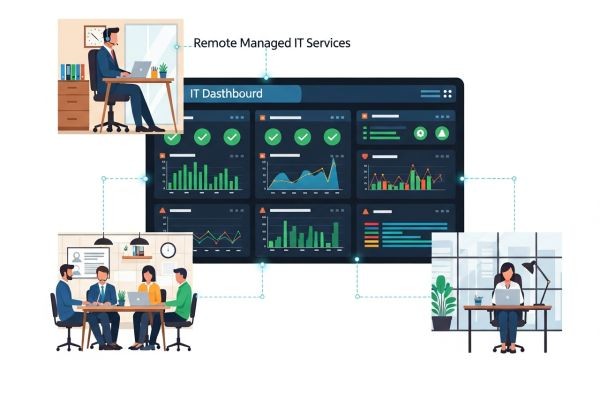
Remote work is now the norm, and businesses that want to stay lean, secure, and competitive are increasingly turning to specialist partners for Remote Managed IT Services. These services give you a full IT team “in the cloud” – monitoring, managing, and supporting your systems 24/7 – without the overhead of building and maintaining an in‑house department. For growing organizations, that shift unlocks better uptime, stronger security, and the freedom to focus on customers instead of constant technical firefighting.
What Are Remote Managed IT Services?
Remote managed IT services combine proactive monitoring, maintenance, security, and help desk support delivered entirely over secure remote connections. Instead of waiting for an engineer to arrive on‑site, your infrastructure, endpoints, and cloud workloads are managed in real time from a central operations center.
This model covers essentials such as:
-
24/7 monitoring of servers, networks, and critical applications
-
Remote troubleshooting and remediation for incidents and performance issues
-
Patch management and configuration updates
-
Managed security (firewalls, antivirus, threat detection)
-
Backup checks and disaster recovery support
-
End‑user support via remote help desk tools
In practice, that means most issues are identified and resolved before your users even realize there is a problem.
Why Remote Beats Traditional On‑Site IT
Traditional IT support was built around physical offices and local servers. A technician would travel to your location whenever something broke. In a world where teams are distributed, applications are cloud‑based, and customer expectations are “always on,” that model no longer fits.
Remote managed IT services are designed for:
-
Speed: Engineers can log in within minutes, not hours, and start remediation immediately.
-
Coverage: True 24/7 monitoring and support regardless of time zone or location.
-
Cost control: Subscription‑based pricing replaces unpredictable call‑out fees and emergency projects.
-
Scalability: New users, locations, or workloads can be added quickly without local hiring.
For businesses shifting to hybrid or fully remote workforces, this kind of flexibility is essential to keep productivity and customer experience high.
Key Business Benefits of Remote Managed IT Services
1. Minimized Downtime and Higher Productivity
Unplanned outages, slow applications, or recurring glitches can silently drain hours of productive time from your teams. Remote managed IT services use continuous monitoring to detect performance anomalies, failing hardware, or service disruptions early, so engineers can take pre‑emptive action.
By resolving incidents faster – and often before they impact users – you preserve billable hours, protect revenue, and keep your digital experience consistent.
2. Stronger Security for Distributed Teams
Remote work has expanded the attack surface: employees connect from home networks, shared Wi‑Fi, and personal devices. Managed providers respond by implementing:
-
Centralized patching and updates
-
Endpoint security and antivirus
-
Firewall and VPN configuration
-
Continuous security monitoring and alerting
-
Incident response playbooks
This layered, always‑on approach drastically reduces the risk of ransomware, data breaches, and account takeover attacks that can cripple a business.
3. Predictable, Lower Total IT Cost
Hiring and retaining a full in‑house IT team is expensive – salaries, benefits, training, tools, and coverage for absences add up quickly. With remote managed IT services, you pay a predictable monthly fee for an entire team’s expertise, tools, and coverage.
You also avoid the hidden costs of downtime, poorly optimized infrastructure, and “DIY IT” where non‑technical staff waste time trying to fix technical issues.
4. Built‑In Scalability as You Grow
Whether you are opening new locations, adding remote team members, or rolling out new applications, remote managed IT scales with you. New users and devices can be onboarded with standardized configurations, security policies, and access controls.
You get the benefits of enterprise‑grade processes – such as centralized identity management and standardized builds – without having to design them from scratch internally.
Core Service Components You Should Expect
When you evaluate a partner for Remote Managed IT Services, look for these core capabilities:
-
Network and infrastructure monitoring: Real‑time visibility into health and performance of your network, servers, and cloud services.
-
Remote help desk: Multi‑channel support (phone, email, chat, portal) for your end users, with clear SLAs on response and resolution.
-
Security operations: Threat detection, log monitoring, and security event handling, not just basic antivirus.
-
Backup and recovery: Verified backups and documented recovery procedures for critical systems and data.
-
Reporting and strategy: Regular reports on incidents, trends, and recommendations so your leadership team can make informed decisions.
Providers that combine these elements into a coherent service give you both day‑to‑day stability and a roadmap for continuous improvement.
Remote Managed IT Services and the Modern Hybrid Workplace
The hybrid workplace – part office, part remote – is here to stay. That introduces complexities that traditional IT models struggle with:
-
Users move between networks and devices regularly.
-
Applications live across SaaS, private cloud, and on‑premises systems.
-
Security policies must be enforced consistently across all of it.
Remote managed IT services are built to handle exactly this environment. Through centralized tools and policies, they provide consistent security, access, and support no matter where your people are working.
For example:
-
A new hire can be fully provisioned with access, security, and support on day one, even if they never step into an office.
-
A location‑wide internet outage can be mitigated by failover and remote rerouting without waiting for on‑site intervention.
-
A suspected security incident can be investigated and contained across devices and locations from a single console.
This level of control and agility is what allows businesses to embrace remote work without sacrificing resilience.
How to Choose the Right Remote Managed IT Partner
Not all providers offer the same depth of service. When shortlisting partners, consider:
-
Experience with remote and hybrid environments: Can they demonstrate success supporting distributed teams?
-
Security posture: Do they offer continuous monitoring, documented incident response, and modern security tooling?
-
Clear SLAs: Are response and resolution times defined, measured, and reported?
-
Scalability and flexibility: Can the service adapt to growth, seasonality, or new locations without long delays?
-
Communication and reporting: Will you get regular, understandable reports and a clear point of contact for strategic discussions?
A strong Remote Managed IT Services provider becomes an extension of your team, not just a vendor you call when things go wrong.
Turning IT from a Burden into an Advantage
Remote managed IT services transform IT from a constant background worry into a structured, predictable function that supports your growth. Instead of reacting to outages and security scares, your organization gains:
-
Stable, secure infrastructure
-
A responsive support experience for users
-
Lower and more predictable IT costs
-
A roadmap for future improvements
For businesses that want to scale confidently in a remote‑first world, partnering with a specialist for Remote Managed IT Services is one of the smartest strategic moves available today.






