
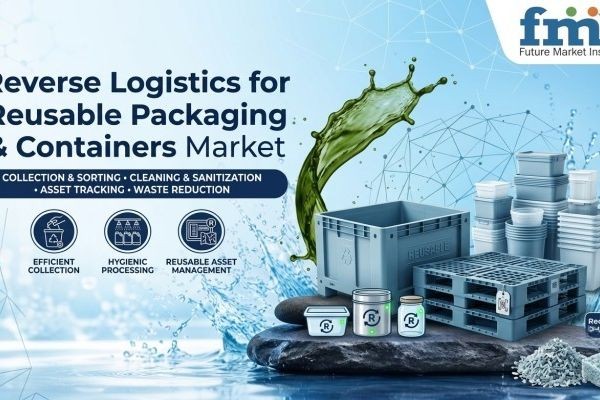
The global reverse logistics for reusable packaging and containers market is projected to reach USD 70.7 billion by 2036, rising from USD 42.3 billion in 2026 at a 5.3% CAGR, according to Future Market Insights (FMI). The market was valued at USD 40.2 billion in 2025, with an incremental opportunity of USD 28.4 billion expected between 2026 and 2036.
The timing matters for FMCG companies, retailers, manufacturers, and logistics operators managing reusable pallets, crates, totes, drums, and IBCs. New packaging-waste rules in Europe begin applying from mid-2026, increasing the need for collection, washing, repair, redeployment, and reporting systems that can keep durable transport assets circulating.
Reverse Logistics for Reusable Packaging and Containers Market Gains From Asset Control
Reusable packaging is increasingly being managed as an operational asset rather than a packaging purchase. The economics depend on how quickly containers return, how accurately their movements are recorded, and whether washing and repair capacity is positioned close enough to high-volume routes.
“The value is not simply in replacing single-use packaging. It comes from keeping reusable assets moving, accounted for, and ready for the next trip,” according to Future Market Insights analysis.
The market covers recovery, inspection, washing, repair, tracking, and return management for durable transport assets. It excludes single-use corrugated and film packaging, forklifts, and generic logistics software that is not designed for packaging circulation.
IFCO Systems is a reusable packaging pooling company that provides pooled crates and related circulation services for supply chains.
One insider-level operating detail stands out: tracking systems are estimated to account for 46% in 2026 in the market snapshot, while the technology-layer analysis places RFID tracking at 39.0%. The figures reflect different segmentation views in the FMI analysis, but both point to asset visibility becoming a central part of reusable packaging operations.
Pooling, Pallets and Plastic Define the Market Structure
Pooling services are expected to account for 41% of the market in 2026 in the market snapshot, as users seek guaranteed circulation, return handling, and asset availability without building complete recovery networks themselves. The service-model analysis separately estimates pooling services at 34.0% in 2026, reflecting its narrower service-model segmentation.
Pallets are projected to represent 38% of the market in 2026, supported by the scale of pallet pools across retail and manufacturing distribution. Plastic is expected to account for 49% of total demand, reflecting the importance of washability, durability, lower weight, nesting efficiency, and repeated-use performance.
Crates account for 28.0% of market share, with standardized footprints supporting automated picking, distribution, and supermarket receiving operations. The shift away from single-use wax-coated cardboard in fresh produce logistics is also supporting demand for rigid reusable crates.
Food and beverage is expected to contribute 29% in 2026. High asset-turn rates, hygiene requirements, and retailer use of pooled trays and crates support the segment.
Closed-loop structures are projected to represent 46.0% in 2026, particularly across automotive and aerospace applications where specialized containers move between defined suppliers and assembly plants.
Tracking Becomes Critical as Return Loops Stretch
RFID tracking is estimated at 39.0% in 2026 within the technology-layer analysis. QR-based systems remain relevant for lower-cost applications, while IoT sensors are gaining traction for higher-value assets where location information needs to be combined with other operating data.
The commercial problem is straightforward. Containers can remain at customer sites for too long, disappear between handoff points, or return without usable movement records when information fails to reconcile between retailers, distributors, pooling operators, and manufacturers.
Operators are therefore using automated entry-exit logging, idle-point detection, and service-cycle scheduling to improve fleet control. FMI analysis notes that tracking software can identify sites where containers remain unused for more than seven days, giving supply chain teams a practical indicator of return bottlenecks.
“When a container sits idle, the economics change. That is why recovery discipline and asset turns are becoming core operating measures,” according to Future Market Insights analysis.
India Leads Major Country Growth
India is expected to record a 5.6% CAGR from 2026 to 2036 among the major country markets cited in the market demand analysis. The United States follows at 5.4%, China at 5.3%, South Korea at 5.2%, Japan at 5.0%, the United Kingdom at 4.7%, and Germany at 4.6%.
India's market is being shaped by retail modernization and wider adoption of returnable plastic crates across grocery and fresh-food distribution. Organized buyers are standardizing packaging formats across vendor networks to improve hygiene control, reduce spoilage, and increase warehouse throughput.
China is projected to expand at 5.3% CAGR, supported by automotive, industrial, and retail flows. Japan is expected to grow at 5.0% CAGR, with dense urban logistics networks supporting reusable food-container pooling where hygiene and return frequency matter.
Europe remains regulation-led, while mature pooling infrastructure supports demand in the United States. Brazil is projected to expand at 5.1% CAGR, supported by food processing, agriculture, and manufacturing applications.
Competitive Landscape Focuses on Recovery Networks
Competition is shaped by depot density, asset pools, washing capacity, return coordination, and backhaul economics. Key participants include CHEP (Brambles), IFCO Systems, Tosca, ORBIS Corporation, IPL Schoeller, Cabka, and Tri-Wall Circular.
FMI analysis finds that buyers increasingly want interoperability rather than asset visibility locked into one proprietary system. This places greater emphasis on data exchange across pooling providers, retailers, distributors, and manufacturers.
Opportunities identified in the market include specialized food-grade wash infrastructure, asset-tracking-as-a-service, and reusable e-commerce return networks. These opportunities address specific gaps in sanitization capacity, fragmented asset data, and recovery requirements in dense urban delivery environments.
About the Report
Future Market Insights' Reverse Logistics for Reusable Packaging and Containers Market study covers service model, packaging type, loop structure, end use, technology layer, and region across North America, Latin America, Europe, East Asia, South Asia, and MEA. The study covers India, China, Brazil, the United States, Germany, the United Kingdom, Japan, and more than 40 additional countries.
The forecast period is 2026 to 2036. FMI applies a supply-side asset-tracking model cross-validated against demand-side logistics spending and corporate sustainability reporting.
FMI Custom Research: Strategic Intelligence for Confident Decision-Making
In today's rapidly evolving business environment, leadership teams need more than market data—they need clear, actionable intelligence tailored to their strategic objectives. FMI's Custom Research solutions are designed around the specific business questions organizations need answered, enabling executives to evaluate growth opportunities, validate investments, assess competitive dynamics, and reduce uncertainty before making critical decisions. By combining deep industry expertise, primary research, and proprietary market intelligence, FMI delivers insights that help organizations move from assumptions to evidence-based strategies with greater speed and confidence.
Business Impact
FMI helps organizations transform market complexity into strategic clarity, enabling leadership teams to identify growth opportunities faster, optimize resource allocation, strengthen competitive positioning, and make high-stakes business decisions with confidence.
About Future Market Insights (FMI)
Future Market Insights, Inc. (FMI) is an ESOMAR-certified, ISO 9001:2015 market research and consulting organization, trusted by Fortune 500 clients and global enterprises. With operations in the U.S., UK, India, and Dubai, FMI provides data-backed insights and strategic intelligence across 30+ industries and 1200 markets worldwide.






