
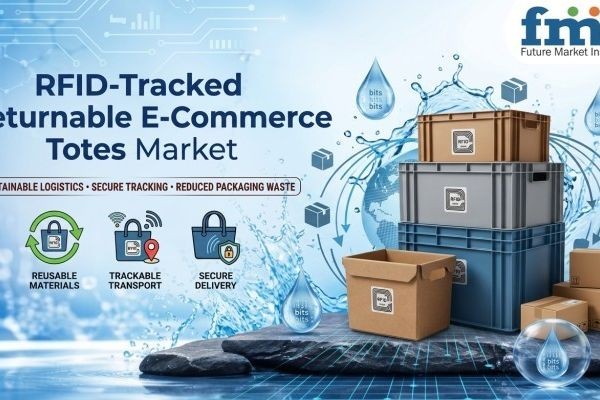
The global RFID-tracked returnable e-commerce totes market is entering a strong growth phase as retailers, logistics providers, and fulfillment operators accelerate the shift from disposable packaging toward reusable, digitally tracked transport assets. According to the latest market analysis by Future Market Insights (FMI), the market is projected to grow from USD 1.2 billion in 2026 to USD 3.6 billion by 2036, registering a CAGR of 11.6% during the forecast period. The market was valued at USD 1.1 billion in 2025.
Market expansion is being supported by increasing adoption of circular packaging models, rising e-commerce return volumes, pressure to reduce corrugated packaging waste, and the need for real-time inventory reconciliation. RFID-enabled totes allow fulfillment centers and retailers to track reusable assets throughout outbound delivery and return cycles, helping reduce shrinkage and accelerate the movement of returned products back into sellable inventory.
As e-commerce networks become increasingly automated, demand is shifting toward ruggedized polymer totes equipped with integrated RFID technology and designed specifically for high-frequency circulation across fulfillment centers, delivery networks, and consumer return channels.
Get detailed market forecasts, competitive benchmarking, and pricing trends:
https://www.futuremarketinsights.com/reports/sample/rep-gb-32268
Market Overview and Strategic Growth Outlook
Institutional pressure to implement circular economy solutions is transforming packaging strategies across e-commerce logistics. Tier-1 third-party logistics providers and major retailers are increasingly evaluating reusable plastic totes as an alternative to disposable corrugated packaging, particularly where assets can achieve lower cost-per-cycle after repeated reuse.
The growing complexity of fashion returns is another important market catalyst. High return rates require rapid identification, reconciliation, and reintegration of returned merchandise. RFID-enabled totes provide automated asset visibility, allowing logistics teams to identify tote movements without relying solely on manual barcode scanning.
The EU Packaging and Packaging Waste Regulation 2024/2841 is also strengthening the strategic case for reusable transport formats as retailers prepare for sustainability targets extending toward 2030.
Key Market Projections and Strategic Insights
- Global Market Value (2026): USD 1.2 Billion
- Forecast Market Value (2036): USD 3.6 Billion
- Forecast CAGR (2026–2036): 11.6%
- Leading Material Segment: High-Density Polyethylene (HDPE)
- HDPE Market Share (2026): 58.0%
- Leading Technology Segment: UHF Passive RFID
- UHF Passive RFID Share (2026): 64.0%
- Leading End-Use Segment: Fashion and Apparel
- Fashion and Apparel Share (2026): 42.0%
- Fastest-Growing Market: China
- China CAGR (2026–2036): 14.5%
- India CAGR (2026–2036): 13.8%
Competitive Landscape and Market Share Analysis
The competitive environment includes established reusable packaging manufacturers and logistics asset providers developing solutions for automated e-commerce fulfillment and closed-loop distribution.
Key companies operating in the market include:
- ORBIS Corporation
- Brambles Limited (CHEP)
- Georg Utz Holding
- Monoflo International
- Schoeller Allibert
- Rehrig Pacific Company
- Myers Industries
- DS Smith
- Cabka Group
- Bekuplast GmbH
Manufacturers are focusing on:
- RFID-integrated reusable tote designs
- Durable HDPE and recycled plastic constructions
- UHF Passive RFID compatibility
- Nestable, stackable, and collapsible formats
- Interoperability across logistics networks
- Automated inventory reconciliation
- Tamper-evident solutions for high-value products
Material and Technology Analysis
HDPE represents the dominant material segment, accounting for 58.0% of the market in 2026. Its impact resistance, wash-cycle stability, and suitability for high-speed conveyor and automated sorting environments make it a preferred material for high-frequency reusable tote applications.
From a technology perspective, UHF Passive RFID is projected to account for 64.0% of market share in 2026. Its ability to support bulk reading enables logistics operators to identify multiple assets during receiving, sorting, and return processing while reducing dependence on manual scanning.
End-Use Analysis
Fashion and apparel is expected to remain the leading end-use segment, representing 42.0% of the market in 2026. High return volumes in the sector make rapid asset identification and merchandise reconciliation particularly valuable.
RFID-enabled totes can help retailers track return movements, reduce shrinkage, improve SKU-level visibility, and shorten the time required to place returned merchandise back into inventory.
Other applications include grocery and fresh food, electronics, and general merchandise. Grocery logistics can particularly benefit from washable, durable tote formats, while electronics and high-value merchandise can utilize tamper-evident designs.
Regional Growth Outlook
China is projected to record the fastest growth, expanding at a 14.5% CAGR through 2036. The market is supported by the Green Express initiative, returnable packaging adoption, and modernization of major shipping hubs.
India follows with a 13.8% CAGR, driven by rapid e-commerce expansion, organized retail distribution investments, and growing demand for reusable logistics assets.
The United States is projected to expand at 10.2% CAGR, supported by omnichannel retail and efforts to manage high-volume apparel returns. Germany is expected to register a 9.5% CAGR, while the United Kingdom is projected to grow at 8.4% amid sustainability and EPR pressures.
Japan and South Korea are expected to record CAGRs of 7.9% and 7.2%, respectively, supported by advanced automation and high-density fulfillment environments.
Market Drivers and Opportunities
Key growth drivers include:
- Expansion of e-commerce and reverse logistics
- Increasing fashion and apparel return volumes
- Adoption of circular packaging systems
- Rising corrugated packaging costs
- Demand for real-time inventory reconciliation
- Sustainability and reusable packaging regulations
- Growth of automated fulfillment and sortation
Emerging opportunities include automated last-mile reconciliation, embedded temperature monitoring for sensitive products, and collaborative pooling networks that allow reusable RFID-tagged assets to circulate across multiple retailers and logistics providers.
Related Reports:
https://www.openpr.com/news/4600326/pallet-labeler-market-size-to-reach-usd-3-81-billion-by-2036-as
https://www.openpr.com/news/4600328/bpa-free-thermal-paper-market-size-to-reach-usd-3-27-billion
https://www.openpr.com/news/4600332/blackout-fabric-laminate-market-size-to-reach-usd-4-76-billion
FMI Custom Research: Strategic Intelligence for Confident Decision-Making
In today's rapidly evolving business environment, leadership teams need more than market data—they need clear, actionable intelligence tailored to their strategic objectives. FMI's Custom Research solutions are designed around the specific business questions organizations need answered, enabling executives to evaluate growth opportunities, validate investments, assess competitive dynamics, and reduce uncertainty before making critical decisions. By combining deep industry expertise, primary research, and proprietary market intelligence, FMI delivers insights that help organizations move from assumptions to evidence-based strategies with greater speed and confidence.
Business Impact
FMI helps organizations transform market complexity into strategic clarity, enabling leadership teams to identify growth opportunities faster, optimize resource allocation, strengthen competitive positioning, and make high-stakes business decisions with confidence.
To explore how FMI Custom Research can support your strategic priorities, please connect with our team at - sales@futuremarketinsights.com
About Future Market Insights (FMI)
Future Market Insights, Inc. (FMI) is an ESOMAR-certified, ISO 9001:2015 market research and consulting organization, trusted by Fortune 500 clients and global enterprises. With operations in the U.S., UK, India, and Dubai, FMI provides data-backed insights and strategic intelligence across 30+ industries and 1200 markets worldwide.






