
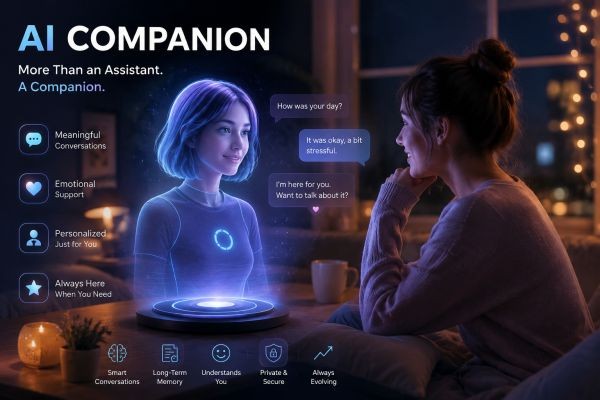
AI companion technology is moving from an experimental category into a mainstream digital experience. Users are increasingly turning to conversational AI for entertainment, social interaction, creative expression, personalized conversations, and emotional support. At the same time, improvements in language models, voice interfaces, memory systems, avatars, and multimodal interaction are making these experiences feel more responsive and personal.
Why More Users Are Turning to Digital Companionship
AI companions are becoming attractive because they provide immediate interaction without the scheduling, social pressure, or unpredictability associated with many human interactions. A user can open an application, select a personality, start a conversation, and return later without having to rebuild the context from scratch.
For many consumers, an AI girlfriend experience represents one form of this broader trend, where conversational technology is used for companionship, roleplay, entertainment, and personalized relationship-oriented interaction. The wider market, however, extends far beyond romantic use cases.
Personalization Is Becoming a Major Reason for Continued Use
One of the strongest advantages of AI companions is personalization. A traditional chatbot generally responds to individual prompts, while a companion-oriented system can maintain a longer-term interaction pattern.
Users can develop preferences around:
- Personality and communication style
- Conversation topics
- Character appearance
- Memory settings
- Voice
- Language
- Humor
- Roleplay scenarios
- Emotional tone
This personalization can make repeated sessions feel different from ordinary chatbot interactions. Instead of treating every conversation as a new transaction, the system can create continuity across sessions.
A 2025 academic study examining Replika and ChatGPT users found a clear distinction in how people perceived the two systems. Replika users tended to assign stronger friendship-oriented roles to the chatbot, while ChatGPT users more frequently viewed the system as an assistant. The study also found differences in perceptions of characteristics including sentience, similarity, and perceived mind.
Text, Voice, and Multimodal Interaction Are Expanding the Market
Text remains an important foundation for AI companion experiences, but the category is moving toward richer communication formats.
Grand View Research reports that text-based AI companions held a 42.7% revenue share in 2025, making text the largest type segment in its analysis. At the same time, voice-based interaction is gaining momentum as speech synthesis and recognition become more natural.
Global Market Growth Is Creating New Opportunities
The commercial opportunity is becoming clearer as consumer adoption increases. App-level data provides another useful indicator.
According to Appfigures data reported from TechCrunch, AI companion applications had reached 220 million downloads globally across the Apple App Store and Google Play as of July 2025. During the first half of 2025, downloads reached 60 million, representing an 88% year-over-year increase. Consumer spending reached $221 million during the same period, 64% higher than the comparable period in 2024.
That concentration creates both opportunity and pressure. New products can find demand, but differentiation becomes essential when users have many alternatives.
Character-Driven Experiences Are Changing User Expectations
AI companions are increasingly designed around personalities rather than generic assistant behavior. A character can have a defined communication style, interests, background, preferences, and relationship dynamic.
This shift is particularly relevant for entertainment-focused applications. Users may not simply want an intelligent answer. They may want an ongoing narrative, a fictional relationship, a roleplay experience, or a character that responds consistently over time.
AI roleplay chat has therefore become another important direction within conversational AI. It allows users to interact with characters across fictional situations while maintaining conversational continuity.
Localization Can Help Platforms Reach More Global Users
Global growth does not mean every market should receive exactly the same product experience.
Language is an obvious factor, but localization extends further. Character preferences, visual presentation, onboarding messages, payment options, communication styles, and marketing language can vary across markets.
A multilingual platform can therefore maintain a shared design system while adapting selected elements for local audiences.
This is also where SEO becomes important. Translating English pages word-for-word does not necessarily capture local search intent. Native keyword research, localized metadata, culturally appropriate copy, and correct hreflang implementation can help search engines understand the relationship between language versions.
Monetization Is Moving Beyond Simple Subscriptions
As AI companion products mature, monetization models are becoming more varied.
Subscriptions remain an important option because advanced models, voice generation, storage, infrastructure, and personalization create recurring operating costs. However, developers can structure paid experiences around different levels of usage.
Potential revenue sources include:
- Premium subscriptions
- Higher message limits
- Voice interaction packages
- Advanced character customization
- Premium avatars
- Additional memory capacity
- Exclusive personalities
- Creator-generated characters
- Digital content
- Enterprise licensing
The commercial model needs to match the product's audience. A casual entertainment application may benefit from a lower-cost subscription with optional upgrades, while a high-engagement platform can create more value around premium interaction.
The app data also suggests that monetization potential is increasing. TechCrunch reported revenue per download rising from $0.52 in 2024 to $1.18 in 2025 for AI companion applications in the Appfigures dataset.
Safety and Trust Are Becoming Product Requirements
Growth also creates a stronger need for responsible product design. AI companions can become highly personalized, which means platforms may handle sensitive conversations, personal preferences, and emotionally significant interactions.
Safety should therefore be treated as part of the product architecture rather than a final moderation layer.
Important areas include:
- Age controls
- Privacy protection
- Data retention policies
- User reporting
- Content moderation
- Consent mechanisms
- Account security
- Transparent AI disclosure
- Protection against manipulative interactions
Research already shows that users can develop meaningful perceptions of AI relationships. The Imagining the Digital Future Center found that 39% of AI companion users agreed that AI understood them better than most people.
That level of perceived connection makes trust particularly important.
What Platform Developers Need to Prioritize in 2026
The next stage of AI companion growth will depend less on simply adding a chatbot and more on creating a coherent product ecosystem.
A strong platform can focus on five areas:
1. Better memory: Conversations should retain relevant preferences without storing unnecessary information.
2. Strong personality consistency: Characters should maintain recognizable behavior across sessions.
3. Multimodal communication: Text, voice, images, and avatars can work together where they genuinely improve the experience.
4. Localization: Language, SEO, design, payments, and communication styles should support individual markets.
5. Responsible infrastructure: Privacy, moderation, age controls, and transparent policies should be built into the technical foundation.
Xchar AI can also benefit from this product direction as users increasingly expect AI characters to provide more personalized and continuous interactions.
A Stronger Competitive Market Is Taking Shape
Market growth will not automatically mean every AI companion product succeeds. As adoption increases, competition will become more focused on retention, personalization, character quality, response speed, pricing, and trust.
The research also shows that market forecasts vary considerably depending on how analysts define the AI companion category. Grand View Research estimates $48.0 billion for 2026, while Fortune Business Insights estimates $49.52 billion, and The Business Research Company reports a narrower 2026 estimate of $24.09 billion.
Conclusion
Rising user interest is giving AI companion platforms a strong foundation for global growth in 2026. Better language models, memory, voice technology, avatars, personalization, and multilingual experiences are changing what users expect from digital interaction.
The numbers reinforce this shift. Market research points toward strong double-digit growth, while app-level data shows substantial downloads and rising consumer spending. At the same time, academic and survey research indicates that some users already perceive AI companions as meaningful social or emotional partners






