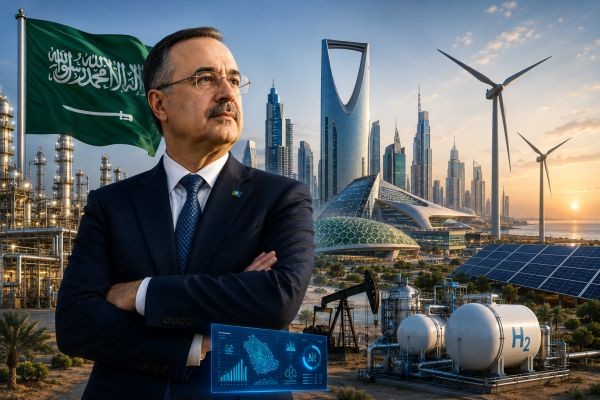
Saudi Arabia’s Vision 2030 is one of the most ambitious national transformation plans in modern history. Launched to reduce the kingdom’s dependence on oil, it aims to reshape the economy through diversification, private sector development, investment in technology, tourism, and large-scale infrastructure projects.
At the center of Saudi Arabia’s energy future is Amin H. Nasser, the President and CEO of Saudi Aramco. Under his leadership, Aramco has continued to strengthen its oil dominance while also investing in cleaner technologies, gas expansion, and global energy partnerships.
But an important question remains: Is Amin Nasser’s energy strategy actually working, or is Saudi Arabia still too dependent on oil revenue despite the Vision 2030 promises?
This article provides a balanced, fact-based analysis of the strategy, its achievements, and the major challenges ahead.
Understanding Vision 2030 and Saudi Arabia’s Energy Goals
Vision 2030 was introduced to prepare Saudi Arabia for a future where oil demand may not be as reliable as it has been in the past. The plan includes economic and social reforms, but energy remains the backbone of the kingdom’s financial strength.
Saudi Arabia’s energy goals under Vision 2030 include:
Reducing dependence on crude oil exports, expanding natural gas production, increasing renewable energy projects, attracting foreign investment, and supporting industrial growth through affordable energy supplies.
While the country wants to diversify, it cannot ignore oil because it still generates a large portion of government revenue. This is why the strategy focuses on using oil profits to fund future industries rather than replacing oil immediately.
Who Is Amin Nasser and Why Does He Matter?
Amin Nasser has been leading Saudi Aramco during a period of global energy uncertainty. Oil markets have experienced major shifts due to inflation, geopolitical conflicts, climate policies, and global supply chain disruptions.
As CEO of the world’s largest oil company, Nasser’s role is not only corporate. His decisions influence Saudi Arabia’s national economy and global energy stability.
His strategy is built around one key idea: oil and gas will remain essential for decades, so Saudi Arabia should maintain leadership in energy production while investing in cleaner technologies.
This approach is sometimes described as a "balanced transition," meaning Aramco will support the energy shift without reducing oil production too quickly.
Aramco’s Oil Strategy: Maintaining Global Market Power
One major part of Amin Nasser’s strategy is ensuring Aramco stays the most reliable and low-cost oil supplier in the world. This matters because if oil demand decreases in the long term, only the most efficient producers will remain competitive.
Saudi Aramco continues investing in upstream production capacity and improving efficiency. The idea is that even if global oil demand peaks, Saudi Arabia can still benefit because its production costs are among the lowest.
This strategy appears to be working in terms of global influence. Aramco remains a major supplier to Asia and continues playing a key role in stabilizing global energy markets.
However, critics argue that relying on oil expansion goes against Vision 2030’s diversification goals. Supporters respond that oil profits are needed to finance the transformation projects.
Gas Expansion: A Strategic Move Toward Cleaner Energy
Amin Nasser has emphasized expanding natural gas production, which is considered cleaner than crude oil. Gas produces fewer carbon emissions than coal and is often used as a transition fuel.
Saudi Arabia is investing in gas fields and infrastructure to support industrial growth, reduce domestic oil consumption, and supply cleaner energy for power generation.
Gas expansion supports Vision 2030 because it allows the country to export more oil instead of using it locally for electricity. It also strengthens Saudi Arabia’s role in global energy markets beyond crude oil.
This is one of the strongest points of Nasser’s strategy because it supports both economic and environmental goals.
Renewable Energy Development: Progress but Still Slow
Saudi Arabia has announced large renewable energy targets, including solar and wind projects. The kingdom has strong potential because of its geography, sunlight, and available land.
Renewable energy is important for Vision 2030 because it helps reduce domestic oil consumption. If Saudi Arabia can generate electricity through renewables, it can reserve more crude oil for export and generate more revenue.
However, critics argue that renewable progress is slower than expected compared to the ambitious targets. While projects are increasing, the country is still heavily reliant on fossil fuels.
The challenge is not only building renewable plants but also developing a modern power grid, storage systems, and a skilled workforce.
Saudi Arabia is moving forward, but renewables are not yet large enough to replace a major share of domestic energy demand.
Carbon Capture and Cleaner Oil: A Practical Approach
Amin Nasser often promotes carbon capture and storage (CCS) as a key solution for reducing emissions. CCS technology captures carbon dioxide from industrial sources and stores it underground instead of releasing it into the atmosphere.
Aramco has invested in carbon capture projects because it allows the company to continue producing oil while lowering its environmental impact.
This strategy is realistic because it supports the global demand for energy while addressing climate pressure. However, CCS technology is expensive and not widely scaled across the world.
If Saudi Arabia can scale CCS effectively, it could become a leader in low-carbon energy production. But success depends on cost reduction, global adoption, and long-term policy support.
Hydrogen and Future Fuels: Long-Term Potential
Hydrogen is often presented as a future fuel for industries like shipping, aviation, and heavy manufacturing. Saudi Arabia is investing in hydrogen projects, including green hydrogen powered by renewables.
Amin Nasser’s strategy includes positioning Saudi Arabia as a future exporter of hydrogen. This supports Vision 2030’s goal of becoming a global energy leader even after oil demand decreases.
However, hydrogen is still a developing market. Global infrastructure for hydrogen transport and storage is limited, and production costs remain high.
Saudi Arabia has strong potential to succeed in hydrogen exports, but it may take many years before hydrogen becomes a major source of revenue.
Vision 2030 Funding: Oil Revenue Still Pays for Everything
One of the biggest realities is that Vision 2030 is still heavily funded by oil revenue. Mega projects like NEOM, tourism development, infrastructure expansion, and economic reforms require massive budgets.
Aramco’s profits and oil exports remain essential to support these projects. Amin Nasser’s strategy is designed to protect these revenue streams for as long as possible.
This approach has worked financially because Aramco continues to generate strong income during high oil price periods. The government can then use these funds to support diversification programs.
But it also creates a risk: if oil prices drop sharply, Vision 2030 funding could face major challenges.
Foreign Investment and Global Partnerships
Saudi Arabia has been working to attract foreign investors. Energy partnerships play a key role because global companies want stable energy supplies and profitable investment opportunities.
Aramco has expanded partnerships with China, India, and other Asian markets. It has also invested in refineries, petrochemical projects, and global supply agreements.
These partnerships strengthen Saudi Arabia’s economic influence and support long-term oil demand by ensuring stable buyers.
This part of the strategy is effective because Asia remains one of the biggest global oil consumers.
Are Economic Diversification Goals Actually Being Achieved?
The success of Vision 2030 is not measured only by energy production. The real goal is building non-oil industries that can support Saudi Arabia’s economy.
There has been progress in tourism, entertainment, construction, and technology investment. The private sector is growing, and the country is creating more employment opportunities.
However, oil still plays the biggest role in revenue. While diversification is happening, it has not yet reached the level where the economy can function without strong oil income.
This means the energy strategy is still closely tied to oil dominance, and the transformation remains incomplete.
Major Criticisms of Amin Nasser’s Energy Strategy
Some analysts believe Saudi Arabia is focusing too much on oil expansion instead of speeding up renewable energy and industrial diversification.
Another criticism is that global climate policies could reduce oil demand faster than expected. If major economies move aggressively toward electric vehicles and renewable energy, oil demand could weaken, reducing Saudi Arabia’s financial advantage.
There are also concerns about whether carbon capture and hydrogen can scale quickly enough to replace oil revenue in the future.
These criticisms highlight that Saudi Arabia’s strategy is not risk-free, even if it looks strong in the short term.
Is the Strategy Working? A Realistic Evaluation
The answer depends on what "working" means.
If the goal is to maintain Saudi Arabia’s global oil dominance while funding Vision 2030, then Amin Nasser’s strategy is delivering results. Aramco remains profitable, global partnerships are expanding, and the kingdom continues to benefit from energy exports.
If the goal is to quickly reduce dependence on oil and transition into a post-oil economy, then progress is slower. Renewable energy development is increasing, but it is not yet large enough to replace fossil fuel reliance.
In practical terms, the strategy is working for stability and short-term economic strength. The long-term success will depend on whether Saudi Arabia can build strong non-oil industries fast enough before global oil demand declines.
Conclusion
Saudi Arabia’s Vision 2030 is an ambitious transformation plan, and Amin Nasser’s energy strategy plays a central role in keeping it financially supported. Under his leadership, Saudi Aramco has maintained global oil dominance, expanded gas production, and invested in emerging technologies like carbon capture and hydrogen.
The strategy appears effective in protecting Saudi Arabia’s economic strength today. However, it still depends heavily on oil revenue, and renewable energy progress must accelerate to meet long-term goals.
Amin Nasser’s approach is realistic for current global energy demand, but the final outcome will depend on how quickly Saudi Arabia can build a diversified economy that does not rely mainly on oil exports.
Frequently Asked Questions (FAQs)
What is Saudi Arabia’s Vision 2030?
Vision 2030 is a national plan to diversify Saudi Arabia’s economy, reduce reliance on oil, and expand sectors like tourism, technology, and private business.
Who is Amin Nasser?
Amin H. Nasser is the CEO of Saudi Aramco and one of the key figures shaping Saudi Arabia’s energy strategy.
Is Saudi Arabia reducing oil dependence under Vision 2030?
Saudi Arabia is working on diversification, but oil still remains the largest source of government revenue.
What role does natural gas play in Saudi Arabia’s strategy?
Natural gas is being expanded to reduce domestic oil consumption and provide a cleaner energy source for industry and power generation.
Is Saudi Arabia investing in renewable energy?
Yes, Saudi Arabia is investing in solar and wind projects, but renewable expansion is still developing compared to the scale of oil production.






