
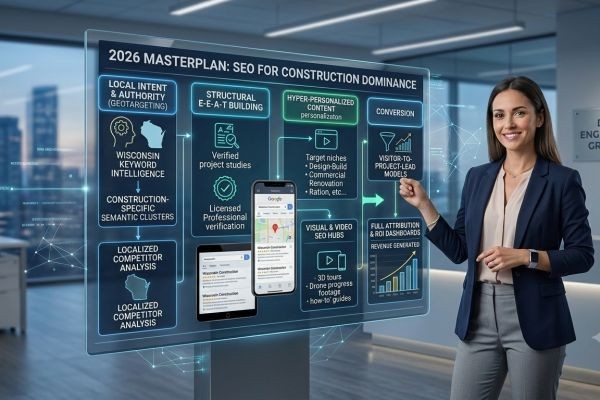
In the commercial and residential construction sectors, winning high-value contracts is no longer dependent solely on traditional handshakes, relationship networks, or bidding portals. Today, when developers, corporate executives, and municipal planners require a general contractor, a design-build firm, or specialized engineering services, they turn to search engines. If your company is invisible on organic search feeds and AI overviews, you are systematically handing multi-million dollar contracts directly to your competitors.
In 2026, standard keyword stuffing and static portfolios are completely obsolete. Achieving dominant search visibility requires a specialized execution of seo for the construction industry. This means building a digital infrastructure focused on hyper-local authority, blueprint-specific search intents, and bulletproof trust signals. This comprehensive guide highlights how to turn your digital presence into your primary driver of high-margin commercial projects.
1. Demystifying Commercial vs. Residential Search Intent
The most common mistake construction firms make is targeting broad, unaligned phrases. To secure a massive return on investment (ROI), your content framework must separate buyer personas based on clear transactional intents.
Commercial and Industrial Intent Keywords
These phrases are utilized by project managers, architects, and corporate decision-makers looking for large-scale execution capabilities:
-
Commercial design-build contractors in [City/State] -
Industrial warehouse construction companies near me -
LEED-certified general contractors for corporate real estate
Residential and Specialized Intent Keywords
These target high-net-worth individuals or local property developers focusing on residential developments:
-
Custom luxury home builders [Zip Code] -
Structural foundation repair specialists in [Region] -
Multi-family residential renovation services
2. The Pillars of a Modern Construction SEO Framework
To rank higher on search engines and secure valuable editorial links from architectural journals and engineering networks, your website must deploy a multi-tiered structural approach.
| SEO Pillar | Technical Focus | Core Business Objective |
| 1. Localized Authority | Google Business Profile, Map Pack Optimization, Geo-targeted Schema | Dominate localized city-wide bidding searches. |
| 2. Technical Integrity | Core Web Vitals, Mobile Responsiveness, Secure HTTPS protocols | Ensure large blueprint files and project galleries load instantly. |
| 3. Structural E-E-A-T | Documented Case Studies, Safety Credentials, Verified By-lines | Build institutional trust with high-net-worth clients. |
| 4. Visual SEO Hubs | Compressed WebP Drone Footage, Alt-Text optimization, 3D Walkthroughs | Capture image-heavy search feeds and AI Overview carousels. |
Pillar 1: Dominating the Local Map Packs
Construction is inherently regional. When a client searches for commercial builders, Google displays a localized Map Pack above standard organic listings. To secure this prime real estate:
-
Geo-Targeted Landing Pages: Build specific sub-pages for every major city or territory you operate in, embedding localized case studies and project parameters directly on those layouts.
-
Structured Local Business Schema: Implement precise
ConstructionBusinessandGeneralContractorstructured data markup in your site’s backend to verify your exact physical coordinates, service radiuses, and physical office locations.
Pillar 2: Technical Performance and Large Asset Management
Construction websites are naturally asset-heavy, featuring high-resolution galleries, interactive 3D renderings, and massive PDF blueprints. If these assets are unoptimized, your site speed will crash, causing potential clients to bounce. Ensure your team utilizes compressed WebP image formats, enforces lazy loading protocols, and serves files through localized Content Delivery Networks (CDNs) to keep your load speed under 2 seconds.
3. Building Structural E-E-A-T for B2B Industrial Trust
Because construction projects involve massive financial allocations and stringent safety liabilities, search engine algorithms classify construction sites under strict business validation frameworks. You must demonstrate unshakeable Experience, Expertise, Authoritativeness, and Trustworthiness (E-E-A-T).
-
Comprehensive Case Study Hubs: Instead of brief image galleries, structure your project summaries into thorough case studies. Outline the initial project challenge, the structural solution implemented, materials utilized, and include a direct quote from the project developer or architect.
-
Safety and Compliance Signaling: Prominently feature your OSHA certifications, state licensing numbers, corporate bonding limits, and industry associations (e.g., AGC, ABC, or LEED accreditation) in your global website footer.
-
Thought Leadership Articles: Publish highly technical content addressing modern building codes, innovative sustainable materials, and supply chain management strategies. This specialized content acts as "link bait," naturally earning high-value backlinks from trade journals, municipal blogs, and real estate networks.
Conclusion: Engineering a Sustainable Inbound Engine
Relying completely on manual bidding networks, expensive print advertising, or word-of-mouth creates a volatile pipeline for any construction business. True corporate expansion requires a predictable, automated stream of incoming organic leads.
By partnering with an elite agency specializing in seo for construction companies, your firm transforms its website from a static portfolio into a highly dynamic client acquisition machine. Ready to outrank localized competitors, command premium project rates, and systematically fill your pipeline? Explore the modern search monetization frameworks engineered by Top Branding Altimeter and establish your digital authority today.






