
The global shipping label market is experiencing consistent growth as businesses invest in logistics modernization, regulatory compliance, and enhanced supply chain visibility. Once viewed primarily as a functional packaging component, shipping labels have evolved into critical tools supporting inventory management, product identification, shipment tracking, and operational efficiency across complex distribution networks.
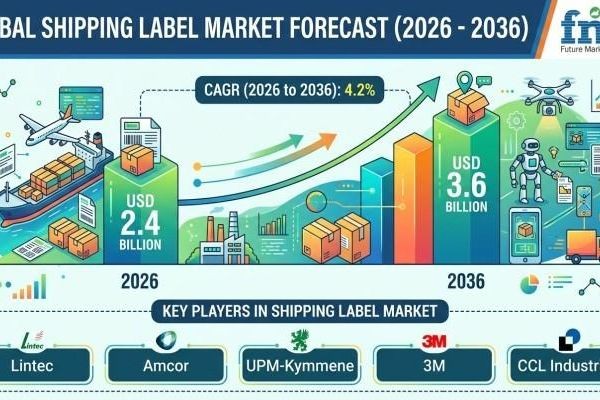
The Shipping Label Market was valued at USD 2.3 billion in 2025, is projected to reach USD 2.4 billion in 2026, and is anticipated to grow to USD 3.6 billion by 2036, expanding at a CAGR of 4.2% during the forecast period.
Organizations are increasingly shifting procurement priorities from cost-centric purchasing models toward performance-oriented, compliance-ready labeling solutions that enhance traceability, durability, and logistics efficiency.
Get detailed market forecasts, competitive benchmarking, and pricing trends:
https://www.futuremarketinsights.com/reports/sample/rep-gb-5790
Quick Stats: Shipping Label Market
- Market Size (2025): USD 2.3 Billion
- Market Size (2026): USD 2.4 Billion
- Market Size (2036): USD 3.6 Billion
- Growth Rate: 4.2% CAGR (2026–2036)
- Top Growth Markets: China (5.7%), India (5.3%), Germany (4.8%)
- Leading Product Segment: Non-Adhesive Labels (32.2% market share in 2026)
Evolution of Procurement Strategies
Procurement practices across the shipping label industry are undergoing significant transformation as organizations focus on operational resilience, compliance assurance, and lifecycle value.
Modern buyers increasingly prioritize:
- Label durability and long-term performance
- High-quality print clarity and consistency
- Compliance with transportation and industry regulations
- Enhanced supply chain traceability
- Reduced total cost of ownership
The integration of digital printing technologies, automated labeling systems, and data-driven logistics platforms is improving labeling precision, minimizing errors, and supporting faster fulfillment operations.
Logistics Infrastructure Modernization Driving Demand
Growing investments in logistics infrastructure, warehousing, and transportation networks are creating sustained demand for advanced shipping label solutions.
Key factors fueling replacement and upgrade cycles include:
- Expanding e-commerce fulfillment operations
- Increasing regulatory and documentation requirements
- Automation of warehouse and distribution facilities
- Demand for durable labels capable of withstanding complex shipping environments
- Adoption of standardized packaging and tracking systems
Emerging economies are particularly witnessing accelerated adoption as industrial development and logistics investments continue to strengthen supply chain capabilities.
Regional Market Dynamics
Market performance varies across regions based on industrial activity, infrastructure development, and regulatory frameworks.
China and India
Rapid industrialization, manufacturing growth, and ongoing logistics modernization are driving strong demand for advanced shipping label technologies.
Europe
Stringent regulatory standards and growing emphasis on traceability, sustainability, and packaging compliance continue to support market expansion.
United States
Stable demand is being driven by warehouse automation, replacement cycles, and continued investments in supply chain optimization initiatives.
Manufacturers are increasingly enhancing regional supply networks, strengthening distribution partnerships, and investing in value-added solutions to maintain competitiveness.
Technology Adoption Reshaping Labeling Operations
Shipping labels are becoming more sophisticated as organizations embrace automation and digital supply chain technologies.
Key application sectors include:
- E-commerce and retail fulfillment
- Manufacturing and industrial packaging
- Warehousing and distribution centers
- Healthcare and pharmaceutical logistics
Advanced technologies supporting market growth include:
- Digital printing systems
- Automated print-and-apply labeling equipment
- Barcode and QR code integration
- Smart logistics and tracking platforms
- Real-time inventory visibility solutions
These innovations are helping businesses improve shipment accuracy, reduce operational inefficiencies, and strengthen end-to-end traceability.
Buyer Preferences Continue to Evolve
Major purchasers of shipping label solutions include:
- Industrial manufacturers
- Packaging converters
- Third-party logistics providers
- Warehousing operators
- Institutional procurement organizations
Critical purchasing considerations include:
- Regulatory-certified products
- Long-term supply reliability
- Material durability and performance
- Cost-efficiency and process optimization
- Technical support and customization capabilities
The growing consolidation of procurement functions among large enterprises is also increasing pressure on suppliers to deliver consistent quality, competitive pricing, and dependable service.
Cost Management and Competitive Pricing Remain Key
As raw material costs and operational expenses fluctuate, manufacturers are focusing on balancing affordability with product performance.
Key strategic priorities include:
- Strengthening supply chain resilience
- Improving manufacturing productivity
- Developing differentiated product offerings
- Reducing lifecycle and operational costs
- Expanding value-added services
Companies that successfully combine performance reliability with cost-effective solutions are expected to secure stronger market positions throughout the forecast period.
Regulatory Compliance Supporting Market Growth
The increasing complexity of logistics and packaging regulations is reinforcing demand for certified shipping label solutions.
Organizations are adopting compliant labeling systems to satisfy requirements related to:
- Product identification and authentication
- Shipment tracking and traceability
- Industrial packaging regulations
- Environmental and sustainability standards
- Transportation safety requirements
As compliance expectations continue to rise globally, demand for high-performance and regulation-ready labeling products is expected to remain strong.
Competitive Landscape
The global shipping label market remains highly competitive, with leading manufacturers focusing on innovation, operational excellence, and customer-specific solutions.
Prominent industry participants include Lintec, Amcor, UPM-Kymmene, 3M, CCL Industries, WS Packaging Group, Herma, Fuji Seal International, PMC Label, and Robos GmbH.
Competitive differentiation is primarily based on:
- Product quality and durability
- Global manufacturing and distribution capabilities
- Customization expertise
- Long-term supply agreements
- Industry-specific application knowledge
- Service responsiveness and technical support
As supply chains become increasingly digitalized and traceability requirements continue to grow, shipping label manufacturers that offer technologically advanced, reliable, and compliant solutions are expected to gain a significant competitive advantage in the years ahead.
About Future Market Insights (FMI)
Future Market Insights, Inc. (FMI) is an ESOMAR-certified, ISO 9001:2015 market research and consulting organization, trusted by Fortune 500 clients and global enterprises. With operations in the U.S., UK, India, and Dubai, FMI provides data-backed insights and strategic intelligence across 30+ industries and 1200 markets worldwide.






