
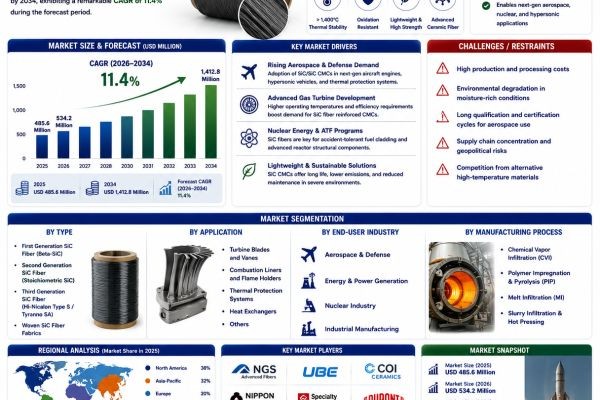
Global Silicon Carbide (SiC) Fiber for Ceramic Matrix Composites market size was valued at USD 485.6 million in 2025. The market is projected to grow from USD 534.2 million in 2026 to USD 1,412.8 million by 2034, exhibiting a remarkable CAGR of 11.4% during the forecast period.
Silicon Carbide (SiC) fibers are high-performance ceramic reinforcement materials that serve as the primary structural constituent in Ceramic Matrix Composites (CMCs). These fibers are manufactured through processes such as chemical vapor deposition (CVD), polymer pyrolysis, and melt spinning, yielding materials with exceptional tensile strength, thermal stability, and oxidation resistance at temperatures exceeding 1,400°C. SiC fibers for CMCs are broadly categorized into first-, second-, and third-generation fiber types, with third-generation variants—including Hi-Nicalon Type S and Tyranno SA—commanding significant market demand due to their near-stoichiometric composition and superior creep resistance. Unlike conventional metallic alloys, SiC fiber-reinforced CMCs maintain structural integrity under extreme thermomechanical cycling, making them indispensable to next-generation propulsion and energy systems.
Get Full Report Here: https://www.24chemicalresearch.com/reports/308627/silicon-carbide-fiber-for-ceramic-matrix-composites-market
The market is witnessing robust expansion driven primarily by the escalating adoption of CMC components in aerospace and defense applications, where weight reduction and thermal performance are critical engineering imperatives. Furthermore, the commercial aviation sector’s decisive shift toward next-generation turbofan engines—such as CFM International’s LEAP engine, which incorporates SiC/SiC CMC hot-section components—has significantly elevated fiber demand across the global supply chain. The growing strategic interest in advanced nuclear energy systems, including accident-tolerant fuel programs and small modular reactors, along with accelerating hypersonic vehicle development programs across multiple defense agencies, also presents meaningful and sustained growth opportunities. Key players operating across this market include NGS Advanced Fibers Co., Ltd., UBE Corporation (formerly Ube Industries, Ltd.), COI Ceramics, Inc., Nippon Carbon Co., Ltd., and Specialty Materials, Inc., each contributing to a competitive and rapidly evolving global supply landscape characterized by high barriers to entry and long-term program-level procurement commitments.
Market Dynamics:
The market’s trajectory is shaped by a complex interplay of powerful growth drivers, significant restraints that are being actively addressed, and vast, untapped opportunities that are gradually becoming accessible as manufacturing technologies mature.
Powerful Market Drivers Propelling Expansion
- Surging Demand from Aerospace and Defense Applications: The aerospace and defense sector remains the most significant driver for SiC fiber-reinforced CMCs, owing to their exceptional thermal stability, high strength-to-weight ratio, and resistance to oxidation at extreme temperatures. SiC/SiC CMCs are increasingly replacing conventional nickel-based superalloys in aircraft engine hot-section components, including turbine blades, vanes, combustor liners, and exhaust nozzles. This substitution is driven by the material’s ability to operate at temperatures exceeding 1,300°C while offering weight savings of up to 40% compared to metallic counterparts, directly translating into improved fuel efficiency and reduced emissions. Leading aero-engine manufacturers have actively incorporated SiC fiber-based CMC components into next-generation turbofan engines, accelerating commercial adoption across both civil and military aviation platforms.
- Growing Investments in Next-Generation Gas Turbine Development: Global efforts to develop more efficient and environmentally compliant gas turbines—both for aviation and land-based power generation—are substantially accelerating demand for SiC fiber-based CMCs. Higher operating temperatures in advanced turbines directly improve thermodynamic efficiency, and SiC/SiC CMCs enable temperature capability that surpasses the limits of even the most sophisticated cooled metallic alloys. Government-backed programs in the United States, Europe, and Japan have committed multi-billion-dollar funding toward advanced propulsion technologies that rely heavily on CMC components. Furthermore, the ongoing modernization of military jet engines, driven by next-generation fighter aircraft programs across NATO and allied nations, has created sustained and long-horizon procurement demand for high-performance SiC fiber reinforcements. The interplay between improved engine performance targets and material capability requirements firmly positions SiC fiber as a foundational enabler of future turbine technologies.
- Expansion into Nuclear Energy and Accident-Tolerant Fuel Programs: Beyond aviation, the nuclear energy sector is emerging as a compelling secondary driver for SiC fiber-based CMC demand. SiC/SiC composites are being actively evaluated and developed for use as accident-tolerant fuel (ATF) cladding materials in light water reactors, owing to their superior neutron irradiation resistance, low neutron activation, and ability to withstand high-temperature steam environments without catastrophic oxidation. Several national laboratories and nuclear fuel developers have demonstrated the technical feasibility of SiC-based cladding systems, and regulatory engagement with nuclear licensing authorities is progressing in multiple countries. As the global nuclear fleet pursues enhanced safety standards and new reactor concepts—including small modular reactors (SMRs)—demand for radiation-tolerant SiC fiber materials is expected to provide an important and structurally distinct long-term growth avenue beyond the traditional aerospace market.
Download FREE Sample Report: https://www.24chemicalresearch.com/download-sample/308627/silicon-carbide-fiber-for-ceramic-matrix-composites-market
Significant Market Restraints Challenging Adoption
Despite its compelling promise, the SiC fiber for CMC market faces meaningful structural hurdles that must be progressively overcome to achieve broader industrial adoption beyond its current aerospace-dominated base.
- Competition from Alternative High-Temperature Materials and Composites: While SiC fiber-reinforced CMCs offer outstanding performance advantages, they face sustained competition from a range of alternative high-temperature structural materials. Advanced oxide-oxide CMCs, which use alumina or aluminosilicate fibers in an oxide matrix, offer lower manufacturing complexity and cost in certain temperature ranges, making them attractive for moderate-temperature aerospace structures such as exhaust components and nacelles. Simultaneously, continued metallurgical advances in nickel and cobalt superalloys, combined with sophisticated internal cooling architectures and thermal barrier coatings, have extended the service capabilities of metallic turbine components, partially reducing the urgency of CMC adoption in some engine programs. The existence of these material alternatives constrains the pace at which SiC/SiC CMCs can displace incumbents, particularly in applications where the total cost of ownership calculus does not yet favor the higher upfront material investment.
- Environmental Sensitivity and Durability Concerns in Service Conditions: Despite their exceptional high-temperature strength, SiC-based CMCs exhibit well-documented susceptibility to environmental degradation under conditions present in real turbine operating environments. Water vapor, a primary combustion byproduct, reacts with the SiC matrix and fiber interphase coatings at elevated temperatures to form volatile silicon hydroxide species, leading to progressive material recession that can compromise component life and structural integrity. This phenomenon, commonly referred to as water vapor corrosion or environmental degradation, necessitates the application of environmental barrier coatings (EBCs)—typically rare earth silicate systems—to protect CMC surfaces during service. However, EBC development, application, and long-term durability assessment add further complexity, cost, and qualification requirements to CMC component programs, representing an ongoing technical restraint to broader deployment.
Critical Market Challenges Requiring Innovation
One of the most persistent and formidable challenges facing the SiC fiber for CMC market is the exceptionally high cost of fiber production. The synthesis of high-purity, near-stoichiometric SiC fibers—particularly third-generation variants such as Tyranno SA and Hi-Nicalon Type S—involves multi-stage, energy-intensive processes including precursor polymer synthesis, melt-spinning, curing, and high-temperature pyrolysis, often under tightly controlled atmospheric conditions. These processes demand specialized equipment, rigorous quality control, and highly skilled technical labor, all of which contribute to fiber costs that remain significantly elevated compared to carbon or glass fiber alternatives. The downstream CMC fabrication process compounds this challenge, as chemical vapor infiltration (CVI) and polymer infiltration and pyrolysis (PIP) densification methods are time-consuming, with cycle times often spanning several weeks per batch.
Additionally, the global supply of high-performance SiC fibers is highly concentrated, with production dominated by a small number of manufacturers in Japan and the United States. This supplier concentration creates significant supply chain vulnerabilities, including geopolitical risks, export control complications, and limited capacity scalability. Many defense and aerospace customers require domestic sourcing under national security provisions, further constraining available supply options for non-Japanese markets. These cumulative cost and supply chain barriers restrict adoption primarily to high-value, performance-critical applications where the economics can be clearly justified.
Vast Market Opportunities on the Horizon
- Expansion into Hypersonic Vehicles and Space Re-entry Thermal Protection Systems: The accelerating global development of hypersonic weapons, vehicles, and space re-entry systems presents a strategically significant growth opportunity for SiC fiber-based CMCs. Hypersonic flight environments impose extreme combined aerothermal, mechanical, and oxidative stresses on structural and thermal protection materials that exceed the capabilities of most conventional engineering materials. SiC-reinforced ultra-high-temperature ceramic composites and SiC/SiC systems are among the leading candidate material platforms for hypersonic leading edges, nose tips, control surfaces, and thermal protection panels. Defense agencies in the United States, Europe, China, and Russia have substantially increased investment in hypersonic programs, creating a sustained pull for advanced CMC materials that can reliably survive and perform under these extreme conditions. As hypersonic program timelines mature toward flight demonstration and eventual operational fielding, demand for flight-qualified SiC fiber-based thermal structural materials is expected to scale considerably.
- Emerging Opportunities in Advanced Nuclear Reactor Programs and Fusion Energy: The renewed global momentum behind advanced fission reactor designs—including high-temperature gas-cooled reactors, molten salt reactors, and small modular reactors—along with the progressive advancement of fusion energy programs, is opening significant new application domains for SiC/SiC CMCs. In advanced fission systems, SiC-based composites are being explored for core structural components, flow channel inserts, and fuel cladding in environments that demand both high-temperature capability and irradiation resistance. In the fusion energy sector, SiC/SiC CMCs are considered a leading structural material candidate for breeding blanket modules and first-wall components in future demonstration reactors, owing to their low activation characteristics under neutron irradiation and excellent high-temperature mechanical properties. International fusion programs, including ITER and various national demonstration reactor initiatives, are actively supporting ongoing materials qualification research, representing a substantial long-term demand pathway.
- Advances in Manufacturing Technology Reducing Cost and Expanding Accessibility: Ongoing innovation in CMC manufacturing processes holds meaningful potential to reduce production costs and expand the addressable market for SiC fiber-based composites. Emerging techniques such as fluidized bed chemical vapor infiltration, rapid infiltration variants of CVI, and advances in preceramic polymer chemistry are being developed to shorten densification cycle times and reduce energy consumption. Additive manufacturing approaches, including binder jetting and direct ink writing of SiC-based precursor systems, are being explored as pathways to near-net-shape CMC component fabrication with reduced material waste and machining requirements. If these manufacturing innovations successfully translate from laboratory to industrial scale, they could materially lower the cost threshold for SiC/SiC CMC adoption in industrial gas turbines, automotive turbocharging systems, and other cost-sensitive high-temperature applications, substantially broadening the market beyond its current aerospace-dominated base.
In-Depth Segment Analysis: Where is the Growth Concentrated?
By Type:
The market is segmented into First Generation SiC Fiber (Beta-SiC), Second Generation SiC Fiber (Stoichiometric SiC), Third Generation SiC Fiber (Hi-Nicalon Type S / Tyranno SA), and Woven SiC Fiber Fabrics. Third Generation SiC Fiber commands the leading position within this segment, owing to its near-stoichiometric composition and exceptionally low oxygen content, which together deliver superior thermal stability and creep resistance at extreme operating temperatures. These advanced fibers demonstrate outstanding compatibility with both oxide and non-oxide ceramic matrix systems, making them indispensable for next-generation high-performance composite fabrication. While first and second generation variants continue to serve cost-sensitive applications where moderate thermal thresholds are acceptable, the industry trajectory is firmly oriented toward third-generation solutions as manufacturers and end users place increasing emphasis on long-term structural reliability under demanding thermomechanical cycling conditions.
By Application:
Application segments include Turbine Blades and Vanes, Combustion Liners and Flame Holders, Thermal Protection Systems, Heat Exchangers, and others. Turbine Blades and Vanes represent the dominant application segment, driven by the relentless push across aerospace and industrial gas turbine sectors to achieve higher operating temperatures while simultaneously reducing component weight. SiC/SiC CMC turbine components enable engine architectures to operate at temperatures far exceeding the practical limits of conventional nickel superalloys, thereby unlocking significant improvements in thermal efficiency and fuel economy. Combustion liners and flame holders constitute another rapidly expanding application area, where the combination of thermal shock resistance and oxidation stability is particularly critical. Thermal protection systems are gaining meaningful traction in hypersonic vehicle programs, further broadening the addressable application landscape for advanced SiC fiber composites.
By End-User Industry:
The end-user landscape includes Aerospace and Defense, Energy and Power Generation, Nuclear Industry, and Industrial Manufacturing. Aerospace and Defense stands as the predominant end-user segment, underpinned by sustained investments in next-generation military and commercial aircraft engine programs that mandate materials capable of withstanding extreme thermal and mechanical stresses. Leading aero-engine manufacturers have progressively integrated SiC/SiC CMC components into hot-section engine architectures, cementing aerospace as the primary commercial driver for SiC fiber demand. The energy and power generation sector is emerging as a highly consequential growth avenue, with advanced gas turbines for power plants benefiting from the same weight and temperature advantages as aviation applications. The nuclear industry presents a uniquely specialized end-user profile, where SiC fiber composites are explored for cladding and structural applications owing to their neutron irradiation tolerance and low activation characteristics.
By Manufacturing Process:
Manufacturing process segments include Chemical Vapor Infiltration (CVI), Polymer Impregnation and Pyrolysis (PIP), Melt Infiltration (MI), and Slurry Infiltration and Hot Pressing. Chemical Vapor Infiltration (CVI) is widely regarded as the leading manufacturing process for producing high-quality SiC fiber-reinforced ceramic matrix composites, prized for its ability to deliver exceptional microstructural uniformity, controlled porosity, and superior fiber-matrix interface integrity. Despite its relatively lengthy processing cycle, CVI remains the preferred route for critical aerospace-grade components where reliability and consistency are non-negotiable. Melt infiltration has gained considerable industrial traction as an alternative approach capable of yielding near-net-shape components with reduced processing time and enhanced matrix density, making it highly attractive for cost-sensitive production scenarios.
Download FREE Sample Report: https://www.24chemicalresearch.com/download-sample/308627/silicon-carbide-fiber-for-ceramic-matrix-composites-market
Competitive Landscape:
The global Silicon Carbide (SiC) Fiber for Ceramic Matrix Composites market is highly concentrated and characterized by a small number of technologically advanced manufacturers commanding the majority of production capacity. The competitive structure is defined by extreme technical barriers to entry, long-term aerospace qualification lock-in, and capital-intensive manufacturing infrastructure that effectively limits the field of credible global suppliers. NGS Advanced Fibers Co., Ltd. (Japan), UBE Corporation (Japan), and Nippon Carbon Co., Ltd. (Japan) collectively represent the core of global SiC fiber supply, with their respective Hi-Nicalon, Tyranno SA, and related fiber grades serving as the backbone of qualified CMC hot-section components in commercial and military jet engines worldwide. Their dominance is underpinned by decades of process know-how, extensive intellectual property portfolios, long-term supply agreements with major aerospace OEMs, and deep integration into the qualification frameworks of leading engine programs.
List of Key Silicon Carbide (SiC) Fiber for Ceramic Matrix Composites Companies Profiled:
- Nippon Carbon Co., Ltd. (Japan)
- UBE Corporation (Japan)
- NGS Advanced Fibers Co., Ltd. (Japan)
- COI Ceramics, Inc. (General Atomics) (USA)
- Specialty Materials, Inc. (USA)
- DuPont Advanced Materials (formerly Dow Corning Sylramic fiber technology) (USA)
- CEA – Commissariat à l’Énergie Atomique et aux Énergies Alternatives (France)
- National University of Defense Technology (NUDT) – SiC Fiber Division (China)
The competitive strategy across leading producers is overwhelmingly focused on sustained R&D investment to enhance fiber purity, microstructural consistency, and high-temperature performance, alongside forming deep strategic partnerships with aerospace OEMs and nuclear energy developers to co-qualify fiber grades within specific engine and reactor programs. Because qualification lock-in effectively guarantees program-life revenue visibility once a fiber grade is certified, securing early-stage design-in positions within new engine and reactor development programs has become the defining strategic priority in this market.
Regional Analysis: A Global Footprint with Distinct Leaders
- North America: Is the dominant consuming region, underpinned by the United States’ deeply established aerospace and defense industrial base. The U.S. hosts some of the world’s leading aerospace original equipment manufacturers and defense contractors who have been at the forefront of adopting SiC fiber-reinforced CMC components for high-temperature turbine engine applications. The U.S. Department of Defense and NASA have consistently funded R&D programs aimed at advancing CMC technologies, and the growing commercial aviation sector’s demand for fuel-efficient engines incorporating CMC hot-section components further reinforces the region’s leadership position as both a primary end-market and a technology development hub.
- Asia-Pacific: Forms a powerful secondary bloc, with Japan serving as the world’s leading SiC fiber producer and China making rapid strides in developing indigenous fiber manufacturing capabilities as part of broader advanced materials self-sufficiency strategies. Japan’s domestic producers possess deep technical expertise in fiber synthesis and processing that is recognized globally, while significant state-backed investment in China is progressively narrowing the technological gap. South Korea’s expanding aerospace sector and growing defense procurement budgets are also generating increased interest in high-performance composite materials across the region.
- Europe, South America, and MEA: These regions represent the complementary and emerging segments of the global SiC fiber CMC market. Europe benefits from a strong aerospace manufacturing tradition anchored by major aircraft and engine producers, with France, Germany, and the United Kingdom serving as key hubs of CMC adoption and research. Defense modernization initiatives across NATO member states generate sustained demand for advanced materials in military propulsion and thermal protection systems. South America and the Middle East & Africa currently represent nascent but developing markets, with Brazil’s established aerospace manufacturing sector and Gulf Cooperation Council nations’ aerospace industrialization ambitions providing the most credible near-term growth foundations in their respective regions.
Get Full Report Here: https://www.24chemicalresearch.com/reports/308627/silicon-carbide-fiber-for-ceramic-matrix-composites-market
Download FREE Sample Report: https://www.24chemicalresearch.com/download-sample/308627/silicon-carbide-fiber-for-ceramic-matrix-composites-market
About 24chemicalresearch
Founded in 2015, 24chemicalresearch has rapidly established itself as a leader in chemical market intelligence, serving clients including over 30 Fortune 500 companies. We provide data-driven insights through rigorous research methodologies, addressing key industry factors such as government policy, emerging technologies, and competitive landscapes.
- Plant-level capacity tracking
- Real-time price monitoring
- Techno-economic feasibility studies
International: +1(332) 2424 294 | Asia: +91 9169162030
Website: https://www.24chemicalresearch.com/






