
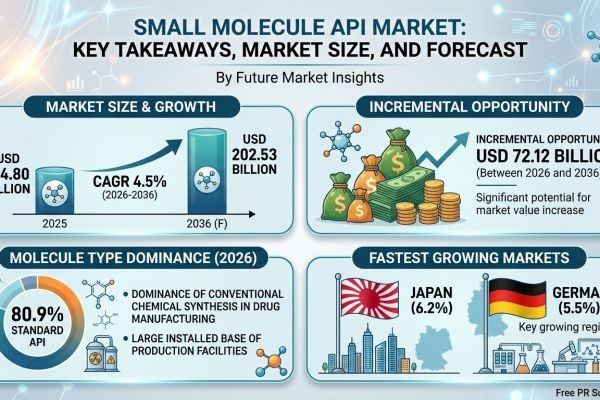
The global small molecule API market is poised for stable long-term expansion as pharmaceutical manufacturers continue to rely on chemically synthesized active ingredients for large-scale drug production. According to latest insights by Future Market Insights, the market is projected to grow from approximately USD 130.4 billion in 2026 to nearly USD 202.5 billion by 2036, registering a CAGR of 4.5% during the forecast period. Rising generic drug demand, expanding oncology pipelines, and increasing outsourcing to contract development and manufacturing organizations (CDMOs) are expected to remain the primary growth catalysts shaping the industry over the next decade.
Small molecule APIs continue to dominate pharmaceutical manufacturing because of their scalability, cost efficiency, and broad applicability across therapeutic categories including cardiovascular diseases, respiratory disorders, infectious diseases, oncology, and metabolic conditions. Despite the increasing popularity of biologics, chemically synthesized APIs remain central to the majority of pharmaceutical formulations worldwide.
Small Molecule API Market Snapshot (2026–2036)
Market size in 2026: USD 130.4 billion
Forecast market value by 2036: USD 202.5 billion
Forecast CAGR (2026–2036): 4.5%
Leading molecule segment: Standard APIs
Fastest-growing category: High Potency APIs (HPAPIs)
Primary demand driver: Generic drug manufacturing
Key growth regions: Japan, Germany, Asia-Pacific
Major demand channel: Pharmaceutical and CDMO outsourcing
Momentum in the Market
The small molecule API market is entering a phase of sustained expansion driven by rising pharmaceutical consumption and the continuous introduction of generic medications across developed and emerging economies. Between 2026 and 2036, patent expiries of blockbuster drugs are expected to create significant opportunities for API manufacturers focused on cost-efficient generic production.
At the same time, oncology drug development is accelerating demand for high-potency active pharmaceutical ingredients (HPAPIs), which require specialized containment systems and advanced manufacturing capabilities. Pharmaceutical companies are increasingly outsourcing API production to specialized CDMOs in order to reduce infrastructure costs and focus resources on drug discovery and commercialization activities.
From 2030 onward, technological advancements in continuous manufacturing, process optimization, and green chemistry are expected to improve operational efficiency while supporting regulatory compliance and sustainability goals.
The Reasons Behind the Market’s Growth
Several structural and technological factors are driving expansion across the global small molecule API industry.
Rising Generic Drug Production
Patent expiration of major branded drugs is significantly increasing the production of generic pharmaceuticals, creating sustained demand for standard APIs worldwide. Generic drug manufacturers continue to expand capacity in response to affordability-focused healthcare policies.
Expansion of Oncology Therapeutics
The growing global oncology pipeline is accelerating demand for HPAPIs used in targeted cancer therapies and cytotoxic drugs. These specialized APIs represent one of the highest-value segments within pharmaceutical manufacturing.
Increasing CDMO Outsourcing
Pharmaceutical companies are increasingly partnering with CDMOs to optimize production efficiency and reduce capital expenditure associated with in-house manufacturing facilities.
Continued Dependence on Chemical Synthesis
Despite growth in biologics, chemically synthesized molecules remain the preferred formulation approach for a large portion of prescription medications because of their stability, scalability, and manufacturing maturity.
Regulatory and Quality Compliance Improvements
Global pharmaceutical manufacturers are investing heavily in GMP-compliant manufacturing infrastructure to meet evolving international regulatory standards established by agencies such as the FDA, EMA, and WHO.
Top Segment Analysis
Molecule Type Analysis
Standard APIs continue to dominate the market and are expected to account for approximately 80.9% of total market share in 2026. Their leadership is supported by high-volume generic drug manufacturing and broad therapeutic applicability.
Meanwhile, HPAPIs are emerging as the fastest-growing segment due to increasing use in oncology, hormonal therapies, and precision medicine applications.
Production Analysis
Captive and in-house manufacturing remains the dominant production model, accounting for nearly 78.2% of market demand in 2026. However, outsourced manufacturing through CDMOs is steadily gaining momentum as pharmaceutical firms pursue operational flexibility and lower manufacturing risks.
Therapeutic Area Analysis
Oncology remains the most lucrative therapeutic area for small molecule APIs due to rapid expansion of targeted therapies and chemotherapy drugs. Cardiovascular, respiratory, and infectious disease applications also continue to contribute substantial production volumes.
Regional Development: Asia and Europe Strengthen Manufacturing Leadership
Global API manufacturing continues to shift toward regions offering strong pharmaceutical infrastructure, cost efficiency, and regulatory expertise.
Japan
Japan is projected to emerge as one of the fastest-growing markets, registering an estimated CAGR of 6.2% through 2036. Growth is supported by advanced pharmaceutical innovation and increasing demand for high-quality APIs.
Germany
Germany is expected to expand at approximately 5.5% CAGR due to its advanced pharmaceutical manufacturing ecosystem and strong investment in specialty drug production.
Asia-Pacific
Countries across Asia-Pacific, particularly India and China, continue to strengthen their role as global API manufacturing hubs due to large-scale production capacity and competitive operational costs.
Challenges, Trends, Opportunities, and Drivers
Drivers
Growing global generic drug demand
Increasing oncology drug development
Expansion of pharmaceutical outsourcing
Rising chronic disease prevalence
Advancements in pharmaceutical manufacturing technologies
Opportunities
Expansion of HPAPI manufacturing facilities
Continuous manufacturing technologies
Green chemistry and sustainable production
Precision medicine and targeted therapeutics
Growth in emerging pharmaceutical markets
Trends
Increasing adoption of outsourced API manufacturing
Rising investments in oncology APIs
Expansion of specialized containment systems
Digitalization and automation in pharmaceutical production
Focus on regulatory compliance and supply chain resilience
Challenges
Stringent global regulatory requirements
Supply chain disruptions for raw materials
High infrastructure costs for HPAPI production
Pricing pressures in generic drug markets
Complex compliance and quality assurance standards
Competitive Landscape
The small molecule API market remains highly competitive, with manufacturers focusing on capacity expansion, regulatory approvals, strategic partnerships, and advanced production technologies.
Leading participants in the market include:
- Pfizer Inc.
- Teva Pharmaceutical Industries Ltd.
- Sun Pharmaceutical Industries Ltd.
- Dr. Reddy’s Laboratories Ltd.
- Aurobindo Pharma
These companies are investing in HPAPI capabilities, advanced synthesis technologies, and global manufacturing expansion to strengthen market positioning and improve supply chain efficiency.
Future Outlook: Advanced Manufacturing to Define the Next Decade
The future of the small molecule API market will be shaped by innovation in pharmaceutical manufacturing, oncology drug development, and increasing reliance on outsourced production networks. As healthcare systems worldwide prioritize affordable medicines and precision therapeutics, API manufacturers capable of balancing cost efficiency with regulatory excellence are expected to gain competitive advantage.
Growing investments in automation, continuous manufacturing, and sustainable production technologies are also expected to redefine operational standards across the industry over the next decade.
For a comprehensive strategic outlook and detailed market analysis, readers can explore the full report on the official Future Market Insights website:
https://www.futuremarketinsights.com/reports/small-molecule-api-market






