
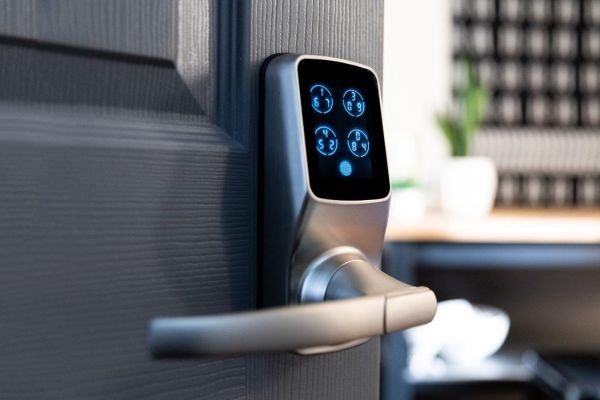
According to the latest industry analysis, the global smart locks market is entering a phase of accelerated growth driven by rising adoption of connected home technologies, increasing demand for phone-based access control, and growing integration of smart security systems across residential and commercial buildings. Valued at USD 3.5 billion in 2026, the market is projected to reach USD 9.4 billion by 2036, expanding at a CAGR of 11.6% during the forecast period.
Smart locks are rapidly evolving from simple keyless entry devices into fully connected access-control platforms that support smartphone authentication, temporary access codes, and smart home ecosystem integration. Adoption is increasing across residential housing, rental properties, hospitality, and managed buildings where convenience, security, and remote access management are becoming essential requirements.
Quick Stats Snapshot
• Market size (2026): USD 3.5 billion
• Forecast (2036): USD 9.4 billion
• CAGR (2026-2036): 11.6%
• Leading end-use segment: Residential (71.0% share)
• Dominant distribution channel: Direct Sales (58.0% share)
• Key authentication segment: Bluetooth-enabled locks (49.0% share)
• Fastest-growing countries: China (13.8%), India (12.9%), Brazil (11.6%), United States (11.2%), Germany (10.5%)
• Leading lock type: Deadbolts (39.0% share)
• Key performance driver: Smartphone-based access and smart home integration
Get detailed market forecasts, competitive benchmarking, and platform insights: https://www.futuremarketinsights.com/reports/sample/rep-gb-1063
Market Size and Growth Outlook
The smart locks market is forecast to expand at a CAGR of 11.6% between 2026 and 2036. Growth is being supported by increasing smartphone penetration, expansion of connected home ecosystems, and rising residential construction activity worldwide.
Demand is further strengthened by homeowners seeking convenient and secure alternatives to traditional mechanical locks. Smart lock systems are increasingly being specified as part of integrated smart home packages in new residential developments and renovation projects.
Market Trends
• Rising smart home adoption: Smart locks are increasingly integrated with voice assistants, home automation systems, and mobile applications.
• Expansion of rental property management: Property managers are using temporary digital access codes to simplify guest and tenant access control.
• Growth in retrofit installations: Easy-to-install deadbolt systems are accelerating replacement demand among existing homeowners.
• Advancements in interoperability: Matter and Aliro standards are improving compatibility across smart home platforms.
• Increased cybersecurity focus: Buyers are prioritizing firmware security, encrypted credentials, and certified connected-device protection.
Key Market Drivers
1. Rising Demand for Smartphone-Based Access
Consumers increasingly prefer app-controlled and keypad-based entry systems that eliminate the need for physical keys.
2. Expansion of Residential Smart Home Projects
Builders are integrating connected locks into smart home packages for apartments, condominiums, and premium residential developments.
3. Growth in Rental and Hospitality Applications
Short-stay rental operators and hospitality providers are adopting timed digital access codes to streamline guest management.
4. Regulatory Push for Connected Device Security
Cybersecurity labeling initiatives and IoT security regulations are encouraging manufacturers to strengthen software reliability and data protection.
Key Challenges
• Concerns regarding cybersecurity vulnerabilities and unauthorized access
• Battery failure risks affecting user confidence
• Compatibility limitations across different smart home ecosystems
• Higher product costs compared to conventional mechanical locks
• Dependence on reliable wireless connectivity and firmware updates
Emerging Opportunities
• Growth of Matter-compatible smart lock ecosystems
• Expansion of AI-enabled access monitoring and behavioral analytics
• Increasing adoption in multifamily housing and managed apartments
• Rising demand for retrofit-friendly deadbolt solutions
• Growth in emerging economies with rising urban housing construction
Segmentation Insights: Residential and Bluetooth Systems Lead Demand
By Lock Type
Deadbolts dominate the market with a 39.0% share due to their compatibility with standard residential front-door installations and strong retrofit demand.
By Authentication Method
Bluetooth-enabled locks lead with a 49.0% share, supported by low power consumption, easy smartphone pairing, and simplified installation.
By Communication Protocol
Bluetooth protocol accounts for 40.0% of market demand as consumers prioritize local phone-based unlocking with longer battery life.
By End Use Application
Residential applications represent 71.0% of total market demand, driven by homeowners upgrading to connected access systems for convenience and security.
By Technology
Conventional smart locks continue to hold a strong share with 48.0% of demand, as basic app-enabled and keypad-based systems remain accessible for mass-market adoption.
By Distribution Channel
Direct sales account for 58.0% of market share, supported by partnerships between manufacturers, builders, and property developers.
Speak to Analyst: Customize insights for your business strategy: https://www.futuremarketinsights.com/customization-available/rep-gb-1063
Regional Analysis
• United States (11.2% CAGR): Strong demand from DIY retrofits, builder-installed smart home packages, and residential replacement cycles
• China (13.8% CAGR): Mobile-first access habits and large-scale residential construction accelerating adoption
• India (12.9% CAGR): Urban housing growth and expanding smartphone usage supporting connected entry systems
• Germany (10.5% CAGR): Apartment renovation activity and demand for secure connected access driving steady expansion
• United Kingdom (10.1% CAGR): Rental management and smart home retail channels supporting growth
Asia Pacific is expected to remain the fastest-growing region due to rapid urbanization, rising smart home adoption, and expanding residential construction activity.
Competitive Landscape
The smart locks market is highly competitive, with leading companies focusing on connected access ecosystems, platform compatibility, and cybersecurity-enabled product innovation.
Key players include ASSA ABLOY, Fortune Brands Innovations, Allegion plc, Samsung Electronics, and dormakaba Holding AG.
Competition is centered on secure app integration, Matter compatibility, battery reliability, and strong residential distribution networks.
Future Outlook
The smart locks market is expected to witness sustained expansion as connected home technologies become mainstream and consumers prioritize convenience-driven security solutions. Residential replacement cycles and builder-led installations will remain the primary demand engines over the forecast period.
Advancements in interoperability standards, cybersecurity compliance, and AI-enabled access management are expected to improve consumer confidence and platform adoption. Emerging economies will continue to provide significant growth opportunities due to rising urban housing development and increasing digital connectivity.
Developed markets are likely to focus on retrofit demand, smart ecosystem integration, and premium security-enabled connected entry systems.
Purchase Full Report for Detailed Insights: https://www.futuremarketinsights.com/reports/smart-locks-market
Executive Takeaways
• Market expected to grow from USD 3.5 billion (2026) to USD 9.4 billion (2036)
• Residential applications remain the dominant demand segment
• Bluetooth-enabled locks continue leading authentication adoption
• Direct sales channels drive large-scale builder and developer procurement
• China and India emerge as the fastest-growing markets
• Smartphone-based access and smart home integration remain key growth drivers
• Competitive advantage increasingly depends on cybersecurity, interoperability, and software reliability
Why Choose FMI: https://www.futuremarketinsights.com/why-fmi
Không có bình luận nào được tìm thấy






