
A massive technological revolution is modernizing global agricultural operations, fueled by a critical shift away from legacy, labor-intensive farming techniques toward the widespread integration of data-driven, precision agriculture.
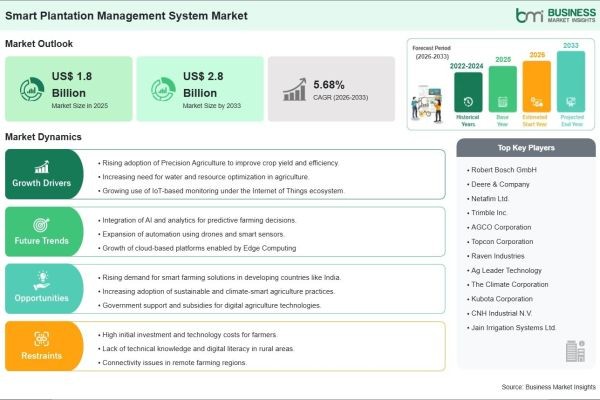
Based on market intelligence from Business Market Insights, the global Smart Plantation Management System Market [https://www.businessmarketinsights.com/reports/smart-plantation-management-system-market] is anticipated to reach US$ 2.8 billion by 2033, mounting from its 2025 value of US$ 1.8 billion at a projected CAGR of 5.68% from 2026 to 2033.
The integration of digital technology is becoming indispensable for modern plantation owners aiming to balance high crop yields with environmental resource conservation. By providing granular, real-time insights into plant physiology, soil health, and micro-climates, these smart systems enable a highly efficient "per-plant" management approach that drastically cuts operational waste and maximizes output.
Download Sample Report: https://www.businessmarketinsights.com/sample/BMIPUB00034376
What Is a Smart Plantation Management System?
A Smart Plantation Management System is an integrated network of agricultural hardware and software designed to optimize the cultivation of large estate crops. This architecture typically comprises field-deployed IoT sensors (measuring soil moisture, temperature, and nutrient levels), automated irrigation controllers, drone imagery, and centralized cloud platforms.
Unlike standard crop farming, plantations for crops like coffee, sugarcane, and cotton require years of constant monitoring, highly specific watering schedules, and precise harvesting windows. Smart plantation systems collect continuous real-time data and utilize artificial intelligence to provide actionable insights, such as predicting disease outbreaks, automating targeted drip irrigation, and determining the exact optimal time for harvest.
Market Drivers
A primary driver accelerating market growth is the escalating global scarcity of manual agricultural labor alongside rising operational costs. As rural populations migrate to urban centers, plantation owners are facing severe worker shortages, particularly during critical harvesting windows. Smart systems mitigate this by automating heavy-labor tasks like irrigation and deploying autonomous harvesting machinery, ensuring operational continuity.
Furthermore, the urgent global push for sustainable farming and water conservation is acting as a massive catalyst. Agriculture accounts for over 70% of global freshwater use. Smart irrigation systems utilize real-time soil moisture sensors to deliver exact quantities of water directly to a plant's root zone only when necessary. This precision drastically reduces water waste and minimizes the runoff of chemical fertilizers, helping plantations comply with stringent environmental regulations.
Additionally, the rising global demand for ethical and traceable sourcing is forcing supply chain transparency. Modern consumers and multinational food corporations demand proof of sustainable cultivation. Cloud-based plantation management software provides end-to-end traceability, digitally logging every drop of water and ounce of fertilizer used, which is critical for securing premium certifications like Fair Trade or Rainforest Alliance.
Market Segmentation
By Type
- Irrigation Systems
- Plant Growth Monitoring Systems
- Harvesting Systems
By Crop
- Coffee
- Oilseeds
- Sugarcane
- Cotton
- Fruits
By Component
- Hardware (Sensors, Drones, Automated Valves, GPS Nodes)
- Software (Cloud Platforms, Predictive Analytics, Mobile Dashboards)
The plant growth monitoring segment is witnessing exceptionally high adoption as AI-driven visual tracking becomes more affordable. Among crops, sugarcane and coffee dominate the market application, given their massive global consumption and high sensitivity to precise micro-climate conditions. Furthermore, the software component is designed to log the highest growth rate as farm owners transition from buying discrete hardware to subscribing to comprehensive Data-as-a-Service (DaaS) agricultural platforms.
Regional Insights
- North America represents a highly mature and dominant market, driven by heavy capital investments in ag-tech, ubiquitous rural internet connectivity, and the early adoption of autonomous farming machinery across massive commercial fruit and cotton estates in the United States.
- Asia-Pacific is projected to witness the fastest regional growth. This is heavily propelled by government subsidies for digital agriculture in countries like India and China, alongside massive modernization efforts across the extensive sugarcane, tea, and rubber plantations of Southeast Asia.
- Europe commands a strong market position, highly influenced by the rigorous European Union environmental mandates regarding chemical runoff and water conservation, driving the rapid adoption of precision irrigation systems in Mediterranean fruit orchards.
- South America holds massive strategic importance, particularly Brazil, which serves as a global powerhouse for coffee, sugarcane, and soybean exports. Large-scale Brazilian estate owners are heavily investing in drone-based crop monitoring to maximize export yields.
Top Players in the Smart Plantation Management System Industry
The global marketplace features a dynamic mix of traditional heavy agricultural machinery giants transitioning into software, alongside specialized IoT ag-tech startups. Key industry participants are heavily focused on establishing strategic partnerships with telecom providers to ensure their remote field sensors can maintain consistent cellular or satellite connectivity.
- Deere & Company (John Deere)
- Trimble Inc.
- Robert Bosch GmbH
- Netafim (Orbia)
- Semios
- Tevatronic Ltd.
- Birlasoft
- AquaSpy
- Sentera
- Rivulis
These market leaders consistently expand their competitive footprints by acquiring specialized software developers and building unified, cross-compatible platforms that allow plantation managers to control all their hardware from a single dashboard.
Technological Innovations
Technological innovations in Unmanned Aerial Vehicles (UAVs) and Multispectral Imaging are profoundly transforming plantation management. Drones equipped with specialized infrared and thermal cameras can scan thousands of acres in a single flight. By analyzing how crop leaves reflect different light spectrums, AI software can identify early signs of pest infestations, nutrient deficiencies, or fungal diseases weeks before they become visible to the human eye, allowing for hyper-targeted pesticide application rather than blanket crop spraying.
Furthermore, the integration of Edge Computing is solving the agricultural sector's biggest hurdle: poor rural internet connectivity. Rather than sending all raw sensor data to a distant cloud server, modern agricultural IoT gateways process data locally at the "edge" of the field. This allows automated irrigation valves to react instantly to sudden weather changes without relying on a constant cellular connection.
Additionally, the development of Robotic Harvesters is revolutionizing high-value crop collection. Engineers are deploying complex machine-vision algorithms that allow robotic arms to navigate dense foliage, identify the exact ripeness of a fruit based on color mapping, and delicately pick the produce without bruising it, directly addressing the severe shortage of manual harvesting labor.
Future Market Outlook
The long-term trajectory for the Smart Plantation Management System Market remains exceptionally strong. As the impacts of global climate change—such as unpredictable rainfall patterns and extreme temperature fluctuations—continue to threaten traditional farming cycles, precision agriculture will transition from a competitive advantage to an absolute survival necessity.
The upcoming maturation of 5G rural networks and Low Earth Orbit (LEO) satellite internet will completely eliminate the connectivity blind spots that currently hinder remote plantations. This will pave the way for fully autonomous "smart farms," where interconnected drone swarms, driverless tractors, and AI-governed irrigation networks operate in seamless unison. Companies that can deliver intuitive, hardware-agnostic software platforms that unify multiple brands of agricultural equipment will dominate the future of digital farming.
Frequently Asked Questions (FAQs)
What is the difference between precision agriculture and smart plantation management?
Precision agriculture is a broad term covering the use of technology to optimize any farming practice. Smart plantation management is a highly specialized subset focused entirely on large-scale, long-term perennial crops (like coffee, rubber, or orchards) which require entirely different monitoring, irrigation, and harvesting technologies compared to seasonal row crops like corn or wheat.
How to do smart irrigation systems save water?
Traditional irrigation water fields on a set schedule regardless of actual need, leading to massive water waste and fertilizer runoff. Smart systems use deep-soil moisture sensors and localized weather forecasts to calculate the exact evapotranspiration rate of the plants, delivering precise volumes of water directly to the root zones via automated drip lines only when the plant physically requires it.
Can small-scale farmers afford smart plantation systems?
Historically, the high capital expenditure for sensors and software limited this technology to massive commercial estates. However, the market is rapidly democratizing. Many tech providers now offer "Hardware-as-a-Service" (HaaS) models, allowing smaller plantation owners to lease the sensors and pay a low monthly software subscription rather than buying the expensive equipment upfront.
How does AI help in crop disease management?
AI algorithms are trained on millions of images of plant diseases. When a drone flies over a plantation taking multi-spectral photographs, the AI instantly analyzes the leaf discoloration patterns. It can pinpoint the exact GPS coordinates of an infected cluster of trees, allowing farmers to quarantine or treat just that specific zone rather than spraying the entire plantation.
Browse More Reports:
https://www.businessmarketinsights.com/reports/thermoplastic-polyolefins-market
https://www.businessmarketinsights.com/reports/thin-wall-packaging-market
https://www.businessmarketinsights.com/reports/tobacco-packaging-market
About Us
Business Market Insights is a market research platform that provides a comprehensive subscription service for targeted industry and company intelligence reports. Our research team has extensive professional expertise across dynamic industrial domains such as Electronics & Semiconductor; Aerospace & Defense; Automotive & Transportation; Energy & Power; Healthcare; Manufacturing & Construction; Food & Beverages; Chemicals & Materials; and Technology, Media, & Telecommunications.
Contact Us
If you have any questions about this report or would like further information, please contact us:
Contact person: Ankit Mathur
Email: sales@businessmarketinsights.com
Phone: +16467917070






