
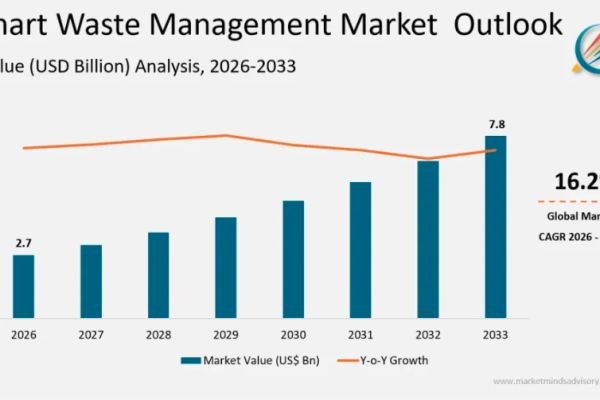
The smart waste management market is undergoing rapid transformation, currently valued at USD 2.7 billion in 2026 and projected to reach USD 7.8 billion by 2033, according to Market Minds Advisory. This growth trajectory is underpinned by the integration of IoT sensors, data analytics, and automation across waste collection, sorting, and recycling processes. Municipalities and private sector operators are increasingly leveraging these technologies to optimize routes, reduce operational costs, and comply with evolving environmental regulations.
Structural changes in waste generation patterns, stricter sustainability targets, and urbanization are driving the need for intelligent waste management infrastructure. Regulatory frameworks mandating circular economy practices and real-time monitoring are accelerating technology adoption. As a result, smart waste management is emerging as a strategic pillar within the broader environmental services sector, enabling stakeholders to achieve efficiency gains, regulatory compliance, and improved resource recovery.
Key Takeaways from Smart Waste Management Market
- The smart waste management market is forecast to expand at a CAGR of 16.2% from 2026 to 2033.
- IoT-enabled sensors and cloud-based analytics are central to operational optimization.
- Regulatory mandates on waste reduction and traceability are intensifying solution adoption.
- Urbanization and rising waste volumes are increasing demand for scalable smart systems.
- Data-driven decision-making is enabling cost reductions and improved service delivery.
- Integration with circular economy initiatives is unlocking new revenue streams.
- North America and Europe are leading in early adoption, with Asia-Pacific showing accelerated growth potential.
Smart Waste Management Market Trends
The market environment is being shaped by the proliferation of connected devices that enable real-time waste monitoring and predictive maintenance. Municipalities are prioritizing investments in digital infrastructure to achieve compliance with stricter environmental standards and to enhance operational transparency.
Additionally, partnerships between technology providers and waste management companies are fostering integrated solutions that streamline collection, sorting, and recycling. The convergence of sustainability imperatives and advancements in AI-driven analytics is further propelling the adoption of smart waste management platforms.
Drivers, Opportunities & Restraints
Urbanization and Sustainability Mandates Drive Demand
Rapid urbanization and the resulting increase in municipal solid waste volumes are primary catalysts for smart waste management adoption. Cities face mounting pressure to optimize collection schedules, minimize landfill use, and meet ambitious sustainability targets. Regulatory frameworks are increasingly mandating waste diversion, recycling quotas, and real-time reporting, compelling both public and private sector stakeholders to invest in advanced solutions. These structural shifts are reinforcing the strategic importance of digital waste management in achieving environmental and operational objectives.
Emerging Value Pools in Circular Economy Integration
The integration of smart waste management with circular economy initiatives is creating significant new value pools. Data-driven insights enable more effective sorting, recycling, and resource recovery, unlocking opportunities for secondary raw material markets. Technology advancements, such as AI-powered material identification and blockchain-based traceability, are enhancing transparency and accountability across the waste value chain. Enterprises are leveraging these capabilities to monetize waste streams, reduce environmental impact, and differentiate through sustainable practices.
Fragmented Infrastructure and Data Standardization Challenges
Despite strong growth prospects, market expansion is constrained by fragmented waste management infrastructure and inconsistent data standards. Legacy systems, limited interoperability, and varying regulatory requirements across regions hinder seamless technology deployment. Additionally, the upfront investment required for digital transformation can be a barrier for smaller municipalities and operators. Addressing these challenges will require coordinated efforts to standardize data protocols, incentivize modernization, and ensure equitable access to smart solutions.
Competitive Landscape
The competitive landscape is characterized by a mix of established environmental services companies and technology-focused entrants. Market participants are prioritizing innovation in IoT, data analytics, and automation to differentiate their offerings. Strategic partnerships, mergers, and acquisitions are common as firms seek to expand their solution portfolios and geographic reach. The ability to deliver scalable, interoperable, and regulatory-compliant platforms is emerging as a key determinant of competitive advantage.
Key Players in Smart Waste Management Market Market are
- IBM Corporation
- SAP SE
- Suez Environment S.A.
- Veolia Environnement S.A.
- Waste Management, Inc.
- Bigbelly, Inc.
- Sensoneo
- Enevo Oy
- Ecube Labs Co., Ltd.
- Covanta Holding Corporation
- Republic Services, Inc.
- CleanRobotics
- SmartBin (OnePlus Systems Inc.)
- Urbiotica
- Compology Inc.
- IoT Solutions Group
- EvoEco
- Pepperl+Fuchs SE
- GreenQ
- Bine
Key Developments
- In March 2024, Veolia Environnement S.A. launched a new AIpowered waste sorting facility in France, enhancing recycling efficiency and material recovery rates.
- In January 2024, IBM Corporation partnered with a major US city to deploy a cloudbased smart waste management platform integrating IoT sensors and predictive analytics.
- In November 2023, Sensoneo expanded its smart waste monitoring solutions to several municipalities in Latin America, supporting digital transformation initiatives.
- In September 2023, Bigbelly, Inc. introduced a solarpowered smart bin with enhanced connectivity features for realtime waste level monitoring.
- In July 2023, Suez Environment S.A. acquired a regional waste management technology provider to strengthen its presence in the AsiaPacific market.
- In May 2023, Ecube Labs Co., Ltd. announced the launch of a nextgeneration smart waste compactor with advanced data analytics capabilities.
Why choose Market Minds Advisory
Market Minds Advisory delivers decision-grade intelligence trusted by executives across machinery & equipment, packaging, chemical, automotive, information & communication technology, food & beverage, consumer goods, healthcare and other industries. We provide market expansion strategies, go-to-market strategies, market share acceleration, brand positioning analysis, and account enablement and growth. Our forecasting methodology integrates primary interviews, proprietary demand models and continuous market validation to ensure accuracy in volatile and emerging industries. With over 10 years of industry experience and insights derived from primary interviews with several industry stakeholders, our research provides actionable insights and white space analysis for the emerging segments providing the opportunity gaps in the market accounting recent market developments and geopolitical risks. We believe in unlocking growth by helping businesses to see the future of their markets.
Contact Us
Market Minds Advisory
86 Great Portland Street, Mayfair, London,
W1W 7FG, England, United Kingdom
T: +44 020 3807 7725






