
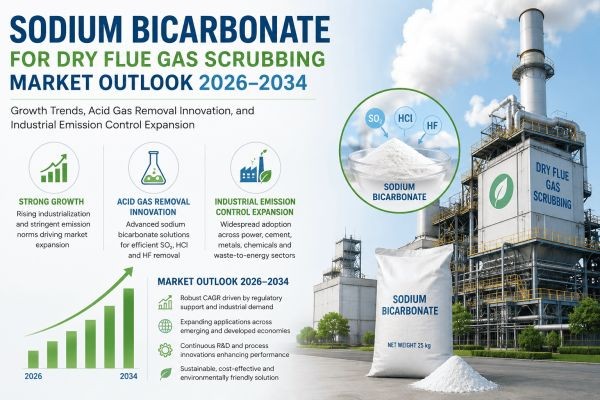
Sodium bicarbonate, commonly known as baking soda, serves as an effective dry sorbent in flue gas treatment systems. When injected into exhaust streams from power plants, waste incinerators, and industrial boilers, it reacts with acid gases such as sulfur dioxide (SO₂) and hydrogen chloride (HCl). This dry scrubbing process, often referred to as dry sorbent injection (DSI), neutralizes these pollutants without the need for large volumes of water, producing a dry waste product that is easier to handle than traditional wet scrubbing methods.
The technology has gained prominence as industries seek compliant yet cost-effective solutions for acid gas removal. Sodium bicarbonate stands out due to its high reactivity, allowing efficient neutralization across a range of operating conditions. Its use supports multi-pollutant control while offering operational simplicity, particularly valuable in retrofit projects and facilities where water usage must be minimized. As environmental priorities evolve, this specialized application of sodium bicarbonate continues to play a vital role in helping facilities meet emission standards through practical and adaptable dry scrubbing approaches.
Get Full Report Here: https://www.24chemicalresearch.com/reports/308422/sodium-bicarbonate-for-dry-scrubbing-of-flue-gas-market
Market Dynamics:
The market's trajectory is shaped by a complex interplay of powerful growth drivers, significant restraints that are being actively addressed, and vast, untapped opportunities.
Powerful Market Drivers Propelling Expansion
-
Stringent Environmental Regulations on Acid Gas Emissions: The global push for lower emissions of sulfur dioxide (SO₂), hydrochloric acid (HCl), and other acid gases from power plants, waste-to-energy facilities, and industrial boilers has accelerated adoption of dry scrubbing technologies. Sodium bicarbonate stands out for its high reactivity, enabling effective neutralization without water addition or complex conditioning of flue gas. This positions it as a preferred sorbent in dry sorbent injection (DSI) systems, particularly where compliance with tightening standards demands reliable multi-pollutant control.
-
Advantages of Dry Systems Over Wet Scrubbers: Dry scrubbing with sodium bicarbonate offers lower capital and operating costs, reduced space requirements, and minimal water consumption compared to wet systems. It avoids wastewater generation and visible plumes, making retrofits easier for smaller utilities and industrial sites. Furthermore, the process integrates well with existing fabric filters or electrostatic precipitators, enhancing overall system simplicity while achieving strong removal rates for SO₂ and HCl, often exceeding 90% under optimized conditions.
-
Expansion in Waste-to-Energy and Industrial Sectors: Growth in waste incineration and biomass facilities, combined with retrofits at smaller coal-fired and industrial boilers, creates strong potential for sodium bicarbonate DSI systems. Its compatibility with SCR setups, lower toxicity, and reduced by-product issues in specific contexts offer economic and operational benefits, particularly where energy recovery and residue handling costs favor dry processes.
Download FREE Sample Report: https://www.24chemicalresearch.com/download-sample/308422/sodium-bicarbonate-for-dry-scrubbing-of-flue-gas-market
Significant Market Restraints Challenging Adoption
Despite its promise, the market faces hurdles that must be overcome to achieve universal adoption.
-
Cost Competitiveness and Sorbent Consumption: Higher unit costs of sodium bicarbonate compared to calcium-based sorbents like hydrated lime can increase operational expenses, especially at elevated stoichiometric ratios needed for high removal efficiencies. Excess sorbent usage not only raises reagent costs but also generates larger volumes of residue containing sodium salts, complicating downstream handling.
-
Competition from Alternative Sorbents and Technologies: Established use of lower-cost calcium-based sorbents and ongoing improvements in wet and semi-dry systems continue to restrain broader penetration of sodium bicarbonate in certain large-scale power applications. While sodium bicarbonate excels in reactivity and multi-pollutant control, its price premium and the familiarity of lime-based processes slow adoption where budget constraints dominate decision-making.
Critical Market Challenges Requiring Innovation
The transition from laboratory success to industrial-scale applications presents its own set of challenges. Residue management remains a key consideration, as the reaction products, primarily sodium sulfate and sodium chloride mixed with fly ash, often exhibit high solubility, limiting options for commercial reuse or safe landfill disposal and potentially raising environmental compliance costs. Furthermore, removal efficiency depends heavily on temperature, particle size, residence time, and flue gas composition; suboptimal conditions can reduce effectiveness and require precise system tuning. These technical hurdles necessitate continued focus on sorbent optimization and system integration for material firms operating in this space.
Additionally, the market contends with considerations around performance variability across different industrial settings. While sodium bicarbonate offers clear advantages in many scenarios, handling high-sulfur flue gases at very high removal targets without excessive sorbent feed can influence technology selection, directing preference toward hybrid or alternative configurations in those specific cases.
Vast Market Opportunities on the Horizon
-
Growth in Waste-to-Energy Plants: Sodium bicarbonate injection offers a compact, water-efficient dry scrubbing solution ideal for space-constrained urban or smaller-scale plants where traditional wet systems may prove impractical. Its non-corrosive handling characteristics and straightforward integration with baghouse filters enhance operational reliability while helping operators meet stringent emission limits for multiple acid gases without extensive retrofitting.
-
Industrial Boilers and Process Applications: Expanding adoption in sectors such as cement, glass, and other heavy industries creates opportunities for sodium bicarbonate in kiln exhaust treatment and acid gas control. The sorbent's reactivity and compatibility with dry processes prove particularly valuable in water-constrained regions, supporting consistent environmental performance across varied industrial operations.
-
Emerging Markets and Regulatory Evolution: Regions experiencing industrial growth and tightening emission standards present significant long-term potential. Plant operators seek compact, water-efficient solutions that align with sustainability goals and best available technology designations for dry flue gas treatment, opening avenues for broader deployment of sodium bicarbonate-based systems.
In-Depth Segment Analysis: Where is the Growth Concentrated?
By Type:
The market is segmented into Standard Sodium Bicarbonate, Pre-milled Fine Grade, and Specialty Formulated Blends. Pre-milled Fine Grade currently leads the market, favored for its enhanced surface area that promotes rapid and efficient reaction with acid gases such as SO2, HCl, and HF in the flue gas stream. This type enables superior neutralization even in short residence times typical of dry sorbent injection systems.
By Application:
Application segments include SOx Removal, HCl and HF Removal, Multi-Pollutant Control, and others. The Multi-Pollutant Control segment currently dominates, driven by the versatile chemistry of sodium bicarbonate that simultaneously addresses multiple acid gases in a single injection step. This integrated approach simplifies flue gas treatment systems and streamlines operations for facility managers.
By End-User Industry:
The end-user landscape includes Waste-to-Energy Plants, Industrial Boilers, and Power Generation Facilities. The Waste-to-Energy Plants segment accounts for the major share, leveraging sodium bicarbonate's suitability for facilities handling heterogeneous waste streams that generate complex acid gas mixtures. The Industrial Boilers sector is rapidly emerging as a key growth area, reflecting the need for flexible emission control solutions.
Download FREE Sample Report: https://www.24chemicalresearch.com/download-sample/308422/sodium-bicarbonate-for-dry-scrubbing-of-flue-gas-market
Competitive Landscape:
The global Sodium Bicarbonate (Baking Soda) for Dry Scrubbing of Flue Gas (Acid Gas Removal) market is semi-consolidated and characterized by intense competition among established chemical manufacturers. The top three companies—Solvay (SOLVAir®), Church & Dwight Co., Inc., and Genesis Alkali—collectively command a significant share of the market. Their dominance is underpinned by extensive production capabilities, specialized grades optimized for DSI applications, and established global distribution networks.
List of Key Sodium Bicarbonate Companies Profiled:
-
Solvay (SOLVAir®) (Belgium/International)
-
Church & Dwight Co., Inc. (United States)
-
Genesis Alkali, LLC (United States)
-
Natrium Products, Inc. (United States)
-
Humens (France)
-
Natural Soda LLC (United States)
-
Tata Chemicals (India/International)
The competitive strategy is overwhelmingly focused on developing high-reactivity grades with optimized particle size distribution, alongside forming strategic partnerships with system integrators and end-users to co-develop and validate application-specific solutions, thereby securing future demand.
Regional Analysis: A Global Footprint with Distinct Leaders
-
North America: Is the undisputed leader, holding a major share of the global market. This dominance is fueled by stringent environmental regulations, a mature industrial base focused on emission control, and strong demand from power generation, waste-to-energy, and industrial sectors. The U.S. is the primary engine of growth in the region, supported by established supply chains and proximity to natural soda ash resources.
-
Europe: Represents a powerful secondary market with significant activity in waste-to-energy plants and industrial facilities subject to tight EU emission directives. Europe's strength is driven by focus on circular economy principles, reduced water usage, and successful implementations in countries like Germany for complex flue gas streams from municipal solid waste incineration.
-
Asia-Pacific, South America, and MEA: These regions represent the emerging frontier of the market. While currently smaller in scale, they present significant long-term growth opportunities driven by expanding industrial capacity, increasing environmental awareness, and evolving emission standards in power generation, cement, and other heavy industries.
Get Full Report Here: https://www.24chemicalresearch.com/reports/308422/sodium-bicarbonate-for-dry-scrubbing-of-flue-gas-market
Download FREE Sample Report: https://www.24chemicalresearch.com/download-sample/308422/sodium-bicarbonate-for-dry-scrubbing-of-flue-gas-market
About 24chemicalresearch
Founded in 2015, 24chemicalresearch has rapidly established itself as a leader in chemical market intelligence, serving clients including over 30 Fortune 500 companies. We provide data-driven insights through rigorous research methodologies, addressing key industry factors such as government policy, emerging technologies, and competitive landscapes.
-
Plant-level capacity tracking
-
Real-time price monitoring
-
Techno-economic feasibility studies
International: +1(332) 2424 294 | Asia: +91 9169162030
Website: https://www.24chemicalresearch.com/






