
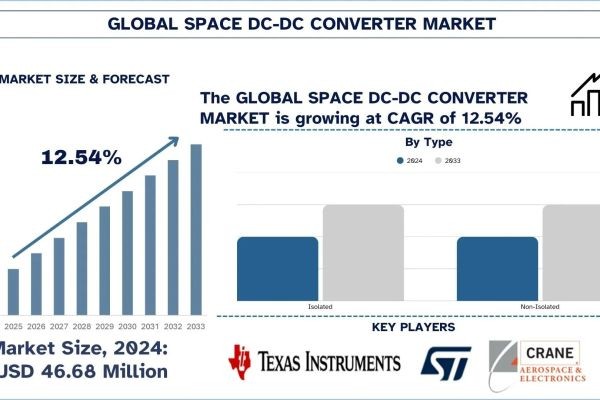
According to the UnivDatos “Space DC-DC Converter Market” report, the global market was valued at USD 46.68 million in 2024 and is expected to grow at a CAGR of about 12.54% during the forecast period from 2025 - 2033, reaching USD million by 2033.
The spacecraft power systems are reaching a new level of sophistication and require DC-DC converters that are precise and highly reliable across the wide range of conditions in orbit and deep space. The booming satellite mega-constellations and deep-space exploration drives market growth with a strong preference toward small satellites and CubeSats. Being the defining elements of power conditioning and distribution, converters are considered by OEMs and integrators to be the keys to mission success, payload performance, and the spacecraft's longevity in general. It is hastened by the shift of heavy, off-the-shelf, and radiation-tolerant designs in favor of high-density and small-volume designs that are needed to maximize payload capability and enable the high-power requirements of current missions. The further features of market evolution include complex incorporation of advanced wide-bandgap semiconductors, digital control of smart power management, and built-in fault tolerance. At the same time, the development of more autonomous spacecraft and in-orbit service requires converters that are fully compatible with advanced electric propulsion, automated power distribution, and real-time health monitors, and so power architectures are more resistant, efficient, and able to support next-generation space operations.
Access sample report (including graphs, charts, and figures): https://univdatos.com/reports/space-dc-dc-converter-market?popup=report-enquiry
Rising Satellite Launches & Small-Sat Proliferation
The increased launch of satellites and a proliferation of small satellite-driven boom in the small satellite market pushes the space DC-DC converter market, since each new spacecraft requires numerous accurate power rails. Starlink and OneWeb are large LEO constellations, which have thousands of satellites, each fitted with thousands of DC-DC converters to supply payload electronics, processors, RF units, and sensors. Large constellations of smallsats are operated by commercial Earth-observation companies such as Planet, with ultra-compact and efficient converters needed to elevate the voltages of their solar arrays or battery buses to low-voltage, low-noise supplies necessary to power imaging and data processing. Institutionally, university CubeSats and national tech-demonstration missions (e.g., 3U/6U CubeSats to experiment with climate or communications) rely on miniaturized radiation-tolerant modules that can survive launch and the space environment. With the increasing cost of launch and additional rideshare options, more such platforms are being created, which directly correlate with a higher demand for space-grade DC-DC power solutions. For instance, in 2024, the highest number of launches was witnessed since the beginning of the space age. There were 261 launch attempts, out of which 254 launches were successful, resulting in an addition of 2578 operational satellites. A total of 2963 objects were placed in orbit. This number was less than that of the previous year, which was 3135 objects from 212 launches in 2023.
Latest Trends in the Space DC-DC Converter Market
Adoption of Wide Bandgap Semiconductors (SiC & GaN)
One of the major trends in the space DC-DC converter market is the transition to wide bandgap semiconductors such as SiC and GaN. This is because these semiconductors have high breakdown voltage, high switching rates, and better thermal characteristics than conventional silicon devices. This enables space power converters to achieve greater efficiency, power content, and switching rate, which is particularly important in satellites and probes where size, weight, and cooling capacity are severely limited. SiC MOSFETs in high-voltage stages (like solar array regulators and electric propulsion power processing units) and GaN FETs in high-frequency lower-voltage DC-DC stages feeding digital and RF payload electronics are becoming common. SiC and GaN both can be radiation tolerant, and a number of space-grade product lines and reference designs by large power and semiconductor vendors are now LEO, GEO, and deep-space qualified or undergoing qualification, which further confirms this shift in next-generation space power architectures.
Click here to view the Report Description & TOC https://univdatos.com/reports/space-dc-dc-converter-market
Evolving Power Architectures Driving the Next Wave of the Space DC-DC Converter Market
The worldwide space DC-DC converter market is at an active stage, with more complex spacecraft electric systems, the mega constellation satellite boom, and the rapid transition to small satellites and CubeSats. DC-DC converters have turned into defining differences between life and death of missions, payloads, and spacecraft durability, since they have been demonstrated to support high-power systems, systems in small packages with limited thermal capacity, and thermally limited systems. The resurgence of power architectures is defined by the shift to high-density and small-volume solutions, which replace heavy, off-the-shelf, rad-tolerant designs, based on wide bandgap semiconductors, digital control, and intrinsic fault protection. With the increasing number of autonomous spacecrafts and in-orbit services, converters that can easily accommodate electric propulsion, automated power distribution, and real-time health monitoring will be in demand in next-generation space missions.
Related Report:-
Space Cryogenics Market: Current Analysis and Forecast (2024-2032)
Commercial Space Payload Market: Current Analysis and Forecast (2023-2030)
Space Tourism Market: Current Analysis and Forecast (2024-2032)
Space Management Software Market: Current Analysis and Forecast (2022-2030)
CubeSat Market: Current Analysis and Forecast (2025-2033)
Contact Us:
UnivDatos
Contact Number - +1 978 733 0253
Email - contact@univdatos.com
Website - www.univdatos.com
Linkedin- https://www.linkedin.com/company/univ-datos-market-insight/mycompany/






