
Industrial enterprises generate enormous volumes of data every second—from production lines, industrial IoT (IIoT) sensors, SCADA systems, Manufacturing Execution Systems (MES), historians, Enterprise Resource Planning (ERP) platforms, and cloud applications. While organizations have invested heavily in digital technologies, many still struggle to transform fragmented operational data into meaningful business intelligence. Data often remains trapped in disconnected systems, limiting visibility across operations and slowing decision-making. As manufacturers accelerate Industry 4.0 initiatives, Industrial DataOps has emerged as one of the most important technology categories for enabling connected, intelligent, and data-driven industrial operations.
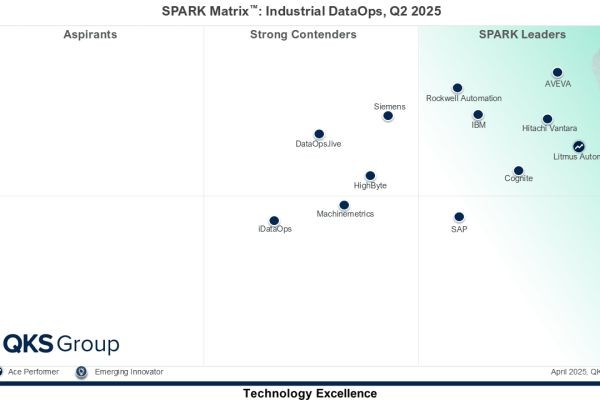
QKS Group's Industrial DataOps market research provides a comprehensive assessment of the global Industrial DataOps market, covering emerging technology trends, competitive dynamics, market developments, and future opportunities. The research helps technology vendors strengthen their competitive positioning while enabling industrial organizations to evaluate vendor capabilities, product innovation, and strategic differentiation. Through its proprietary SPARK Matrix™, QKS Group evaluates leading vendors based on Technology Excellence and Customer Impact, providing technology buyers with a trusted framework for selecting the right Industrial DataOps platform.
Industrial DataOps Q2 2025 represents the next evolution of industrial data management by enabling organizations to collect, integrate, contextualize, govern, and analyze operational data across diverse industrial environments. Unlike traditional data integration solutions, Industrial DataOps platforms are purpose-built for industrial operations, connecting IT and Operational Technology (OT) systems while delivering real-time, analytics-ready data for enterprise-wide decision-making.
Industrial DataOps software provides organizations with analytics-driven capabilities that simplify industrial data integration while improving operational efficiency and business agility. These platforms bridge data silos across engineering, plant operations, maintenance, quality management, production, IT, and data science teams. By creating a trusted industrial data foundation, organizations gain actionable insights that improve productivity, optimize asset utilization, reduce downtime, and accelerate digital transformation initiatives.
One of the primary growth drivers shaping the Industrial DataOps market is the rapid adoption of Industrial Internet of Things (IIoT) technologies. Connected sensors, smart machines, industrial gateways, and intelligent devices continuously generate massive volumes of operational data. Industrial DataOps platforms collect and normalize this information from multiple protocols, enabling manufacturers to monitor equipment performance, production quality, energy consumption, and operational efficiency through unified dashboards and advanced analytics.
Artificial Intelligence (AI) and Machine Learning (ML) are significantly enhancing Industrial DataOps capabilities. AI-powered analytics automatically identify operational anomalies, predict equipment failures, optimize production processes, and recommend corrective actions based on historical and real-time operational data. Machine learning models continuously improve prediction accuracy, enabling organizations to transition from reactive operations toward predictive and prescriptive decision-making.
Another defining characteristic of modern Industrial DataOps platforms is their ability to unify IT and OT environments. Manufacturing organizations often operate multiple disconnected systems including MES, ERP, SCADA, PLCs, historians, CMMS, Laboratory Information Management Systems (LIMS), and cloud analytics platforms. Industrial DataOps solutions provide standardized connectors, APIs, and industrial protocol support that enable seamless interoperability between these systems. This integration delivers a single source of truth across industrial operations while eliminating manual data preparation and redundant workflows.
Cloud computing continues to reshape Industrial DataOps deployment strategies. Cloud-native architectures allow organizations to centralize industrial data management while supporting global manufacturing operations across multiple facilities. Combined with edge computing, Industrial DataOps platforms process operational data close to production equipment while synchronizing critical information with enterprise cloud environments for long-term analytics, AI model training, and enterprise reporting.
Data governance and cybersecurity have become increasingly important as industrial organizations expand connected operations. Industrial DataOps platforms incorporate data lineage, metadata management, role-based access controls, encryption, audit trails, and compliance capabilities that help organizations maintain trusted, secure, and governed industrial data. These features are particularly important for highly regulated industries such as pharmaceuticals, energy, chemicals, food and beverage, and critical infrastructure.
The convergence of Industrial DataOps with digital twins, Asset Performance Management (APM), predictive maintenance, and advanced manufacturing analytics is creating significant business value. By combining contextualized industrial data with simulation models and predictive algorithms, organizations can optimize equipment performance, reduce maintenance costs, improve Overall Equipment Effectiveness (OEE), and accelerate continuous improvement initiatives.
The Industrial DataOps evaluates leading vendors based on comprehensive technology capabilities and customer success metrics. QKS Group's evaluation framework examines product innovation, industrial connectivity, scalability, interoperability, analytics capabilities, AI integration, deployment flexibility, implementation support, customer experience, and overall market impact.
The vendors included in this year's SPARK Matrix™ are AVEVA, Cognite, DataOps.live, HighByte, Hitachi Vantara, IBM, Litmus Automation, Machinemetrics, Rawcubes, Rockwell Automation, SAP, and Siemens. Each vendor has been evaluated on its ability to deliver robust Industrial DataOps capabilities, simplify industrial data integration, support digital transformation initiatives, and provide measurable business outcomes across manufacturing and industrial environments.
Looking ahead, the Industrial DataOps market is expected to witness sustained growth as organizations continue investing in smart manufacturing, AI-enabled operations, industrial automation, edge computing, and connected enterprise initiatives. Emerging technologies such as generative AI, autonomous operations, industrial knowledge graphs, semantic data models, and digital thread architectures will further enhance the value of Industrial DataOps platforms.
QKS Group's SPARK Matrix™: Industrial DataOps Q2 2025 serves as a strategic resource for technology vendors, industrial enterprises, digital transformation leaders, and manufacturing executives seeking to understand the rapidly evolving Industrial DataOps landscape. Through independent vendor analysis, competitive benchmarking, and technology evaluation, the research empowers organizations to identify the right platform partners for building intelligent, connected, and data-driven industrial operations.
As Industry 4.0 continues reshaping global manufacturing, Industrial DataOps Q2 2025 will remain a foundational technology for unlocking the full value of industrial data. Organizations that successfully implement Industrial DataOps platforms will be better positioned to improve operational efficiency, accelerate innovation, enhance collaboration between IT and OT teams, and build resilient, future-ready manufacturing ecosystems.
Frequently Asked Questions (FAQs)
- What is Industrial DataOps?
Industrial DataOps is a software approach that enables organizations to collect, integrate, contextualize, govern, and analyze industrial data from OT and IT systems. It helps manufacturers improve operational efficiency, enable real-time analytics, and support data-driven decision-making.
- Why is Industrial DataOps important for Industry 4.0?
Industrial DataOps provides the data foundation required for Industry 4.0 by connecting machines, sensors, enterprise applications, and cloud platforms. It enables AI, predictive maintenance, digital twins, and advanced manufacturing analytics.
- Which industries benefit most from Industrial DataOps?
Industrial DataOps is widely adopted across manufacturing, oil & gas, utilities, chemicals, pharmaceuticals, mining, automotive, food & beverage, energy, and other industrial sectors that rely on connected operations and industrial automation.
- Which vendors are included in the SPARK Matrix™: Industrial DataOps Q2 2025?
The report evaluates leading vendors including AVEVA, Cognite, DataOps.live, HighByte, Hitachi Vantara, IBM, Litmus Automation, Machinemetrics, Rawcubes, Rockwell Automation, SAP, and Siemens, assessing them on Technology Excellence and Customer Impact.






