
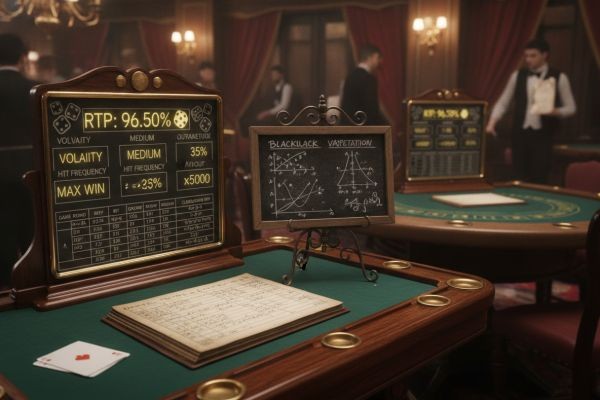
The analysis of game mechanics in classic table games relies heavily on probability and statistics. Every game has a mathematical profile defined by its rules, payouts, and probability structures. For educational purposes, understanding these statistics allows for a deeper appreciation of game design. Return to Player, or RTP, is a central metric used to describe the long-term statistical return of a game. Unlike digital slots, where RTP is managed by software, table game RTP is determined by the physical rules of the game. For example, the number of pockets on a roulette wheel directly dictates the mathematical probability of each bet. By studying these mathematical foundations, one can analyze how different rules modify the statistical landscape.
Analyzing Single-Zero vs Double-Zero Rules
Roulette is one of the clearest examples of probability in table games, as its outcomes are easily defined. In French or European roulette, the wheel contains thirty-seven pockets, including a single zero. This design results in a house edge of two point seven percent for standard bets, corresponding to a theoretical RTP of ninety-seven point three percent. In American roulette, a double zero pocket is added, increasing the total number of pockets to thirty-eight. This small change increases the house edge to five point two six percent, reducing the theoretical RTP to ninety-four point seven four percent. Comparing these two variants demonstrates how a minor structural modification alters the game's statistical output. Understanding these differences is key for academic research into game design and probability theory. Researchers analyze these patterns to study the long-term distribution of random events.
Probability and Card Games
Card games like blackjack present a more complex statistical challenge, as the probability changes with every card dealt. Unlike roulette, where every spin is independent, blackjack operates on dependent trials. The remaining composition of the deck determines the probability of subsequent card draws. By analyzing the mathematical probabilities of various card combinations, mathematicians have developed basic strategy models. These models indicate the mathematically optimal decision for every possible hand combination. When players follow this model, the theoretical house edge can be reduced to less than one percent. However, this assumes perfect adherence to the mathematical rules, which is difficult to maintain over long periods. The study of these systems remains a popular topic in mathematical education and game theory.
Understanding Statistical Deviations
A common challenge in statistics is understanding the difference between theoretical expectations and short-term results. Over a small sample of rounds, the actual results will almost always deviate from the theoretical average. This deviation is expected in any random system and is described by the law of large numbers. As the number of rounds increases, the actual distribution of outcomes will align closer with the theoretical model. For instance, flipping a coin ten times might result in seven heads, but flipping it ten thousand times will yield close to fifty percent. In table games, this means that short-term sessions can produce highly variable results, both positive and negative. Understanding this variance is essential for a realistic analysis of random systems and statistical probability.
Licensing and Testing of Table Game Software
For digital versions of table games, the physical mechanics are replaced by virtual code. These digital systems must undergo testing to verify that they replicate the physical probabilities accurately. Testing agencies run simulations of millions of rounds to verify that the virtual card decks or wheels are unbiased. The software must prove that its random number generator produces uniformly distributed numbers. Once verified, the software receives a compliance certificate, ensuring that the digital game behaves exactly like its physical counterpart. This verification process is essential for maintaining the credibility of virtual table games in the academic and regulatory space. Source: https://casino-slotsgem.it/






