
Swarm Robotics Market Set to Reach USD 14.7 Billion by 2034 as AI and Automation Accelerate Adoption
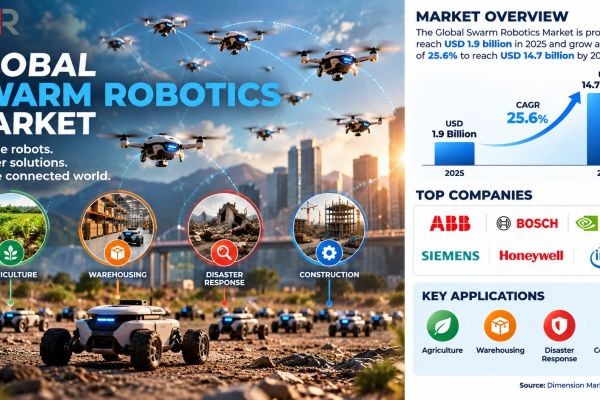
The global Swarm Robotics Market is entering a period of rapid expansion as businesses, governments and research institutions increase investment in autonomous, collaborative and intelligent robotic systems. According to Dimension Market Research, the global Swarm Robotics Market is projected to reach USD 1.9 billion in 2025 and expand at a 25.6% compound annual growth rate from 2025 to 2034, reaching approximately USD 14.7 billion by 2034.
Swarm robotics uses groups of relatively simple robots that coordinate through communication, distributed decision-making and swarm intelligence. Inspired by collective behavior found in ants, bees and birds, these systems allow multiple autonomous robots to divide workloads, respond to changing conditions and continue operations even when individual units encounter problems.
Swarm Robotics Market Growth Driven by Intelligent Automation
The growing need for scalable automation is a central factor supporting market expansion. Unlike conventional robotics systems that may depend on a single sophisticated machine, swarm robotics distributes tasks among multiple units. This approach can support operations across large warehouses, agricultural fields, industrial facilities and difficult or hazardous environments.
Advances in artificial intelligence, machine learning, edge computing, sensors, wireless communication and miniaturized processors are improving the ability of robots to coordinate and respond to real-time information. More compact and affordable components are also helping developers create robotic platforms that can be deployed in larger numbers.
- AI enables faster autonomous decision-making.
- Miniaturized sensors support compact robot designs.
- Edge computing reduces data-processing latency.
- Distributed control improves swarm resilience.
- Lower hardware costs can support larger deployments.
Key Applications Across Industry
Swarm robotics is moving beyond research environments into practical commercial and industrial applications. In warehouse automation and logistics, robot fleets can coordinate material movement, package sorting, inventory handling and restocking. Their ability to dynamically allocate tasks can help organizations manage changing workflows.
Agriculture represents another important application. Agricultural robot swarms can monitor soil conditions, assess crop health and support precision farming activities. Because multiple small robots can cover broad areas, the technology can support data collection and repetitive field operations.
Disaster management and search and rescue are also significant use cases. Swarm robots can enter environments that may be dangerous for humans, map affected areas and search for survivors. Aerial UAV swarms can provide rapid coverage, while ground-based systems can investigate areas that are difficult to access.
Environmental monitoring provides another opportunity, with robotic systems potentially collecting information from oceans, polluted locations, forests and other challenging environments.
Technology Trends Reshaping Swarm Robotics
The integration of AI and edge computing is emerging as an important trend. Processing information closer to where it is generated can allow robots to react quickly while reducing dependence on centralized infrastructure.
Bio-inspired algorithms are also important to swarm intelligence. These algorithms replicate principles observed in natural systems to help robots make decentralized decisions using local information. Reinforcement learning, particle swarm optimization and ant colony optimization are further supporting research into adaptive and self-organizing robotic systems.
Smart manufacturing and logistics are increasingly relevant areas for deployment because organizations require flexible automation that can respond to production and supply chain changes.
Market Segmentation Highlights
Hardware is projected to account for approximately 58.9% of the market in 2025, supported by demand for sensors, actuators, controllers, communication systems and power technologies.
Ground-based robots are expected to represent around 45.8% of the platform segment in 2025, reflecting their applications in manufacturing, agriculture, logistics and warehouse operations. Aerial UAV platforms are also expected to experience significant growth as autonomous drones find applications in surveillance, crop monitoring and emergency response.
Bio-inspired algorithms are projected to hold approximately 29.6% of the technology segment in 2025. Military and defense applications are expected to account for around 29.6%, while government and defense end users are projected to hold approximately 35.1%.
Regional Swarm Robotics Market Outlook
North America is estimated to hold a 34.9% revenue share in 2025, supported by advanced robotics research, AI development, private investment and government-backed programs. The region has established capabilities across defense, logistics, agriculture and industrial automation.
The U.S. Swarm Robotics Market size is projected to reach approximately USD 0.6 billion in 2025, growing at a 24.0% CAGR over the forecast period. Research institutions, technology companies and government organizations continue to contribute to developments in autonomous robotics and coordinated robotic systems.
Europe is projected to reach approximately USD 0.5 billion in 2025, with a 23.7% CAGR. Collaborative research programs, industrial automation and interest in safe and energy-efficient robotic systems are supporting regional development.
Japan's Swarm Robotics Market is projected to reach approximately USD 0.1 billion in 2025, with a 27.1% CAGR. Research into biohybrid systems, industrial robotics and autonomous technologies contributes to the country's role in the sector.
Asia Pacific is expected to experience significant growth through the forecast period, supported by industrialization, smart manufacturing, agriculture automation, logistics development and increasing investment in robotics research.
Leading Companies in the Market
- BAE Systems
- Lockheed Martin
- Airbus Defense & Space
- Saab AB
- Boeing
- General Dynamics
- Boston Dynamics
- SwarmFarm Robotics
- Skydio
- Textron Systems
- Raytheon Technologies
- Northrop Grumman
- RRAI
- Dedrone
- Voliro
- Flock
- Flytrex
- Pensa Systems
- Roboswarm Inc.
The competitive landscape is evolving as established technology companies, robotics specialists, startups and research organizations develop new approaches to robot coordination, autonomous navigation and swarm intelligence. Competition is increasingly focused on improving communication reliability, adaptability, scalability and operational efficiency.
Market Drivers, Restraints and Opportunities
The advancement of AI and hardware miniaturization remains a major growth driver. Growing demand for automation in large-scale, repetitive and high-risk environments is also encouraging organizations to evaluate swarm-based solutions.
However, reliable coordination among large numbers of robots remains technically challenging. Wireless interference, environmental obstacles and communication failures can affect swarm performance. High initial investment and the requirement for specialized engineering expertise can also create adoption barriers, particularly for smaller organizations.
Healthcare and smart-city infrastructure represent emerging opportunities. Potential applications include hospital disinfection, medicine delivery, infrastructure monitoring, waste management and connected urban services. Integration with IoT networks could further expand the role of autonomous robot fleets.
Recent Industry Developments
- In March 2025, UBTECH Robotics completed a multi-humanoid collaborative training program at Zeekr's 5G Intelligent Factory, demonstrating coordinated robotic operations in an industrial environment.
- In August 2024, Swarmbotics AI announced a USD 4 million funding round intended to support research and development, autonomous planning capabilities and scalable swarm robotics solutions for industry and defense.
Report Also Cover
What is the Swarm Robotics Market size in 2025?
The global Swarm Robotics Market is projected to reach USD 1.9 billion in 2025 and is forecast to reach USD 14.7 billion by 2034.
What is the projected Swarm Robotics Market CAGR?
The market is projected to expand at a 25.6% CAGR from 2025 to 2034.
Which region leads the Swarm Robotics Market?
North America is estimated to hold the largest regional revenue share, at approximately 34.9% in 2025.
Which component is expected to dominate?
Hardware is expected to lead the component segment in 2025, with an estimated 58.9% share.
Which platform is projected to lead?
Ground-based robots are expected to lead the platform segment in 2025, with approximately 45.8% share.
What are the major swarm robotics applications?
Major applications include military and defense, agriculture, industrial automation, warehouse and logistics, environmental monitoring, surveillance, healthcare and disaster response.
What technologies support swarm robotics?
Key technologies include bio-inspired algorithms, optimization algorithms, reinforcement learning, particle swarm optimization and ant colony optimization.
What is driving swarm robotics adoption?
AI advancement, hardware miniaturization, automation requirements and demand for scalable robotic systems are key adoption factors.
What challenges affect the market?
Communication complexity, coordination challenges, technical requirements and high initial investment can restrict adoption.
What opportunities are emerging?
Healthcare, smart cities, IoT integration, environmental monitoring and intelligent logistics offer potential areas for further deployment.
Swarm Robotics Market Report Scope
- Market size in 2025: USD 1.9 billion
- Forecast value in 2034: USD 14.7 billion
- CAGR from 2025 to 2034: 25.6%
- Historical data: 2019 to 2024
- Forecast data: 2025 to 2034
- Leading region: North America
- Key growth region: Asia Pacific
- Major platform: Ground-based robots
- Major component: Hardware
- Major end user: Government and defense
The Swarm Robotics Market is developing as organizations seek autonomous systems capable of distributing workloads, adapting to operational changes and functioning across complex environments. Continued progress in artificial intelligence, communication systems, sensors, edge computing and robotic hardware is expanding the potential applications of coordinated robot fleets. For business leaders and technology decision-makers, understanding market size, segmentation, regional development, competitive activity and emerging applications can support evaluation of opportunities within this rapidly developing robotics industry.
About Us
Dimension Market Research (DMR) is a global market intelligence and consulting firm delivering data-driven insights that help organizations make informed strategic decisions. With expertise across 12+ industries and global markets, DMR provides syndicated reports, custom research, competitive analysis, white space analysis, and business strategy consulting.
Our research solutions combine analytical rigor, industry expertise, and forward-looking intelligence to identify opportunities, reduce risks, and support sustainable growth. Trusted by clients across diverse sectors, DMR is committed to delivering accurate, actionable insights that enable businesses to navigate evolving market landscapes with confidence.
Contact Us
Phone USA: +17323699777
Phone India: +919310023843
E-mail: enquiry@dimensionmarketresearch.com
Address USA: 957 Route 33, Suite 12 #308, Hamilton Square, NJ-08690
Address India: D44, Sector 6, Noida 201301, India






