
A significant operational scale-up across foam expansion processing, precision CNC core shaping, and composite sandwich panel assembly is prioritizing low smoke-density compliance, fire, toxicity, and heat release (FST) safety certifications, and tight density tolerances to meet rigorous aviation quality standards.
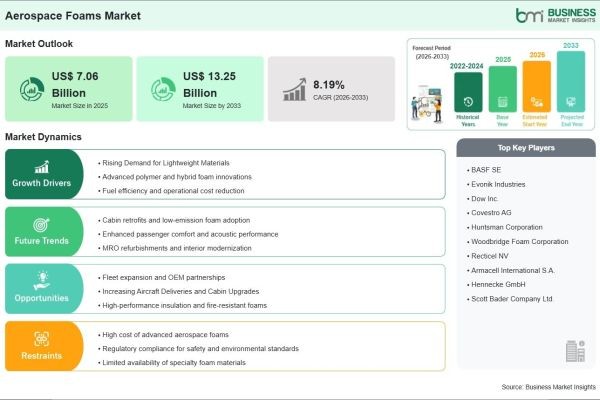
Based on market intelligence from Business Market Insights, the global Aerospace Foams Market is anticipated to reach US$ 13.25 Billion by 2033, mounting from its 2025 value of US$ 7.06 Billion at a projected CAGR of 8.19% from 2026 to 2033.
Technological advancement is heavily shaping the industry landscape, with major advanced materials manufacturers focusing on bio-based polyurethane foams, flame-retardant polyimide structures, and highly specialized metal foams. This evolution enables aerospace engineers to produce aircraft interiors and structural components featuring exceptional fire, smoke, and toxicity (FST) compliance, prolonged durability, and reduced overall weight. Strong collaboration between chemical suppliers, aerospace OEMs, and regulatory bodies is accelerating the deployment of next-generation foam solutions across modern commercial, military, and general aviation fleets.
Download Sample Report : https://www.businessmarketinsights.com/sample/BMIPUB00033746
What Are Aerospace Foams?
Aerospace foams are highly engineered, low-density cellular materials designed specifically for the rigorous demands of the aviation and space exploration sectors. Manufactured primarily from polymers like polyurethane, polyethylene, melamine, and polyimide, as well as specialized metals, these foams are characterized by their exceptional structural integrity, lightweight properties, and resistance to extreme temperatures and chemicals.
The material offers essential functional advantages, including superior vibration dampening, acoustic insulation, thermal regulation, and structural reinforcement. Modern aerospace foams are integral to aircraft design, serving as critical components in passenger seating, cabin wall insulation, floor carpeting underlays, flight deck padding, and overhead stowage bins, directly contributing to overall fuel efficiency and passenger comfort.
Market Drivers
A primary driver of the Aerospace Foams Market is the surging global demand for fuel-efficient and lightweight aircraft. With aviation fuel representing a major operational cost and environmental concern, aerospace manufacturers are heavily prioritizing weight reduction. Replacing traditional dense materials with high-performance aerospace foams directly reduces aircraft weight, leading to significant fuel savings and reduced carbon emissions.
The steady growth of commercial aviation and the escalating volume of global air passenger traffic act as another major catalyst. To accommodate this demand, airlines are continuously expanding and modernizing their commercial fleets, thereby driving massive volume requirements for interior foam components, particularly in seating, acoustic insulation, and cabin interiors.
Furthermore, stringent safety and passenger comfort regulations are accelerating market adoption. Aviation authorities mandate strict Fire, Smoke, and Toxicity (FST) standards for interior aircraft materials. The development of advanced, flame-retardant melamine and polyimide foams ensures compliance with these critical safety regulations while simultaneously enhancing the acoustic and thermal comfort of the passenger cabin environment.
Market Segmentation
By Material Type
- Polyurethane (PU) Foams: The dominant segment, highly valued for its versatility, exceptional cushioning properties, and cost-effectiveness, making it the standard for aircraft seating and interior padding.
- Polyimide / PMI Foams: A rapidly growing segment utilized in high-temperature environments and structural core applications due to its outstanding fire resistance and structural rigidity.
- Polyethylene (PE) Foams: Extensively applied in vibration dampening, impact absorption, and packaging of delicate aerospace components due to its moisture resistance and resilience.
- Melamine Foams: Favored for superior acoustic and thermal insulation capabilities, coupled with inherent flame-retardant properties essential for cabin wall panels.
- Metal Foams: An emerging, highly specialized segment used in structural applications requiring extreme strength, impact absorption, and thermal management.
By Application
- Aircraft Seats: The largest application segment, demanding massive volumes of durable, comfortable, and fire-resistant polyurethane foams.
- Cabin Walls and Ceilings: Heavily reliant on specialized acoustic and thermal insulation foams to regulate temperature and minimize engine noise for passengers.
- Flight Deck Pads: Utilizing high-density, fatigue-resistant foams to ensure pilot comfort and vibration reduction during long-haul flights.
- Floor Carpets & Overhead Stow Bins: Incorporating lightweight foams for underlayment cushioning and structural weight savings in cabin storage solutions.
By End-Use Industry
- Commercial Aviation: The largest end-user segment, fueled by rising global air travel, commercial fleet expansions, and continuous cabin interior upgrades by major airlines.
- Military Aircraft: A major segment utilizing highly specialized, radar-absorbent, and extreme-temperature resistant foams for fighter jets and tactical transport aircraft.
- General Aviation: Experiencing steady growth driven by corporate jets, private air charters, and the rising demand for luxury aircraft interiors.
Regional Insights
- North America holds a dominant market position, supported by the presence of major aerospace manufacturers, robust military defense spending, and early adoption of advanced lightweight composite materials.
- Europe represents a highly strategic market, driven by strict environmental and aviation emission standards, strong aerospace engineering heritage, and continuous innovation in sustainable, bio-based aerospace materials.
- Asia-Pacific is projected to be the fastest-expanding region, fueled by surging domestic air travel demand in countries like China and India, massive commercial fleet procurement, and expanding regional aerospace manufacturing hubs.
- Middle East & Africa is witnessing steady growth, propelled by the expansion of luxury commercial carriers and significant investments in modernizing regional aviation infrastructure.
- South & Central America is experiencing reliable long-term growth as regional airlines modernize aging fleets and expand operational capacities to meet growing tourism demands.
Top Players in the Aerospace Foams Market
The competitive landscape features dominant global chemical corporations, advanced composite manufacturers, and specialized aerospace suppliers focused on optimizing foam weight, enhancing fire retardancy, and streamlining supply chains for aerospace OEMs.
- BASF SE
- Evonik Industries AG
- Rogers Corporation
- Armacell International S.A.
- Solvay S.A.
- Zotefoams plc
- Boyd Corporation
- General Plastics Manufacturing Company
- UFP Technologies, Inc.
- SABIC
Technological Innovations
The integration of bio-based and highly recyclable polymers is transforming the aerospace foams market, addressing the aviation industry's urgent push for sustainability. Material scientists are successfully commercializing polyurethane and polyethylene foams derived from renewable feedstocks, significantly reducing the carbon footprint of manufacturing without sacrificing the critical strength-to-weight ratios required for flight.
Additionally, advancements in syntactic and closed-cell metal foams are expanding the boundaries of aerospace engineering. These ultra-lightweight, high-strength materials provide exceptional ballistic resistance, thermal shielding, and radar-absorbent properties, making them increasingly vital for next-generation military stealth aircraft and advanced unmanned aerial vehicles (UAVs).
Future Market Outlook
The future outlook for the Aerospace Foams Market is exceptionally strong through 2033, reinforced by the continuous global emphasis on fuel efficiency, passenger comfort, and the rapid rise of the Urban Air Mobility (UAM) and eVTOL (electric vertical takeoff and landing) sectors. As electric aircraft demand hyper-lightweight construction to maximize battery range, the reliance on advanced aerospace foams will intensify exponentially.
Market leadership over the coming decade will belong to advanced material developers that deliver fully integrated, multi-functional foam solutions—combining structural reinforcement, thermal management, and acoustic dampening into a single lightweight matrix that complies with the most stringent global aviation safety standards.
Frequently Asked Questions (FAQs)
What is the projected size of the Aerospace Foams Market by 2033?
The global market is projected to reach US$ 10.28 Billion by 2033, expanding from US$ 6.07 Billion in 2025.
What is the CAGR for the Aerospace Foams Market?
The market is estimated to record a CAGR of 6.80% from 2026 to 2033.
Which material segment holds a dominant position in the market?
Polyurethane (PU) Foams hold the largest market share due to their unmatched versatility, cost-effectiveness, and essential role in providing comfort and fire resistance in aircraft seating.
Which region is leading market growth?
North America currently dominates the market, while Asia-Pacific is projected to expand at the fastest growth rate driven by massive commercial fleet expansions and surging air passenger traffic.
What is the primary factor driving demand for aerospace foams?
Key drivers include the global aviation industry's intense focus on manufacturing lightweight, fuel-efficient aircraft, alongside stringent safety regulations requiring advanced fire-retardant and acoustic dampening materials.
Browse More Reports:
https://www.businessmarketinsights.com/reports/high-speed-data-converter-market
https://www.businessmarketinsights.com/reports/titanium-dioxide-market
https://www.businessmarketinsights.com/reports/fiber-optics-collimating-lens-market
About Us
Business Market Insights is a market research platform that provides subscription service for industry and company reports. Our research team has extensive professional expertise in domains such as Electronics & Semiconductor; Aerospace & Defense; Automotive & Transportation; Energy & Power; Healthcare; Manufacturing & Construction; Food & Beverage; Chemicals & Materials; and others.
Contact Us
If you have any questions about this report or would like further information, please contact us:
Contact person: Ankit Mathur
Email: sales@businessmarketinsights.com
Phone: +16467917070






