
A significant operational scale-up across flexible convertors and container manufacturing facilities is prioritizing chemical resistance integrity, puncture resistance, moisture-vapor barrier performance, and circular design for enhanced post-use recyclability.
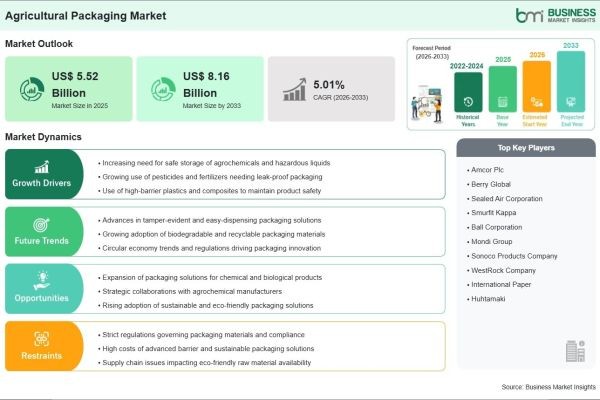
Based on market intelligence from Business Market Insights, the global Agricultural Packaging Market is anticipated to reach US$ 8.16 Billion by 2033, mounting from its 2025 value of US$ 5.52 Billion at a projected CAGR of 5.01% from 2026 to 2033.
Technological advancement is heavily shaping the industry landscape, with major packaging manufacturers focusing on high-barrier flexible films, UV-resistant bulk containers, and compostable bio-plastics. This evolution enables farmers and distributors to protect sensitive agrochemicals from moisture and prevent post-harvest spoilage of perishable goods. Strong collaboration between material scientists, agricultural cooperatives, and logistics providers is accelerating the deployment of smart, active packaging solutions equipped with temperature and humidity sensors across global food and farming supply chains.
Download Sample Report : https://www.businessmarketinsights.com/sample/BMIPUB00033753
What Is Agricultural Packaging?
Agricultural Packaging refers to the specialized materials and containers designed to store, protect, handle, and transport agricultural products. This encompasses the packaging of raw farm outputs, such as fruits, vegetables, grains, and meat, as well as crucial farming inputs, including seeds, fertilizers, pesticides, and biologicals.
The packaging offers essential functional advantages, including protection against physical damage during transit, defense against moisture, pests, and contamination, and prolonged product shelf life. Modern agricultural packaging solutions range from heavy-duty woven sacks and rigid plastic drums for bulk agrochemicals to flexible pouches and ventilated trays for fresh consumer produce.
Market Drivers
A primary driver of the Agricultural Packaging Market is the rapidly growing global population and the subsequent surge in demand for food security and increased agricultural output. To minimize post-harvest losses and ensure that fresh produce reaches domestic and international markets safely, farmers and logistics companies are increasingly relying on high-performance, durable packaging solutions.
The rising global trade of agricultural commodities and agrochemicals acts as another major catalyst. With complex, cross-border supply chains, agricultural products require specialized bulk packaging—such as Flexible Intermediate Bulk Containers (FIBCs) and rigid industrial drums—that comply with stringent international phytosanitary regulations and hazardous materials transport standards.
Furthermore, the shift toward sustainable and eco-friendly farming practices is accelerating market adoption of biodegradable and recyclable packaging. Rising environmental scrutiny regarding single-use agricultural plastics has prompted manufacturers to innovate with paper-based sacks, compostable mulch films, and bio-based polymers to reduce the industry's carbon footprint.
Market Segmentation
By Material Type
- Plastics: The dominant segment, heavily favored for its durability, lightweight nature, and excellent moisture barrier properties, widely used in films, pouches, and rigid containers.
- Paper & Paperboard: A rapidly growing, eco-friendly segment widely utilized for multiwall sacks, corrugated boxes, and trays for fresh produce and seed packaging.
- Metal & Glass: Utilized primarily for specialized agrochemical containment and processed agricultural goods requiring rigid, air-tight protection.
- Composites & Jute: Traditional yet sustainable materials heavily relied upon for bulk grain and potato sacks due to their breathability and high tensile strength.
By Product Type
- Pouches & Bags: The largest product segment, extensively used for packaging seeds, animal feed, and fertilizers due to their flexibility and cost-effectiveness.
- Drums & IBCs: Essential for the safe transport and storage of bulk liquid pesticides, herbicides, and liquid fertilizers.
- Trays & Clamshells: Heavily demanded for the retail display and safe transport of fragile fruits, vegetables, and floriculture.
- Bottles & Cans: Used predominantly for liquid agricultural chemicals and concentrated nutritional supplements.
By Application
- Agrochemicals (Fertilizers & Pesticides): Requires highly specialized, chemically resistant packaging to prevent leaks, contamination, and hazard exposure during handling.
- Food Products (Fresh Produce & Grains): The largest volume segment, demanding breathable, moisture-controlled packaging to preserve freshness and reduce food waste.
- Seeds & Biologicals: Necessitates high-barrier packaging to protect delicate seeds from moisture and temperature fluctuations prior to planting.
Regional Insights
- Asia-Pacific holds a dominant market position and is projected to expand at the fastest rate, propelled by massive agricultural economies in China and India, rising crop yields, and booming agrochemical production.
- North America represents a highly strategic market, supported by advanced mechanized farming operations, highly developed cold-chain logistics, and a strong shift toward sustainable, bio-based packaging solutions.
- Europe maintains a significant share, driven by stringent environmental regulations minimizing plastic waste and a strong consumer preference for organically farmed, sustainably packaged fresh produce.
- South & Central America is experiencing reliable growth, fueled by massive export-oriented agricultural operations in Brazil and Argentina, requiring high volumes of bulk transport packaging.
- Middle East & Africa is witnessing steady market expansion as regional governments invest heavily in modernizing agricultural infrastructure to improve domestic food security.
Top Players in the Agricultural Packaging Market
The competitive landscape features dominant global packaging conglomerates and specialized agricultural material suppliers focused on lightweighting designs, enhancing material recyclability, and developing smart-tracking packaging features.
- Amcor plc
- Berry Global Inc.
- Mondi Group
- Sonoco Products Company
- Smurfit Kappa Group
- Greif, Inc.
- LC Packaging International BV
- ProAmpac Holdings, Inc.
- Coveris Holdings S.A.
- DS Smith plc
Technological Innovations
The integration of "Smart" and Active Packaging is transforming the agricultural supply chain. Innovators are embedding RFID tags, temperature indicators, and moisture sensors directly into packaging. This enables real-time tracking of perishable goods during transit, ensuring optimal storage conditions are maintained and significantly reducing spoilage rates.
Additionally, advancements in Biodegradable Polymers (such as PLA and PHA) are creating highly functional, compostable alternatives to traditional agricultural plastics. These advanced materials provide the necessary barrier strength for seeds and fertilizers while naturally degrading in soil post-use, aligning with global circular economy goals and zero-waste farming initiatives.
Future Market Outlook
The future outlook for the Agricultural Packaging Market is exceptionally strong through 2033, reinforced by the escalating need for food security and resilient global food supply chains. As smart farming techniques and precision agriculture become standard, the demand for equally advanced, secure packaging will rise proportionally.
Market leaders over the coming decade will be distinguished by their ability to provide closed-loop, sustainable packaging ecosystems that balance the rigorous physical demands of agricultural transport with strict global environmental regulations and reduced carbon footprints.
Frequently Asked Questions (FAQs)
What is the projected size of the Agricultural Packaging Market by 2033?
The global market is projected to reach US$ 13.05 Billion by 2033, expanding from US$ 7.64 Billion in 2025.
What is the CAGR for the Agricultural Packaging Market?
The market is estimated to record a CAGR of 6.92% from 2026 to 2033.
Which product segment holds a dominant position in the market?
Pouches & Bags hold the largest market share due to their widespread use, cost-effectiveness, and flexibility in packaging seeds, fertilizers, and animal feed.
Which region is leading market growth?
Asia-Pacific is both the largest and fastest-growing regional market, driven by massive agrarian economies, increasing crop yields, and high demand for agrochemical packaging.
What is the primary factor driving demand for agricultural packaging?
Key drivers include the rising global population necessitating increased food production, the need to minimize post-harvest food waste, and the expansion of international agricultural trade.
Browse More Reports:
https://www.businessmarketinsights.com/reports/radar-market
https://www.businessmarketinsights.com/reports/smart-refrigerator-market
https://www.businessmarketinsights.com/reports/e-mobility-market
About Us
Business Market Insights is a market research platform that provides subscription service for industry and company reports. Our research team has extensive professional expertise in domains such as Electronics & Semiconductor; Aerospace & Defense; Automotive & Transportation; Energy & Power; Healthcare; Manufacturing & Construction; Food & Beverage; Chemicals & Materials; and others.
Contact Us
If you have any questions about this report or would like further information, please contact us:
Contact person: Ankit Mathur
Email: sales@businessmarketinsights.com
Phone: +16467917070






