
Introduction
The Internet of Things is moving beyond basic device connectivity. Enterprises across manufacturing, logistics, utilities, transportation, retail, healthcare, and smart infrastructure are deploying increasingly large and diverse connected-device ecosystems. As these deployments scale, managing connectivity across cellular, Wi-Fi, LPWAN, satellite, and other networks becomes increasingly complex.
Traditional connectivity management approaches are often designed primarily to provision devices, manage SIMs, monitor network performance, and maintain connectivity. However, enterprise requirements are changing. Organizations now want connectivity platforms that can help transform device telemetry into intelligent applications and actionable business insights.
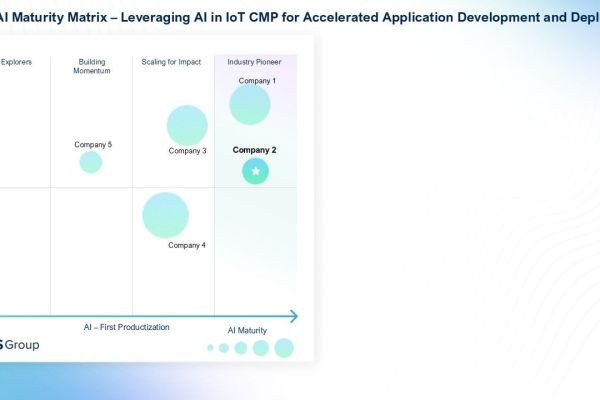
This shift is driving the evolution of IoT Connectivity Management Platforms (CMPs) toward AI-enabled, cloud-native, and application-centric environments. QKS Group's research examines how artificial intelligence is reshaping this landscape and evaluates leading vendors through its proprietary AI Maturity Matrix™.
Click Here For More Information: https://qksgroup.com/market-research/qks-ai-maturity-matrix-leveraging-ai-in-iot-cmp-for-accelerated-application-development-and-deployment-2026-10515
What Are IoT Connectivity Management Platforms?
An IoT Connectivity Management Platform provides centralized capabilities for managing connectivity across large-scale IoT deployments. It enables organizations to provision devices, manage SIM lifecycles, monitor data usage, diagnose network issues, apply security controls, and optimize connectivity.
Modern platforms can support multiple communication technologies and networks, helping enterprises manage heterogeneous IoT ecosystems from a centralized environment.
As deployments become more sophisticated, CMPs are increasingly expected to provide capabilities beyond connectivity administration. Analytics, automation, AI-driven insights, intelligent orchestration, and application development are becoming important differentiators.
Why AI Is Becoming Critical for IoT Connectivity
The growing volume of IoT telemetry presents both an opportunity and a challenge. Enterprises have access to massive amounts of device and network data, but extracting meaningful intelligence can require specialized data science and engineering resources.
AI can simplify this process by automating analysis, identifying patterns, predicting connectivity issues, and supporting faster application development.
Generative AI is particularly significant because it can allow users and developers to interact with IoT data and platform capabilities using natural language. Instead of manually navigating complex workflows or writing extensive code, users can increasingly describe what they want the platform to accomplish.
This can reduce development complexity and help organizations move from experimentation to production more quickly.
Connect With Our Analyst: https://qksgroup.com/analyst-briefing?analystId=82&reportId=10515
Key AI Trends Shaping IoT Connectivity Management
- Generative AI Is Improving Developer Productivity
Generative AI can help developers create workflows, analyze device data, generate application logic, and troubleshoot connectivity issues. This can reduce the technical effort required to develop IoT applications.
For enterprises managing thousands or millions of connected devices, improving developer productivity can have a significant impact on the speed of innovation.
- Intelligent Workflow Automation Is Expanding
AI-enabled orchestration can automate repetitive connectivity and operational workflows. Platforms can use intelligent rules and analytics to identify issues and initiate appropriate actions.
This can help organizations reduce manual intervention while improving the consistency of IoT operations.
- Low-Code Development Is Accelerating Application Creation
Low-code environments are becoming increasingly relevant for enterprises that want business and operational teams to participate in IoT application development.
Combined with AI, low-code tools can simplify the creation of dashboards, workflows, alerts, and intelligent applications without requiring extensive programming expertise.
- Natural Language Analytics Is Changing Data Interaction
Traditional IoT analytics often require users to understand dashboards, query languages, and data structures. Natural language interfaces can simplify this experience by allowing users to ask questions about device performance, network status, data usage, or operational events.
This makes IoT intelligence more accessible across technical and business teams.
- Cloud-Native Architectures Support Global Scale
Cloud-native IoT CMPs provide the scalability and flexibility required to manage geographically distributed device deployments. They can support centralized management while enabling enterprises to scale connectivity operations across different regions and networks.
Why AI Maturity Matters
Not every platform that incorporates AI capabilities can be considered AI mature. Enterprises need to understand how deeply AI is embedded throughout the platform architecture and product experience.
QKS Group's AI Maturity Matrix™ evaluates leading IoT Connectivity Management Platform vendors across multiple dimensions, including AI-first product strategy, native Generative AI capabilities, intelligent workflow automation, developer experience, IoT data intelligence, deployment readiness, governance, and customer adoption.
This approach enables enterprise technology leaders to differentiate between surface-level AI features and platforms where intelligence is more deeply integrated into the overall product strategy.
Vendor Landscape
QKS Group's research provides a comparative assessment of leading IoT Connectivity Management Platform vendors with global impact, including AT&T, Orange Business, Soracom, Verizon, and Vodafone.
The AI Maturity Matrix™ provides technology buyers with a structured perspective on vendor capabilities and positioning. It can help organizations assess how effectively different platforms support AI-driven application development, deployment, automation, and operational intelligence.
For vendors, the research also provides valuable insights into competitive differentiation and opportunities to strengthen AI capabilities across the product lifecycle.
From Connectivity Management to AI-Powered Application Enablement
The evolution of IoT CMPs reflects a broader transformation in enterprise IoT strategy.
The traditional model focused on answering questions such as:
- Is the device connected?
- How much data is it using?
- Which network is it using?
- Is the SIM active?
- Is the device experiencing connectivity issues?
The emerging model goes further:
- What is happening across the connected environment?
- What patterns are emerging in the telemetry?
- Can an issue be predicted before it affects operations?
- Can an AI-powered workflow automatically respond?
- How quickly can a business user create an IoT application?
- Can natural language simplify access to operational intelligence?
This transition positions IoT CMPs as potential application-enablement platforms rather than simply connectivity administration tools.
What Should Enterprises Consider When Evaluating AI-Ready IoT CMPs?
Organizations evaluating IoT Connectivity Management Platforms should consider more than network coverage and device management capabilities.
Important evaluation criteria include:
- Native Generative AI capabilities
- AI-first product strategy
- Intelligent workflow automation
- Low-code and no-code development
- Natural language interfaces
- IoT data analytics and intelligence
- Multi-network connectivity management
- Security and governance
- Deployment readiness
- Developer experience
- Scalability and global coverage
- Integration with enterprise and IoT ecosystems
The strongest platforms should combine connectivity management with intelligence, automation, and application development capabilities.
The Future of IoT Connectivity Management
The IoT Connectivity Management Platform market is entering a new phase. Connectivity remains foundational, but it is increasingly becoming only one component of a broader intelligent IoT platform.
As enterprises seek to deploy AI-powered applications faster, platforms that reduce dependence on specialist AI teams, simplify development, and automate complex workflows are likely to become increasingly valuable.
AI maturity will therefore become an important consideration in technology selection. Enterprises will increasingly evaluate not simply whether a vendor offers AI, but how deeply AI is embedded into the platform and whether it delivers measurable improvements in development speed, deployment efficiency, operational performance, and business outcomes.
Download Sample Report Here: https://qksgroup.com/download-sample-form/qks-ai-maturity-matrix-leveraging-ai-in-iot-cmp-for-accelerated-application-development-and-deployment-2026-10515
Conclusion
IoT Connectivity Management Platforms are evolving from centralized connectivity administration systems into intelligent platforms capable of supporting application development, automation, analytics, and AI-driven decision-making.
QKS Group's AI Maturity Matrix™ provides enterprise technology leaders with a structured framework for evaluating the AI maturity of leading vendors, including AT&T, Orange Business, Soracom, Verizon, and Vodafone.
For organizations preparing their next-generation IoT strategies, the key question is no longer simply “Can we connect our devices?” It is “Can our connectivity platform help us turn connected-device data into intelligent applications and measurable business outcomes?”






