
A significant operational scale-up across diagnostic device manufacturing and medical imaging assembly is prioritizing precision X-ray sensor calibration, ergonomic table design, reduced radiation dose optimization, and seamless integration with hospital Picture Archiving and Communication Systems (PACS).
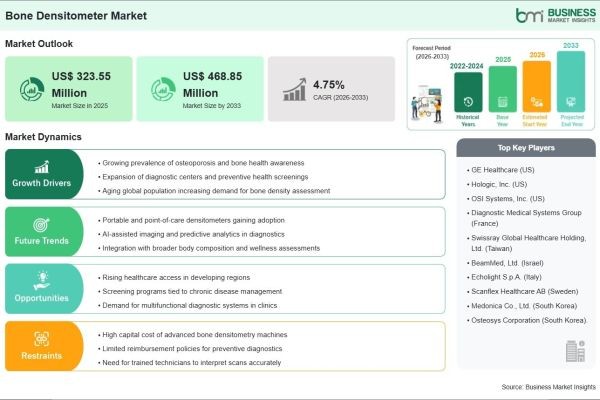
Based on market intelligence from Business Market Insights, the global Bone Densitometer Market is anticipated to reach US$ 468.85 Million by 2033, mounting from its 2025 value of US$ 323.55 Million at a projected CAGR of 4.75% from 2026 to 2033.
Growth is primarily driven by the increasing prevalence of osteoporosis and related bone disorders, expanding healthcare infrastructure, rising geriatric populations, and greater emphasis on preventive care. Technological advancements including improved imaging software, AI-assisted analysis, and portable densitometer systems are enhancing diagnostic accuracy and expanding access, particularly in emerging markets. While high device costs and limited reimbursement in certain regions pose challenges, government bone-health initiatives and the expansion of diagnostic services create strong long-term opportunities.
Download Sample Report : https://www.businessmarketinsights.com/sample/BMIPUB00033361
What Is a Bone Densitometer?
A Bone Densitometer is a specialized medical imaging device used to measure bone mineral density and assess fracture risk. The most widely used technology is Dual-Energy X-ray Absorptiometry (DEXA or DXA), which provides precise, low-radiation measurements of BMD at key skeletal sites. Axial systems typically scan the spine and hip the sites most associated with osteoporotic fractures while peripheral systems assess sites such as the wrist, heel, or finger. Beyond osteoporosis diagnosis, densitometers support evaluation of osteopenia, cystic fibrosis-related bone loss, chronic kidney disease (CKD) effects on bone, rheumatoid arthritis, and body composition analysis. Results are typically reported as T-scores and Z-scores that guide clinical decision-making. Modern systems increasingly incorporate advanced software analytics and, in some cases, AI to improve interpretation and workflow efficiency.
These devices are valued for their non-invasive nature, rapid results, and ability to support early intervention before fractures or severe bone loss occur.
Market Drivers
The primary driver is the rising prevalence of bone disorders, particularly osteoporosis and osteopenia. According to projections from the International Osteoporosis Foundation, osteoporosis is expected to affect more than 500 million people worldwide by 2030, leading to a significant increase in fragility fractures. Aging populations, sedentary lifestyles, poor nutrition, and the growing incidence of chronic conditions such as CKD, rheumatoid arthritis, and cystic fibrosis all contribute to higher demand for accurate bone-health assessment. Greater public and clinical awareness of bone health has also expanded screening programs in hospitals and specialty clinics.
A second major driver is the expansion of diagnostic services and healthcare infrastructure. Governments and private providers are investing in new hospitals, specialty clinics, and imaging centers, particularly in emerging markets. Improved reimbursement policies in some regions and the establishment of dedicated osteoporosis clinics further support adoption. High-risk groups—including postmenopausal women, the elderly, and patients with chronic illnesses—benefit significantly from early detection and monitoring enabled by densitometers. The development of portable and multi-functional systems is also helping extend screening capabilities beyond large hospitals into smaller clinics and community settings.
Market Segmentation
By Technology
- Axial Bone Densitometry: The dominant segment. Axial systems are preferred for their high accuracy, ability to assess major fracture-prone sites (spine and hip), strong physician acceptance, and reliability in monitoring treatment response.
- Peripheral Bone Densitometry
By Application
- Osteoporosis & Osteopenia Diagnosis: The leading application segment, driven by the high prevalence of these conditions among aging populations and the need for regular monitoring and early intervention.
- Cystic Fibrosis Diagnosis
- Chronic Kidney Disease (CKD) Diagnosis
- Body Composition Measurement
- Rheumatoid Arthritis Diagnosis
By End User
- Hospitals & Specialty Clinics: The dominant end-user segment. These facilities perform the highest volume of bone density assessments, maintain advanced densitometry equipment, employ skilled technicians, and provide comprehensive patient management programs.
- Diagnostic & Imaging Centers
Regional Insights
- Asia-Pacific is expected to register significant growth during the forecast period. Rising cases of osteoporosis and osteopenia, expanding healthcare infrastructure, growing geriatric populations, and increasing investments in hospitals and diagnostic centers in China, India, Japan, and South Korea are key factors. Adoption of advanced axial and peripheral systems, AI-based software, and portable densitometers is accelerating, supported by government initiatives and preventive healthcare programs.
- North America remains a major market due to high awareness, advanced healthcare systems, strong reimbursement frameworks, and the presence of leading manufacturers.
- Europe shows steady growth driven by aging demographics, established screening guidelines, and focus on preventive care.
- Other regions are gradually expanding densitometry capacity as healthcare access and awareness improve.
Top Players in the Bone Densitometer Market
The competitive landscape includes established medical imaging and diagnostics companies focused on innovation, AI integration, and geographic expansion.
- GE Healthcare (US)
- Hologic, Inc. (US)
- OSI Systems, Inc. (US)
- Diagnostic Medical Systems Group (France)
- Swissray Global Healthcare Holding, Ltd. (Taiwan)
- BeamMed, Ltd. (Israel)
- Echolight S.p.A. (Italy)
- Scanflex Healthcare AB (Sweden)
- Medonica Co., Ltd. (South Korea)
- Osteosys Corporation (South Korea)
Technological Innovations
Recent developments highlight ongoing innovation and market expansion. In November 2024, Echolight signed an agreement enabling Siemens Healthineers to resell its bone densitometers as part of women’s health solutions. In October 2025, Echolight planned to showcase its technology at the RSNA 2025 Congress. In February 2024, FUJIFILM India installed an advanced DEXA machine in Delhi to strengthen diagnostic capabilities for bone-related diseases. Manufacturers are focusing on portable systems, AI-assisted analysis, multi-functional platforms, and improved software to enhance accuracy, workflow efficiency, and accessibility.
Challenges and Opportunities
Challenges include high device costs, limited reimbursement in some markets, and the need for trained operators. Economic pressures can also delay capital equipment purchases. However, opportunities are substantial: government bone-health initiatives, expansion of diagnostic infrastructure in emerging markets, development of user-friendly portable systems, and integration of AI and multi-functional diagnostic tools are expected to drive future growth.
Future Market Outlook
The Bone Densitometer Market outlook remains positive through 2033. Rising osteoporosis prevalence, aging populations, greater emphasis on preventive care, and continuous technological improvements will sustain demand. Axial systems and osteoporosis diagnosis will continue to dominate, while hospitals and specialty clinics remain the primary end users. Asia-Pacific is positioned for the strongest growth as healthcare infrastructure and awareness expand. Companies that deliver accurate, accessible, and increasingly intelligent densitometry solutions will be well placed to capture opportunities in this essential diagnostic segment.
Frequently Asked Questions (FAQs)
What is the projected size of the Bone Densitometer Market by 2033?
The market is projected to reach US$ 468.85 Million by 2033, rising from US$ 323.55 Million in 2025 at a CAGR of 4.75%.
Which technology segment is dominant?
Axial Bone Densitometry holds the largest share due to its high accuracy and ability to assess major fracture-prone sites.
Which application segment leads the market?
Osteoporosis & Osteopenia Diagnosis dominates because of the high prevalence of these conditions and the need for regular monitoring.
What is the primary factor driving demand?
The primary drivers are the rising prevalence of osteoporosis and other bone disorders, aging populations, and expanding diagnostic infrastructure.
Which region offers the strongest growth potential?
Asia-Pacific is expected to register significant growth driven by rising disease prevalence, healthcare investments, and increasing awareness.
Browse More Reports:
https://www.businessmarketinsights.com/reports/fuel-management-system-market
https://www.businessmarketinsights.com/reports/common-mode-chokes-market
https://www.businessmarketinsights.com/reports/distribution-feeder-automation-system-market
About Us
Business Market Insights is a market research platform that provides subscription service for industry and company reports. Our research team has extensive professional expertise in domains such as Electronics & Semiconductor; Aerospace & Defense; Automotive & Transportation; Energy & Power; Healthcare; Manufacturing & Construction; Food & Beverages; Chemicals & Materials; and Technology, Media.
Contact Us
If you have any questions about this report or would like further information, please contact us:
Contact person: Ankit Mathur
Email: sales@businessmarketinsights.com
Phone: +16467917070






