
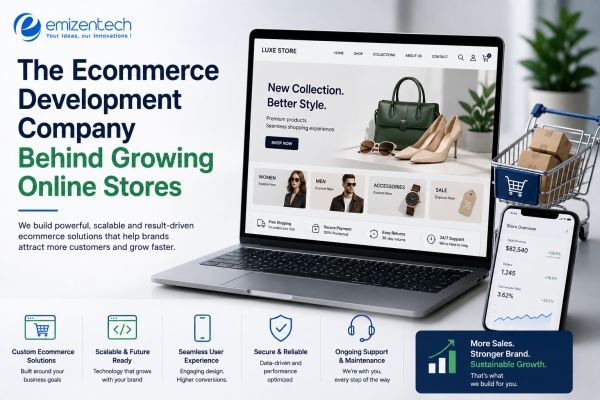
Every online store you shop from today, whether it's a small independent brand or a large retail name, was built by a development team working behind the scenes. An e-commerce development company is responsible for that work. It builds the store, connects the tools that make it function, and keeps it running as the business grows.
For anyone planning to launch or improve an online store, understanding what this kind of company actually does makes it much easier to know what to ask for and what to expect.
What Does an Ecommerce Development Company Do?
An ecommerce development company builds, launches, and maintains online stores. This includes everything from the first version of a website to ongoing updates once the store is live and taking orders.
Most of this work falls into a few core areas: designing how the store looks and functions, connecting it to payment and shipping systems, and making sure it loads quickly and works well on both desktop and mobile devices. The goal isn't just to get a store online, it's to make sure customers can browse, choose products, and check out without running into friction along the way.
Core Services an Ecommerce Development Company Provides
A typical ecommerce development company offers a mix of services that cover both the initial build and the store's long-term upkeep.
Store Setup and Design
This is the starting point for most projects. It involves building the store's layout, organizing product categories, and designing pages so they reflect the brand while staying easy to navigate. A store that looks good but confuses shoppers usually performs worse than a simpler one that's easy to use.
Platform Migration
Businesses sometimes need to move an existing store from one platform to another, often because the old system can't keep up with growth. Migration means transferring product data, customer records, and order history without losing information or disrupting the store's search engine rankings in the process.
Payment and API Integration
Every online store needs to connect with outside systems to function properly. This includes payment gateways, shipping calculators, inventory management tools, and sometimes marketing or customer service software. Getting these integrations right is what keeps checkout smooth and inventory accurate.
Performance and Speed Optimization
A slow-loading store tends to lose customers before they even reach the checkout page. Development teams work on compressing images, cleaning up code, and improving how quickly pages load, particularly on mobile connections where speed matters even more.
Ongoing Maintenance and Support
A store doesn't stop needing attention once it launches. Software updates, security patches, and small bug fixes are a regular part of keeping a site safe and functional. This is usually an ongoing relationship rather than a one-time project.
Common Ecommerce Platforms Used for Development
Most ecommerce development companies build on established platforms rather than starting from scratch each time. The right platform usually depends on the size of the business and how complex its catalog is.
Shopify and Shopify Plus are commonly used for stores that want a fast setup and reliable scaling as order volume grows. They're popular with businesses that want to launch quickly without managing heavy technical infrastructure themselves.
Adobe Commerce (Magento) tends to suit larger businesses with big product catalogs or more complex store logic, since it offers more flexibility for custom development, though it usually requires more technical resources to manage.
WooCommerce works well for businesses already running on WordPress, especially those that rely heavily on content alongside their product pages, like blogs or guides tied into the shopping experience.
BigCommerce is often chosen by mid-sized, fast-growing merchants who want strong built-in features, including tools for selling across multiple channels at once.
None of these platforms is universally "better." The right choice depends on catalog size, technical needs, and how much customization the business expects to need down the line.
How to Think About Choosing a Development Approach
Businesses evaluating an e-commerce build usually need to think through a few practical questions early on: how large is the current or expected product catalog, does the store need to integrate with existing business tools, and how much ongoing support will be needed after launch?
A small store with a simple catalog often doesn't need the same setup as a business managing thousands of SKUs across multiple warehouses. Matching the platform and development approach to the actual size and complexity of the business tends to produce a smoother build and fewer headaches later.
Conclusion
An e-commerce development company handles far more than just building a website. From initial setup and platform migration to integrations, performance, and ongoing maintenance, the work spans the full life of an online store, not just its launch. Understanding these pieces makes it easier for any business to plan a build that actually fits its size, its catalog, and how it expects to grow.
FAQs
What does an e-commerce development company actually build?
It builds and maintains the online store itself, including its design, product pages, checkout process, and the connections to payment, shipping, and inventory systems.
Which platform is best for an e-commerce store?
It depends on the business. Shopify suits fast, simple launches, Adobe Commerce fits larger catalogs, WooCommerce works well for content-driven sites, and BigCommerce suits merchants selling across multiple channels.
Does a store need ongoing development after it launches?
Yes. Most stores need regular updates, security patches, and occasional fixes to stay functional and secure as the business and its traffic grow.
How long does it usually take to build an e-commerce store?
This varies widely based on catalog size and how many custom features are needed, ranging from a few weeks for a simple setup to several months for a complex, highly customized store.






