
Introduction
The manufacturing industry is entering a period of unprecedented change. Driven by digital transformation, automation, and the growing demand for faster production, businesses are increasingly adopting technologies that improve efficiency and reduce operational complexity. Among these innovations, additive manufacturing stands out as one of the most disruptive and promising technologies of the 21st century.
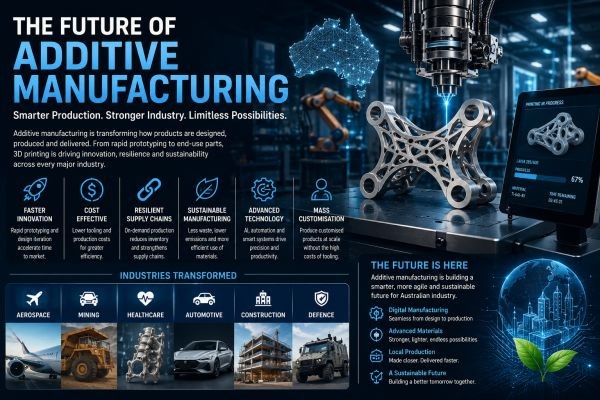
Additive manufacturing, commonly known as 3D printing, is no longer limited to creating prototypes. Today, it is helping manufacturers produce functional components, custom products, tooling, spare parts, and production-ready assemblies across numerous industries. As technology continues to evolve, additive manufacturing is expected to become a central pillar of modern industrial production.
Why Additive Manufacturing Is Gaining Momentum
The global manufacturing landscape is becoming more competitive. Companies must respond to customer demands faster while maintaining quality and controlling costs.
Traditional manufacturing methods often involve:
- High tooling costs
- Long production lead times
- Large inventory requirements
- Limited design flexibility
Additive manufacturing addresses these challenges by enabling direct production from digital designs. This allows businesses to move quickly from concept to finished product while reducing many of the costs associated with conventional manufacturing.
As a result, manufacturers are increasingly viewing additive manufacturing as a strategic investment rather than an experimental technology.
The Emergence of Highly Automated Production
One of the most significant developments shaping the future of additive manufacturing is automation.
Industrial production facilities are becoming more connected through advanced technologies such as:
- Robotics
- Artificial intelligence
- Automated quality control
- Digital production management systems
Future additive manufacturing facilities will feature highly automated workflows where machines operate continuously with minimal human intervention.
This level of automation will improve:
- Production consistency
- Manufacturing speed
- Operational efficiency
- Scalability
As automation technologies continue to mature, additive manufacturing will become even more attractive for industrial applications.
Design Freedom Will Drive Product Innovation
Traditional manufacturing often forces engineers to compromise between design performance and production limitations.
Additive manufacturing removes many of these restrictions.
Engineers can create:
- Lightweight structures
- Complex internal geometries
- Multi-functional components
- Optimised performance designs
This freedom enables manufacturers to improve product functionality while reducing weight, material usage, and assembly requirements.
Future products will increasingly be designed specifically for additive manufacturing rather than adapted from traditional manufacturing methods.
Digital Inventories Will Replace Physical Stock
Inventory management remains a significant challenge for many manufacturers.
Warehousing costs, obsolete stock, and supply chain delays can create substantial financial burdens.
The future of additive manufacturing introduces a different model.
Rather than storing thousands of physical parts, businesses will maintain digital inventories containing design files that can be manufactured whenever required.
This approach offers several advantages:
- Reduced storage costs
- Improved spare parts availability
- Lower inventory risks
- Greater production flexibility
Digital inventory systems are expected to become a major component of future manufacturing strategies.
Additive Manufacturing and Artificial Intelligence
Artificial intelligence is set to transform the way additive manufacturing operates.
AI-powered systems can help manufacturers:
- Generate optimised designs
- Predict production outcomes
- Monitor machine performance
- Improve quality control
- Reduce production waste
By combining AI with additive manufacturing, businesses can create more efficient and intelligent production environments capable of continuously improving performance.
This integration will play a major role in the future growth of the industry.
Sustainable Manufacturing for a Greener Future
Environmental sustainability is becoming increasingly important for businesses across every industry.
Additive manufacturing supports sustainability goals by:
- Minimising material waste
- Supporting local production
- Reducing transportation requirements
- Lowering inventory levels
- Improving resource efficiency
Unlike traditional subtractive manufacturing processes, additive manufacturing uses only the material necessary to build a part.
As organisations seek to reduce their environmental footprint, additive manufacturing will become an increasingly valuable tool for achieving sustainability objectives.
Expanding Industrial Applications
The range of applications for additive manufacturing continues to grow.
Aerospace
Aircraft manufacturers use additive manufacturing to produce lightweight components that improve fuel efficiency and reduce operating costs.
Mining
Mining companies leverage industrial 3D printing to create replacement parts and specialised components that minimise downtime.
Healthcare
Medical manufacturers produce customised implants, surgical tools, and patient-specific devices using advanced additive manufacturing technologies.
Automotive
Automotive companies utilise additive manufacturing for rapid prototyping, tooling, and specialised production components.
Construction
Large-scale 3D printing technologies are opening new possibilities for construction, infrastructure, and architectural innovation.
These industries are only the beginning of what is expected to be widespread adoption across the broader manufacturing sector.
Material Innovation Will Expand Possibilities
Materials are at the heart of additive manufacturing's future.
Advancements in material science are producing:
- Stronger polymers
- Heat-resistant composites
- Lightweight metal alloys
- High-performance engineering materials
Future materials will offer enhanced mechanical properties while expanding the number of applications suitable for additive manufacturing.
As material options continue to improve, manufacturers will gain access to new production opportunities previously unavailable through traditional methods.
Local Manufacturing Will Become More Important
Global supply chain disruptions have encouraged many businesses to rethink their manufacturing strategies.
Additive manufacturing enables local production by allowing components to be manufactured closer to where they are needed.
Benefits include:
- Faster delivery times
- Reduced shipping costs
- Improved supply chain resilience
- Greater production control
- Increased domestic manufacturing capability
This shift toward localised production is expected to become one of the defining trends of future manufacturing.
Challenges That Remain
Despite its rapid growth, additive manufacturing still faces challenges that must be addressed.
These include:
- Workforce training
- Material certification
- Process standardisation
- Production scalability
- Regulatory compliance
However, continued investment in research, technology, and education is helping overcome these barriers and accelerate adoption.
Conclusion
The future of additive manufacturing is incredibly promising. As businesses embrace digital transformation, automation, artificial intelligence, and sustainable production practices, additive manufacturing will become a core component of modern manufacturing operations.
Its ability to reduce costs, accelerate innovation, strengthen supply chains, and enable advanced product designs positions it as one of the most important industrial technologies of the coming decades.
For Australian manufacturers and businesses worldwide, additive manufacturing represents more than just a new production method—it represents the future of how products will be designed, manufactured, and delivered in an increasingly connected and competitive world.






