
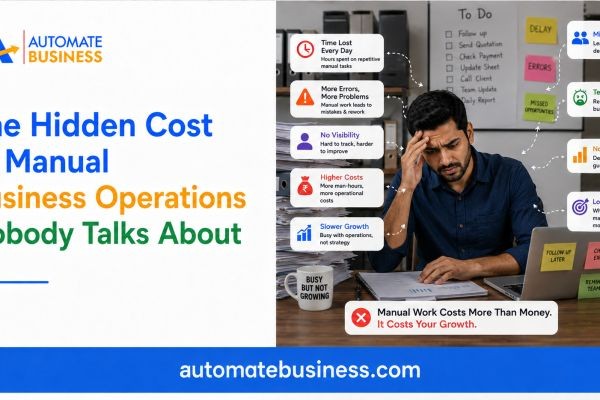
Ask any MSME owner what their biggest cost is and they will tell you raw materials, staff salaries, rent, logistics. These are the visible costs. They appear on every invoice, every salary slip, every P&L statement. They are managed, negotiated, and optimized with great attention.
But there is another category of cost that never appears on any statement one that is equally significant, often larger, and almost completely invisible. It is the cost of doing things manually. The cost of coordination, repetition, human error, delayed decisions, and the slow but steady leakage of time and revenue that happens when a business runs on WhatsApp groups, spreadsheets, and individual memory.
Automate Business [https://www.automatebusiness.com/] a unified platform trusted by over 12,000 MSMEs across India exists to solve exactly this problem. With five integrated apps covering task management, CRM, attendance, forms, and WhatsApp communication, it helps growing businesses replace the invisible costs of manual operations with the compounding advantages of systematic automation. But before any MSME can fix this problem, it first needs to see it clearly.
This blog breaks down what manual business operations are actually costing in ways that rarely show up in financial discussions but show up everywhere in how the business performs.
The Cost Nobody Sees: Time Spent on Low-Value Repetition
The most significant hidden cost of manual operations is temporal. Every hour a capable person spends doing something a system could do automatically is an hour not spent on work that requires human intelligence and judgement.
Consider a typical day across an MSME team. A manager starts by calling three people for status updates. A salesperson spends forty minutes copying leads from a portal into a spreadsheet. An HR executive compiles attendance from a register to produce a report that could generate itself. A front desk team member answers the same six WhatsApp queries they answered yesterday.
None of this work is wrong. All of it is necessary. But none of it requires a human being. When capable people spend significant portions of their day on tasks a system would handle in seconds, the business is paying full human cost for work with zero human value-add.
Across a team of ten people, this easily represents fifteen to twenty wasted hours per day a cost far larger than most MSME owners estimate when calculating the "savings" of not investing in automation.
The Cost of Coordination: When People Become the Integration Layer
In a manually operated business, people function as the integration layer between disconnected processes. The sales team closes a deal and someone manually informs operations. A delivery is completed and someone manually updates the spreadsheet. Leave is approved and someone manually adjusts the attendance record.
Every handoff is a coordination cost. It takes time. It introduces the possibility of error. It creates dependency on the specific person who knows how to move information from one place to another.
In a well-functioning system, these handoffs are automated a closed deal creates an onboarding task, a completed delivery updates the record in real time, an approved leave adjusts attendance automatically. When people do what systems should do, the business also creates fragility: a team member who leaves takes their undocumented process knowledge with them. The business does not just lose a person. It loses a workflow nobody else fully understood.
The Cost of Missed Follow-Ups: Revenue That Quietly Walks Out
Research across sales industries consistently shows that the majority of lost deals are not lost to price or competition they are lost to follow-up failure. A prospect expressed interest, had a conversation, and then heard nothing not because the business did not want to follow up, but because no system ensured it happened.
In a manually operated MSME, follow-up depends entirely on individual memory. The salesperson who was supposed to call back on Thursday got pulled into an urgent delivery issue. The WhatsApp reminder got buried. The lead representing ₹80,000 of potential revenue never received another call.
This is not a sales failure. It is an operational failure. And it happens across dozens of leads every month. The true cost is not the value of a single lost lead it is the compounded value of every lead never followed up over a year. For most growing MSMEs, this number is in the lakhs annually. It is entirely preventable. And it never appears on any financial report, because the business never sees what it never converted.
The Cost of Data Errors: Decisions Made on Wrong Information
Manual data entry is error-prone not because people are careless, but because humans are not optimized for repetitive precision tasks at speed. A lead entered with a wrong number. An attendance typo that changes a leave balance. A quotation sent with an incorrect GST calculation. An inventory count that is one digit off.
Each error has a downstream cost the wrong number means the follow-up call fails; the leave miscalculation creates a payroll dispute; the quotation error loses a customer or reduces margin. What makes these costs genuinely hidden is that they are rarely traced to their source. The payroll dispute gets resolved manually. The stockout gets managed with an emergency purchase. The root cause a manual entry error is never identified, so it never gets fixed, and keeps happening.
Automated systems eliminate most of this error class. Data entered once flows accurately across every function that uses it no re-entry, no transcription, no human precision failures.
The Cost of Delayed Decisions: When Information Arrives Too Late
In a manually operated business, information travels slowly. The daily sales report is compiled every evening and reviewed the next morning. The attendance exception is noticed during payroll three weeks later. The missed task is discovered on Friday when the client calls.
By the time information reaches the person who needs to act, the optimal moment has often passed. A sales dip that could have been addressed in week two becomes a quarterly shortfall. An attendance pattern signaling a disengaged employee goes unnoticed until the resignation arrives.
Real-time visibility changes the timing of decisions. When a manager sees today's task completion at 11 AM instead of the following morning, they can intervene before the problem compounds. When attendance exceptions appear in real time instead of monthly reports, patterns are caught before they become cultural norms. The cost of delayed information is the accumulation of decisions made on stale data decisions that would have been made differently if the right information had arrived on time.
The Cost of Key-Person Dependency: When the Business Cannot Run Without You
In a manually operated MSME, operational knowledge lives in people's heads. The sales manager knows which leads are priority. The owner knows which vendor to call for urgent orders. None of this knowledge is systematized or accessible to anyone else.
When that person is on leave, sick, or overwhelmed, the business slows decisions take five hours instead of five minutes, urgent tasks are delayed, customer calls go unanswered. The business is only as reliable as the availability of its most informed individual.
Automation moves operational knowledge from individuals' heads into a shared platform. Any authorized team member can see the current state of any process, task, or customer relationship at any time making the business resilient rather than dependent on who happens to be available.
What the Visible Costs Are Actually Hiding
The paradox of manual business operations is that they feel cheaper than automation because the costs are distributed invisibly across salaries, missed revenue, poor decisions, and operational fragility rather than appearing as a line item on an invoice.
When an MSME invests in automation, the cost is visible and immediate. When it does not, the cost is invisible and ongoing paid every day in lost hours, missed leads, data errors, delayed decisions, and key-person dependencies.
Teams using Automate Business [https://www.automatebusiness.com/partner-with-us/] report a 70% increase in productivity, 40% time saved in operations, and a 20% reduction in operational costs numbers that represent hidden costs being recovered, not new value being created from nothing. The hidden cost of manual operations is already being paid. The only question is whether it continues invisibly or gets redirected into a system that makes the business faster, more accurate, and genuinely capable of scaling.
See how Automate Business [https://www.automatebusiness.com/features/] helps MSMEs eliminate the hidden costs of manual operations with five connected apps that automate tasks, customer relationships, attendance, forms, and WhatsApp communication from one unified platform.






