
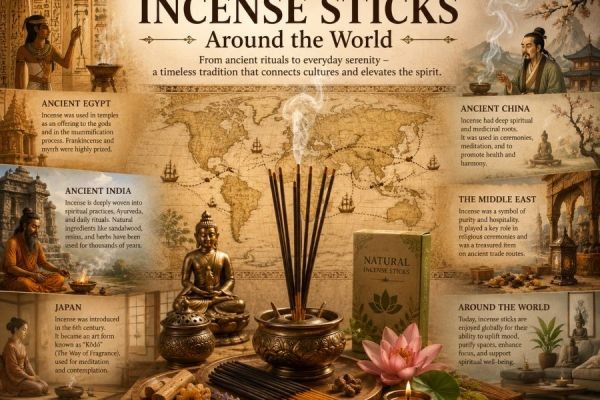
Incense Sticks History
Picture a merchant crossing the desert three thousand years ago, guarding a cargo more valuable than gold by weight — not spices, not silk, but resin. Frankincense and myrrh once commanded prices that could bankrupt kings, and entire trade routes were built around moving them from one civilization to another. That's how seriously ancient people took fragrance. Incense sticks, in the rolled, portable form most people recognize today, are actually a relatively recent evolution of something much older and stranger — a global obsession with burning aromatic material that stretches back further than most written history itself. If you've ever picked up Mayapur Store Incense Sticks without thinking twice about where the tradition came from, the backstory is worth knowing, because it explains why incense still matters the way it does.
This isn't a dry timeline. It's the story of how one simple act — burning something fragrant — became sacred, medicinal, political, and eventually commercial across nearly every major civilization on earth.
Ancient Egypt: Where Smoke Met the Divine
Long before incense sticks existed in their current form, ancient Egyptians were burning raw resins and aromatic woods in temple ceremonies, believing the rising smoke carried prayers directly to the gods. Frankincense held a particularly elevated status, used extensively in religious rituals and even in embalming practices, since Egyptians associated its scent with purification and the preservation of the body for the afterlife.
What's genuinely striking is how much labor and cost went into acquiring this resin. Frankincense trees grew almost exclusively in specific regions of the Arabian Peninsula and parts of East Africa, meaning Egypt had to import it through extensive trade networks — a logistical undertaking comparable to importing rare spices centuries later. This scarcity is exactly why frankincense became so tied to royalty and divinity. Something that difficult to obtain naturally accumulated symbolic weight.
China: Incense as Time, Medicine, and Meditation
China developed one of the most sophisticated relationships with incense in the ancient world, treating it not just as ritual offering but as a functional tool. Incense clocks, ingeniously designed to burn at a steady, predictable rate, were used to measure time long before mechanical clocks became widespread. Certain temples relied on marked incense coils that would burn through the night, alerting monks to specific hours through scent changes or small bells attached at intervals.
Traditional Chinese medicine also incorporated aromatic smoke as part of broader herbal practice, with specific resins and woods believed to carry therapeutic properties tied to balancing internal energy. Buddhist and Taoist practices further cemented incense as essential to meditation, using fragrance as an anchor for focus in exactly the way many people still use it today — as a sensory signal that shifts the mind into a different mode.
India: Where the Modern Incense Stick Actually Took Shape
While aromatic offerings existed in Indian religious practice for millennia, tied closely to Vedic fire rituals and temple worship, the rolled incense stick format most people recognize globally is believed to have developed later, evolving through centuries of refinement in South Asian craft traditions.
The technique of hand-rolling a paste of natural ingredients onto a bamboo core — what's now called "masala" style incense — became particularly associated with Indian production, later spreading its influence to neighboring regions and eventually across the world through trade.
India's incense tradition carries a distinct devotional weight tied specifically to Vaishnava and broader Hindu worship practices, where dhoop offerings remain a core element of daily puja even now. Sandalwood, in particular, became deeply woven into Indian spiritual life, valued both for its calming fragrance and its symbolic association with purity and devotion.
- Sandalwood's role in temple worship predates written records in some regions, embedded so deeply into ritual practice that its use became almost inseparable from the act of worship itself.
- Regional variation flourished, with different parts of India developing distinct incense-making traditions based on locally available resins, woods, and flowers.
- Trade with Southeast Asia and beyond eventually carried Indian incense-making techniques outward, influencing production methods in neighboring cultures.
Japan: Turning Incense Into an Art Form
Japan took a strikingly different path, transforming incense appreciation into a refined cultural practice known as kōdō, one of Japan's traditional arts alongside tea ceremony and flower arranging. Rather than simply burning incense for ambient fragrance, kōdō practitioners developed elaborate rituals around identifying and appreciating specific scents, often through structured "incense games" where participants would attempt to distinguish between different aromatic woods purely through smell.
This level of ritualized attention reflects something worth noting: incense wasn't treated as background sensory decoration in Japan. It became a discipline requiring genuine skill, patience, and cultivated sensitivity — closer to wine tasting than casual room fragrance.
Agarwood, known in Japan as jinkō, held particular reverence within this tradition, with certain rare pieces valued extraordinarily high due to their scarcity and complexity of scent.
The Middle East and the Frankincense Trade Routes
The ancient frankincense trade deserves its own mention, since it genuinely shaped regional economies for centuries. The famous "Incense Route" connected southern Arabia to the Mediterranean, passing through what's now Oman, Yemen, and Jordan, carrying frankincense and myrrh toward markets in Egypt, Greece, and eventually Rome.
- Entire cities grew wealthy primarily through their position along these trade paths.
- Religious practices across multiple civilizations, including early Christian and Jewish traditions, incorporated frankincense and myrrh as significant ceremonial materials.
- The scarcity and difficulty of transport kept prices extraordinarily high for centuries, comparable to luxury goods like silk or precious stones.
This trade network didn't just move goods — it moved cultural practices, spreading incense use and appreciation across regions that might otherwise have had little direct contact.
How Incense Traveled West Through Trade and Conquest
European exposure to incense expanded significantly through contact with the Middle East and Asia, particularly through Roman trade networks and later through the spice trade era. Frankincense and myrrh became deeply embedded in early Christian liturgical practice, a tradition that continues in many churches today during formal ceremonies.
Interestingly, incense use in Europe never developed the same widespread domestic, everyday presence it held in Asian and Middle Eastern households. It remained more closely tied to formal religious ceremony rather than becoming a common household ritual, a distinction that still shapes how incense is perceived culturally in different parts of the world today.
The Global Spread Beyond Its Origins
By the time European trading companies established regular shipping routes through Asia, incense had already traveled well beyond its original regions of use. Southeast Asian nations, particularly those with strong Buddhist and Hindu influence, developed their own regional variations, often blending techniques absorbed from Indian and Chinese traders with locally available woods and resins.
Vietnam, Thailand, and Indonesia each developed distinct incense-making traditions, frequently centered around agarwood harvested from their own forests, which added regional character to what had started as imported practice. This cross-pollination is worth noting because it shows incense wasn't simply exported unchanged from one culture to another — it kept absorbing local ingredients and ritual meaning wherever it traveled.
By the colonial era, incense had become a genuinely global commodity, moving through the same trade networks as spices, textiles, and other luxury goods. What started as sacred, scarce material accessible mostly to temples and royalty gradually became available to ordinary households, a shift that mirrors how many once-exclusive goods eventually became part of everyday domestic life.
From Rare Ritual Object to Everyday Household Staple
Perhaps the most significant historical shift, and one rarely discussed, is how incense moved from an expensive, ceremony-only material to something affordable enough for daily household use. This transition happened gradually, tied closely to improvements in production techniques and the wider availability of ingredients through expanding trade.
- Mass production techniques, developed particularly in India and later adopted in other manufacturing regions, made rolled incense sticks significantly cheaper than the raw resin burning of earlier centuries.
- Wider ingredient availability through global trade meant households no longer needed direct access to rare regional resins to enjoy similar fragrances.
- Cultural practices adapted accordingly — daily household worship, once limited by the cost of frankincense or genuine sandalwood, became accessible to far broader segments of society once affordable incense sticks became widely available.
This is genuinely worth appreciating: the incense stick sitting in a box on a shelf today represents the end point of thousands of years of trade, craft refinement, and cultural adaptation, condensed into something anyone can afford and use without a second thought.
Why This History Still Shapes How We Use Incense Now
Understanding where incense practices originated actually explains a lot about modern usage patterns that might otherwise seem arbitrary.
- Sandalwood's continued dominance in devotional contexts traces directly back to its historical role in Indian temple worship, not simply because it smells pleasant.
- The rolled stick format itself, now used worldwide, reflects centuries of refinement in South Asian craft techniques rather than a modern manufacturing shortcut.
- The ritualistic, mindful approach to burning incense, seen in practices like Japanese kōdō, still influences how many people today intuitively treat incense as something requiring presence and attention rather than casual background use.
None of this history is required knowledge to enjoy lighting a stick of incense today. But knowing it changes the experience slightly — turning what might feel like a small, forgettable habit into participation in something genuinely ancient, carried forward through thousands of years of trade routes, temple rituals, and quiet human attention to the simple act of burning something fragrant.






