
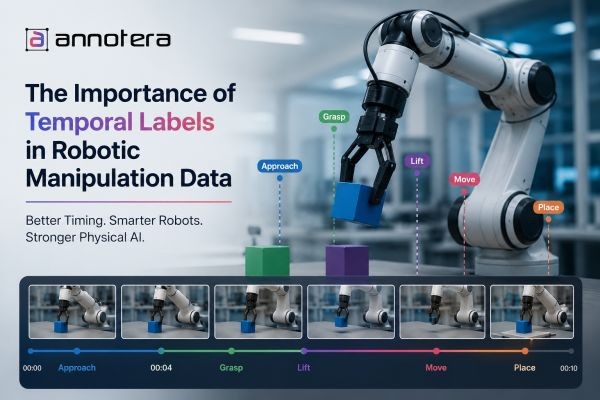
Robots are increasingly expected to perform complex physical tasks such as picking fragile objects, assembling components, sorting products, and assisting people in dynamic environments. To perform these activities reliably, robots need more than visual recognition. They must understand what happens, when it happens, and how one action leads to another. This is where temporal labels become essential.
Temporal annotation adds time-based context to robotic manipulation data by identifying actions, transitions, events, and task phases across a sequence. Instead of treating a demonstration as a collection of disconnected frames, temporal labels turn it into a structured representation of behavior. For companies developing intelligent robots, high-quality robotics data annotation services can help transform raw sensor recordings and demonstrations into training-ready datasets.
What Are Temporal Labels in Robotic Data?
Temporal labels identify meaningful events or actions at specific points or intervals within a robotic data sequence. For example, a manipulation recording may contain the stages “approach object,” “align gripper,” “grasp,” “lift,” “move,” and “release.” Temporal annotation establishes when each stage begins and ends.
These labels can be applied to different types of robotic data, including:
-
RGB and video recordings
-
Depth and 3D sensor data
-
Joint-position and joint-velocity logs
-
Force and torque measurements
-
End-effector trajectories
-
Teleoperation demonstrations
-
Multimodal sensor recordings
A temporally labeled sequence allows machine learning systems to associate observations with corresponding actions. This is particularly important for Physical AI systems, where models must learn behaviors that unfold continuously in the real world.
Why Timing Matters in Robotic Manipulation
Robotic manipulation is inherently sequential. A robot cannot successfully place an object without first locating it, reaching toward it, establishing a stable grasp, and transporting it to the intended position. Each action depends on the outcome of the previous one.
Consider a simple pick-and-place task. A visual frame showing a gripper near an object does not necessarily indicate whether the robot is preparing to grasp, already holding the object, or recovering from a failed attempt. Temporal information provides the missing context.
By marking action boundaries and transitions, datasets can communicate:
-
What action is occurring
-
When the action starts
-
When it ends
-
What action follows
-
Whether the intended outcome was achieved
This structure gives learning algorithms a clearer understanding of robotic behavior.
Temporal Labels Improve Action Recognition
A robot learning system must distinguish between similar-looking states that have different meanings. For example, a gripper moving toward an object and a gripper moving away from an object may appear visually similar, but they represent different stages of manipulation.
Temporal labels help models associate movement patterns with specific task phases. When training data consistently marks transitions such as approach-to-contact or grasp-to-lift, models can learn more meaningful relationships between perception and action.
This can improve the recognition of manipulation primitives such as reaching, grasping, pushing, pulling, rotating, inserting, and releasing.
Supporting Learning From Demonstrations
Demonstration-based learning depends heavily on the quality and structure of recorded examples. Human operators or teleoperators may demonstrate the same task in slightly different ways. One operator might pause before grasping, while another may move continuously. Without temporal structure, these variations can make learning more difficult.
Temporal labels help standardize demonstrations by identifying the underlying phases of a task regardless of minor differences in execution.
For example, several demonstrations of a bottle-picking task might have different movement speeds but share the same sequence:
Reach → Align → Contact → Grasp → Lift → Transport → Release
Annotators can mark these phases consistently, allowing models to focus on task structure rather than irrelevant timing variations.
Handling Transitions and Action Boundaries
Action boundaries are among the most valuable temporal annotations in robotic datasets. A boundary represents a meaningful change from one behavior or task state to another.
For manipulation systems, useful boundaries may include:
-
Object detected → approach begins
-
Approach → contact
-
Contact → grasp
-
Grasp → lift
-
Lift → transport
-
Transport → placement
-
Placement → release
-
Successful action → recovery or retry
Accurately identifying these transitions helps models learn when to initiate, maintain, or terminate an action.
Poorly defined boundaries can introduce ambiguity into training data. If a grasp label begins several seconds before actual contact, for example, the model may learn an inaccurate relationship between visual observations and manipulation behavior.
Temporal Annotation for Failure Analysis
Temporal labels are useful not only for successful demonstrations but also for identifying failures.
Robotic manipulation can fail because an object slips, the gripper approaches from an incorrect angle, contact is unstable, or the robot encounters an unexpected obstacle. Labeling the exact point at which the behavior deviates from the intended sequence can help engineers understand why a policy failed.
A dataset might identify a sequence as:
Approach → Contact → Failed Grasp → Object Slip → Recovery
This information is valuable for training models to recognize failure conditions and select appropriate recovery strategies.
Connecting Multiple Sensors Over Time
Modern robots often rely on multiple sensors simultaneously. Cameras provide visual information, while depth sensors, force sensors, joint encoders, and other systems capture additional information about the robot and its environment.
Temporal labels provide a common reference across these modalities.
For example, a “contact” event can be aligned with:
-
A visual change in the object’s position
-
A force spike
-
A change in gripper state
-
A reduction in end-effector velocity
This synchronization is important for developing Physical AI training data that reflects how perception, movement, and physical interaction are connected.
Improving Robot Policy Learning
Robotic policies must learn mappings between observations, actions, and outcomes. Temporal annotation makes these relationships easier to model by providing information about the progression of a task.
Instead of learning from isolated states, a model can learn patterns such as:
Observation → Action → Transition → New Observation → Next Action
This is particularly useful for imitation learning, behavior cloning, reinforcement learning, and other approaches that use demonstrations or sequential experience.
Temporal structure can also make datasets easier to segment into reusable manipulation primitives, allowing developers to combine learned behaviors into more complex workflows.
The Role of High-Quality Annotation
Temporal annotation requires more than simply assigning timestamps. Annotators need clear guidelines for defining action boundaries, identifying overlapping actions, handling pauses, and distinguishing successful actions from failed attempts.
Consistency is critical. If different annotators interpret the same event differently, the resulting dataset can contain temporal noise that affects model performance.
Experienced robotics data annotation services can establish annotation taxonomies, quality-control procedures, and validation workflows tailored to robotic manipulation tasks. Multiple review stages can further improve consistency across large datasets.
Building Better Training Data for Physical AI
As robots move beyond controlled environments, their training data must capture the complexity of real-world interaction. Temporal labels provide an important layer of structure for this purpose.
A strong dataset should capture not only what an object looks like but also how the robot interacts with it over time. It should represent action sequences, transitions, pauses, corrections, failures, and outcomes.
This makes temporal annotation a valuable component of Physical AI training data. By preserving the progression of physical behavior, annotated datasets can give learning systems a more complete representation of manipulation.
Conclusion
Robotic manipulation is a process, not a collection of isolated moments. Robots need to understand sequences, transitions, action durations, and the relationship between one event and the next. Temporal labels provide this essential context.
From improving action recognition and demonstration learning to supporting multimodal sensor alignment and failure analysis, temporal annotation can make robotic datasets substantially more useful. As the development of intelligent machines accelerates, organizations that invest in carefully structured temporal data will be better positioned to train robots capable of performing complex physical tasks with greater consistency.
For developers building next-generation robotic systems, combining precise temporal labeling with high-quality visual, trajectory, and sensor annotation can create richer datasets—and ultimately support more capable, adaptable, and reliable robots.






