
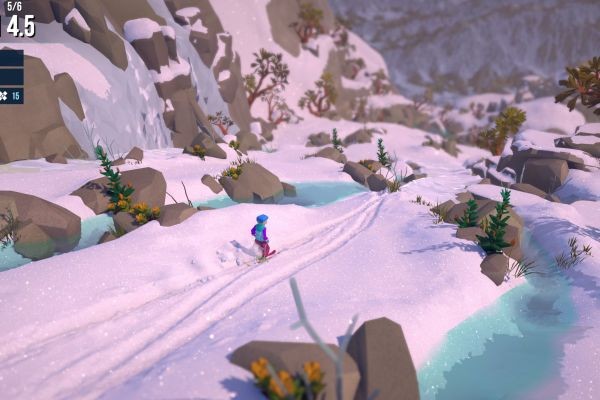
What Is Snow Rider ?
Snow Rider is an arcade skiing/snowboarding game where you descend mountains at high speed while avoiding obstacles, collecting boosts, and racing against time or other players. The game combines simple controls with surprising depth.
The Physics of Momentum
Snow Rider uses a simple physics model: you accelerate downhill naturally, but turning and hitting obstacles slow you down. Understanding this is fundamental.
Key principles:
- Gravity always accelerates you down the slope.
- Friction from turning slows you.
- Obstacles cause collision damage (slow or crash).
- Boosts provide temporary speed increases.
The best players work with these physics, not against them. They find paths that maximize acceleration while minimizing friction.
The Concept of "Racing Lines"
A racing line is the path through a course that's fastest when combined with perfect execution. In Snow Rider, the racing line usually:
- Takes the widest, smoothest arcs around obstacles
- Minimizes sharp turns
- Uses straightaways to build and maintain speed
- Avoids unnecessary detours to grab boosts
Finding the optimal line for each course is what separates casual players from competitive ones.
Steering Mastery
To nail your lines, steering must be precise and smooth:
- Use full control range but apply it gently.
- Predict terrain ahead and adjust your line before you reach it.
- Make one smooth arc instead of multiple sharp turns.
- Keep your speed in mind—high-speed sections need earlier, gentler inputs.
Jump Mechanics
Jumping has three uses:
- Clear gaps (essential)
- Avoid low obstacles (trees, rocks)
- Change direction mid-air (advanced technique)
Perfect jump timing comes from repetition. After 10-15 runs of the same course, your jumps become instinctive.
Obstacle Navigation
Different obstacles require different strategies:
- Trees: Weave through them using smooth turns.
- Gaps: Jump when you have clearance, steer around when possible.
- Cliffs: Slow down, navigate carefully, then rebuild speed on flats.
- Rocks: Plan your line to avoid them entirely.
Boost Strategy and Risk Management
Boosts are valuable but not worth a crash. Grab them when:
- They're on your natural line
- You're in an open area where detouring is safe
- The speed boost will be used on a straightaway
Skip them otherwise. A consistent, safe run beats a wrecked aggressive run.
Course-Specific Mastery
The final piece is deep course knowledge. Memorize:
- Every major obstacle location
- The optimal line for each section
- Boost locations and whether they're worth grabbing
- The best braking points and acceleration zones
This is why top players repeat courses dozens of times.
Snow Rider is a game of momentum, precision, and smart decision-making. Master smooth steering, find your racing line, time your jumps perfectly, and manage your risk. Do these things consistently, and you'll go from struggling to survive to confidently crushing every course. The mountain rewards practice—so get out there and ride.






