
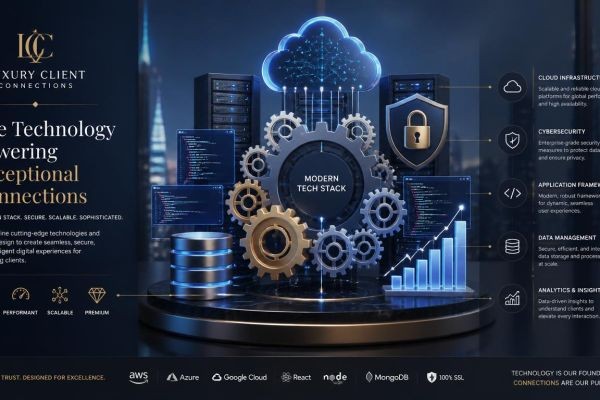
Luxury client connection platforms operate in a very different environment compared to traditional web applications. They are expected to deliver high performance, strict privacy, seamless user experience, and near-invisible operational complexity. Whether the platform connects high-net-worth individuals with premium services, curated experiences, or private bookings, the underlying technology stack must prioritize security, scalability, and discretion above all else.
This post breaks down the modern full-stack architecture typically used by an Escort Website Development Company to build such systems—from frontend frameworks to backend infrastructure, databases, real-time communication layers, and deployment pipelines.
1. Frontend Layer: Crafting a Premium User Experience
At the surface level, users judge the entire platform based on speed, usability, and visual refinement. That’s why the frontend stack is critical.
Most modern luxury-grade platforms rely on frameworks like React, often paired with server-side rendering solutions such as Next.js.
React is widely used because of its component-based architecture, which allows developers to build reusable UI elements such as booking cards, profiles, calendars, and messaging modules. This modularity is especially useful for platforms that need frequent UI updates without breaking existing features.
Next.js enhances React by adding:
-
Server-side rendering (SSR) for faster initial load
-
Static site generation (SSG) for SEO-heavy landing pages
-
API routes for lightweight backend functions
-
Built-in performance optimizations
Luxury platforms benefit significantly from SSR because page speed and first impressions are crucial. A slow-loading experience can immediately reduce trust, especially in high-value service ecosystems.
Additional frontend tools often include:
-
Tailwind CSS for design consistency
-
Framer Motion for smooth micro-interactions
-
TypeScript for type safety and maintainability
The frontend is not just about visuals—it’s about creating an experience that feels private, fast, and premium.
2. Backend Architecture: The Engine of the Platform
Behind every smooth interface is a robust backend system handling authentication, bookings, messaging, and data orchestration.
A common backend stack includes Node.js and Express.js.
Node.js is favored due to its non-blocking I/O model, which is ideal for handling multiple simultaneous user requests such as chat messages, booking requests, and profile updates.
Express.js provides a minimal but powerful framework for building REST APIs quickly. It acts as the middleware layer where business logic is implemented.
In more advanced systems, backend architecture may evolve into microservices, where each service handles a specific domain:
-
Authentication service
-
Booking engine
-
Messaging service
-
Payment processing service
-
Admin dashboard API
This separation ensures better scalability and fault isolation, which is essential for high-traffic platforms.
3. Databases: Managing Sensitive and Structured Data
Luxury client connection websites often handle sensitive personal data, private communications, and transactional records. Choosing the right database architecture is crucial.
The most commonly used relational database is PostgreSQL.
PostgreSQL is preferred because of:
-
Strong ACID compliance (data consistency)
-
Advanced indexing for fast queries
-
Support for complex relationships (users, bookings, payments)
-
Built-in encryption capabilities
For flexible or unstructured data (such as chat logs or activity feeds), developers may also use MongoDB.
MongoDB’s document-based structure allows rapid iteration and is useful when data schemas evolve frequently.
To optimize performance, many platforms introduce in-memory caching using Redis. Redis is used for:
-
Session storage
-
Real-time leaderboard or ranking systems
-
Caching frequently accessed profiles
-
Rate limiting APIs
Together, these databases form a hybrid architecture that balances consistency, flexibility, and speed.
4. Real-Time Communication Layer
One of the defining features of modern connection platforms is real-time interaction—chat, notifications, and live updates.
This is typically implemented using WebSockets, standardized under the protocol defined at.
WebSockets enable persistent, bidirectional communication between client and server. Unlike traditional HTTP requests, WebSockets allow instant data exchange without repeated polling.
Use cases include:
-
Instant messaging between clients and service providers
-
Live booking confirmations
-
Real-time availability updates
-
Push notifications for status changes
For structured APIs that may also require real-time capabilities, some platforms adopt GraphQL alongside subscriptions, allowing clients to request exactly the data they need.
5. Infrastructure and Cloud Hosting
Luxury platforms must guarantee uptime, global accessibility, and data security. This is where cloud infrastructure becomes essential.
The dominant provider in this space is Amazon Web Services.
AWS offers a wide range of services that support scalable architecture:
-
EC2 for virtual servers
-
S3 for secure file storage (images, documents)
-
RDS for managed databases
-
CloudFront for global content delivery (CDN)
-
Lambda for serverless functions
A typical deployment architecture might look like:
-
Frontend hosted on CDN (CloudFront)
-
Backend APIs running on EC2 or Kubernetes
-
Databases managed via RDS (PostgreSQL)
-
Media assets stored in S3
This setup ensures high availability and low latency across different geographic regions.
For containerized deployments, developers often use:
-
Docker for packaging applications
-
Kubernetes for orchestration and scaling
6. Web Server and Load Balancing
At scale, traffic must be distributed efficiently across multiple backend instances. This is where reverse proxies like Nginx come into play.
Nginx handles:
-
Load balancing incoming requests
-
SSL termination (HTTPS encryption)
-
Static file delivery
-
Rate limiting and security rules
It acts as the first point of contact between users and backend services, ensuring stability even under heavy traffic spikes.
7. Security and Privacy Layer
Security is one of the most critical aspects of luxury client connection platforms.
Key security practices include:
7.1 Authentication & Authorization
-
OAuth 2.0 or JWT-based authentication
-
Multi-factor authentication (MFA)
-
Role-based access control (RBAC)
7.2 Data Protection
-
End-to-end encryption for messages
-
Encryption at rest for databases
-
Secure API gateways
7.3 Infrastructure Security
-
DDoS protection via cloud providers
-
Firewall rules and IP filtering
-
Regular penetration testing
Because these platforms often deal with private interactions and sensitive data, trust is built entirely on invisible security mechanisms.
8. Payment Integration Systems
Monetization in such platforms usually involves:
-
Subscription models
-
Pay-per-booking systems
-
Membership tiers
Payment gateways such as Stripe or PayPal are commonly integrated through secure APIs. These systems ensure:
-
PCI-DSS compliance
-
Fraud detection mechanisms
-
Secure tokenization of card data
Sensitive payment data is never stored directly on application servers, reducing risk exposure.
9. CI/CD and Development Workflow
Modern development teams rely heavily on automation pipelines for continuous integration and deployment (CI/CD).
Typical workflow includes:
-
Code pushed to Git repositories
-
Automated testing (unit + integration)
-
Build pipelines triggered on merge
-
Deployment to staging and production environments
Tools often used:
-
GitHub Actions
-
Jenkins
-
GitLab CI/CD
This ensures rapid iteration while maintaining system stability.
10. Scalability Considerations
As user bases grow, systems must scale horizontally.
Key strategies include:
-
Microservices architecture
-
Database sharding
-
CDN-based asset delivery
-
Auto-scaling groups in cloud infrastructure
-
Asynchronous processing using queues (e.g., RabbitMQ or SQS)
Scaling is not just about handling traffic—it’s about maintaining consistent performance and privacy under load.
Conclusion
The technology stack behind luxury client connection websites is a carefully balanced ecosystem of performance, privacy, and scalability. From frontend frameworks like React and Next.js to backend systems powered by Node.js and Express, and from databases like PostgreSQL and MongoDB to cloud infrastructure on AWS, every layer plays a critical role.
What makes these platforms truly “luxury” is not just their design, but the invisible engineering that ensures speed, confidentiality, and reliability at every interaction. As user expectations continue to rise, the architecture behind these systems will only become more sophisticated, integrating smarter automation, stronger encryption, and even more seamless real-time experiences.






