
A significant operational scale-up across heavy electrical transformer manufacturing and rail equipment assembly is prioritizing thermal dissipation management, short-circuit withstand capability, structural weight minimization, and compliance with stringent international rail safety and fire standards.
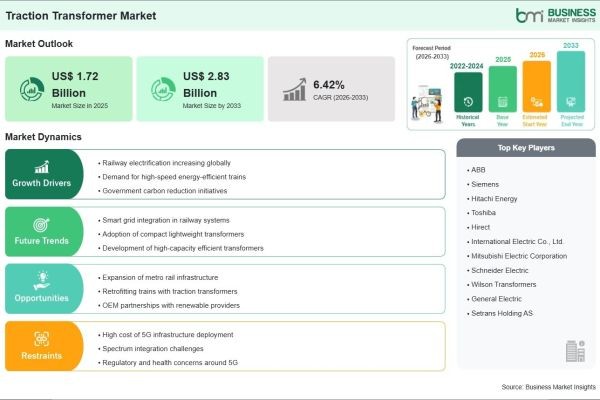
Based on market intelligence from Business Market Insights, the global Traction Transformer Market is anticipated to reach US$ 2.83 Billion by 2033, mounting from its 2025 value of US$ 1.72 Billion at a projected CAGR of 6.42% from 2026 to 2033.
Technological advancement is heavily shaping the industry landscape, with leading electrical equipment manufacturers focusing on Solid-State Transformers (SSTs), eco-friendly ester fluid insulation, and advanced thermal management systems. This evolution enables rail vehicle manufacturers to reduce onboard equipment weight, optimize power density, and extend maintenance intervals. Strategic partnerships between railway operators, rolling stock original equipment manufacturers (OEMs), and power grid developers are accelerating the modernization of electrified rail lines across both developed and emerging economies.
Download Sample Report : https://www.businessmarketinsights.com/sample/BMIPUB00033717
What Are Traction Transformers?
Traction transformers are critical electrical power equipment mounted directly onto electric rolling stock—such as locomotives, high-speed trains, and electric multiple units (EMUs). Their primary function is to step down high voltage tapped from catenary overhead lines (typically 15 kV or 25 kV AC) to lower, manageable voltage levels suitable for traction converters, propulsion motors, and auxiliary onboard systems.
The equipment offers essential functional advantages, including high mechanical strength to withstand continuous vibrations, superior thermal endurance under varying duty cycles, and high energy efficiency. Modern traction transformers are engineered with compact footprints and low noise profiles, making them vital for enabling high-speed rail connectivity and quiet urban metro operation.
Market Drivers
A primary driver of the Traction Transformer Market is the accelerating global shift toward railway electrification. Governments worldwide are replacing diesel locomotives with electric traction to cut greenhouse gas emissions and operational fuel costs, directly propelling the demand for high-capacity traction transformers.
The aggressive expansion of urban rail networks—including metro systems, light rail transit (LRT), and suburban commuter lines—acts as another major catalyst. Rapid urbanization in developing regions necessitates efficient mass transit infrastructure, driving continuous procurement of electric multiple units (EMUs) equipped with lightweight traction transformers.
Furthermore, significant capital investment in high-speed rail (HSR) networks across Europe and Asia-Pacific is boosting market adoption. High-speed trains require ultra-reliable, high-power-density traction transformers to deliver consistent acceleration and maintain operational stability at speeds exceeding 300 km/h.
Market Segmentation
By Type
- Tap Changing Transformers: A traditional segment utilized for mechanical voltage step regulation in conventional electric locomotives.
- Converter Transformers: The dominant and fastest-growing segment, designed to work seamlessly with modern power electronic converters for precise speed and torque control.
By Overhead Line Voltage
- 25 kV AC: The global standard for main line, freight, and high-speed rail electrification, commanding a major market share.
- 15 kV AC: Extensively deployed in central European rail networks across Germany, Austria, Switzerland, and Scandinavia.
- 3 kV DC / 1.5 kV DC & Others: Utilized in specialized suburban, metro, and legacy regional rail routes.
By Application / Rolling Stock Type
- Electric Locomotives: A major segment driven by heavy freight transportation and long-distance passenger train demands.
- High-Speed Trains: A high-value segment requiring advanced high-power traction transformers for ultra-fast intercity corridors.
- Metros & EMUs (Electric Multiple Units): The fastest-growing application segment, driven by rapid urban transit development worldwide.
- Trams & Light Rail Vehicles: Essential for low-voltage, compact urban transit operations.
Regional Insights
- Asia-Pacific holds a dominant market share and is projected to expand at the fastest rate, driven by China's extensive high-speed rail network, rapid metro expansion in major Indian cities, and continuous electrification projects across Southeast Asia.
- Europe represents a mature and highly strategic market, supported by strict carbon neutrality goals, cross-border high-speed rail corridors, and major rolling stock manufacturing hubs in Germany, France, and Switzerland.
- North America is witnessing steady growth, propelled by federal investments in passenger rail modernization (such as Amtrak upgrades), urban transit expansions, and freight line efficiency projects.
- Middle East & Africa is experiencing rising market adoption, fueled by ambitious intercity railway megaprojects in Saudi Arabia and the UAE, as well as freight line developments in South Africa.
- South & Central America is demonstrating long-term growth as major metropolitan areas invest in modernizing suburban rail networks to relieve traffic congestion.
Top Players in the Traction Transformer Market
The competitive landscape features established power engineering leaders and specialized railway technology conglomerates focused on high-efficiency designs, noise reduction, and modular transformer architectures.
- Hitachi Energy Ltd.
- Siemens Energy AG
- ABB Ltd.
- Alstom SA
- General Electric Company (GE Vernova)
- Mitsubishi Electric Corporation
- Schneider Electric SE
- CG Power and Industrial Solutions Limited
- International Electric Co., Ltd. (IEC)
- SNC-Lavalin Group (AtkinsRéalis)
Technological Innovations
The development of Solid-State Transformers (SSTs) incorporating silicon carbide (SiC) power electronics is transforming the traction transformer market. SSTs operate at high frequencies, allowing for drastic reductions in physical volume and weight—up to 50% smaller compared to conventional low-frequency transformers. This space savings translates directly to higher passenger capacity and reduced energy consumption per train set.
Additionally, the industry is transitioning away from conventional mineral oils toward biodegradable synthetic and natural ester fluids. Ester-filled traction transformers offer higher fire safety ratings, superior moisture tolerance, and full biodegradability, mitigating environmental contamination risks in the event of an operational leak or derailment.
Future Market Outlook
The future outlook for the Traction Transformer Market is highly positive through 2033, reinforced by international commitments to decarbonize transport sectors and expand high-speed rail connectivity. As multi-system locomotives capable of operating across different national voltage standards gain popularity, demand for versatile, multi-frequency traction transformers will climb.
Market leaders over the coming decade will be distinguished by their ability to supply ultra-lightweight, high-efficiency transformers that incorporate smart condition-monitoring sensors for predictive maintenance, minimizing life-cycle operational costs for rail operators.
Frequently Asked Questions (FAQs)
What is the projected size of the Traction Transformer Market by 2033?
The global market is projected to reach US$ 5.48 Billion by 2033, expanding from US$ 3.28 Billion in 2025.
What is the CAGR for the Traction Transformer Market?
The market is estimated to record a CAGR of 6.62% from 2026 to 2033.
Which application segment is witnessing rapid growth?
Metros & EMUs (Electric Multiple Units) represent the fastest-growing application segment due to massive global investments in urban rail transit infrastructure.
Which region leads the global traction transformer market?
Asia-Pacific is both the largest and fastest-growing regional market, supported by China's expansive high-speed rail system and urban metro development in India.
What is the primary function of a traction transformer?
A traction transformer steps down high voltage tapped from overhead power lines to lower voltages that feed train propulsion converters, traction motors, and onboard electric systems.
Browse More Reports:
https://www.businessmarketinsights.com/reports/fiber-optics-collimating-lens-market
https://www.businessmarketinsights.com/reports/bone-densitometer-market
https://www.businessmarketinsights.com/reports/automatic-labeling-machine-market
About Us
Business Market Insights is a market research platform that provides subscription service for industry and company reports. Our research team has extensive professional expertise in domains such as Electronics & Semiconductor; Aerospace & Defense; Automotive & Transportation; Energy & Power; Healthcare; Manufacturing & Construction; Food & Beverage; Chemicals & Materials; and others.
Contact Us
If you have any questions about this report or would like further information, please contact us:
Contact person: Ankit Mathur
Email: sales@businessmarketinsights.com
Phone: +16467917070






