
A significant operational scale-up across sensor calibration, hermetic vacuum sealing, and optical glass alignment is prioritizing quantum efficiency maximization, dark current suppression, pixel uniformity, and sub-nanosecond synchronization accuracy for demanding scientific workflows.
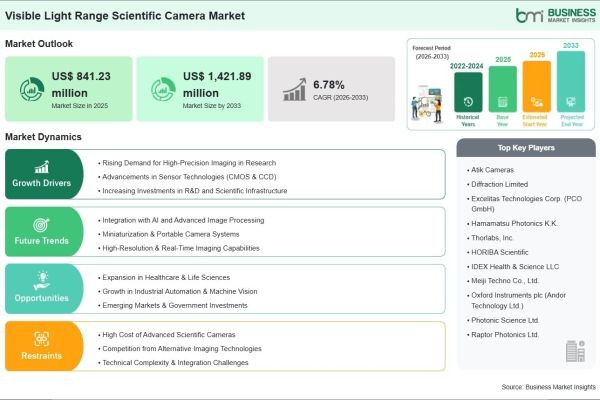
Based on market intelligence from Business Market Insights, the global Visible Light Range Scientific Camera Market [https://www.businessmarketinsights.com/reports/visible-light-range-scientific-camera-market] is anticipated to reach US$ 1,421.89 Million by 2033, mounting from its 2025 value of US$ 841.23 Million at a projected CAGR of 6.78% from 2026 to 2033.
Technological advancement is continuously shaping the industry landscape, with major sensor manufacturers focusing on smart scientific cameras that integrate on-chip AI for real-time feature extraction and autonomous anomaly detection. Innovations in back-thinned sensor architectures and deep-cooling mechanisms are achieving superior quantum efficiency for ultra-low light imaging. Strategic investments in research and development are accelerating the deployment of these next-generation sensors across astronomy, semiconductor metrology, and genomics research facilities globally.
Download Sample Report : https://www.businessmarketinsights.com/sample/BMIPUB00034607
What Are Visible Light Range Scientific Cameras?
Visible light range scientific cameras refer to high-precision imaging instruments engineered to capture and quantify photons specifically within the 400 nm to 700 nm spectral band. Unlike standard consumer-grade sensors, these cameras are built for quantitative accuracy and analytical rigor.
These highly specialized instruments are fundamental to demanding applications where single-photon detection, ultra-low noise, and high dynamic range are critical. They serve as the core optical engines for advanced microscopy, spectroscopy, space-based observation, and automated optical inspection systems utilized in semiconductor manufacturing.
Market Drivers
A primary driver of the Visible Light Range Scientific Camera Market is the rapid digitalization of microscopy and the rising institutional demand for precision imaging in life sciences. Techniques such as live-cell imaging, super-resolution microscopy, and fluorescence imaging require cameras that deliver superior sensitivity and dynamic range to study complex biological samples without causing phototoxicity.
The expansion of the semiconductor and electronics manufacturing sectors acts as another major catalyst. There is a surging demand for sub-nanometer precision optical overlay metrology and defect detection to support the production of the next generation of AI chips and microprocessors, fueling the adoption of high-speed, high-resolution scientific cameras.
Furthermore, emerging cross-disciplinary applications are accelerating market growth. The integration of artificial intelligence and IoT connectivity enables automated image analysis and real-time data sharing, opening lucrative opportunities in environmental monitoring, aerospace, and telemedicine diagnostics.
Market Segmentation
By Type
- sCMOS (Scientific CMOS): The fastest-growing subsegment, indispensable for high-speed imaging with ultra-low noise, widely adopted in life sciences, astronomy, and materials research.
- CCD (Charge-Coupled Device): Essential for applications requiring high sensitivity and precision, particularly favored in traditional spectroscopy and specific fluorescence imaging tasks.
- EMCCD (Electron Multiplying CCD): The premium standard for ultra-low light imaging, enabling researchers to capture faint signals and single-photon events in single-molecule studies and astrophysics.
By Camera Resolution
- Less than 4 MP: Typically utilized in high-speed applications where frame rate is prioritized over extreme spatial resolution.
- 4 MP to 5 MP: Represents a standard balance of resolution, speed, and data management for general laboratory and industrial inspection workflows.
- 6 MP to 9 MP: Serving advanced microscopy and metrology requiring high spatial detail.
- More than 9 MP: High-end segment driven by the need to capture massive fields of view in astronomy, pathology, and flat-panel display inspection.
Regional Insights
- North America maintains a preeminent position within the global industry, characterized by a highly sophisticated research ecosystem and dense investments in the United States and Canada. Growth is supported by substantial federal funding for space exploration, life sciences, and the early adoption of back-thinned sCMOS technology.
- Europe holds a robust market share, driven by world-leading academic institutions, extensive pharmaceutical research hubs, and stringent quality control standards in automotive and aerospace manufacturing that rely on precise automated optical inspection.
- Asia-Pacific represents a rapidly expanding market, fueled by massive infrastructure development, a booming semiconductor manufacturing industry (particularly in China, Taiwan, and South Korea), and increasing governmental investments in scientific research and smart city initiatives.
- Middle East & Africa is experiencing reliable growth, propelled by regional investments in digital healthcare, university research infrastructure, and sustainable smart manufacturing.
- South & Central America is witnessing steady market expansion as regional laboratories modernize their diagnostic and analytical imaging capabilities.
Top Players in the Visible Light Range Scientific Camera Market
The competitive landscape features highly specialized photonics and optical equipment manufacturers dedicated to pushing the boundaries of sensor sensitivity and resolution.
- Hamamatsu Photonics K.K.
- Oxford Instruments plc (Andor Technology Ltd.)
- Excelitas Technologies Corp. (PCO GmbH)
- Thorlabs, Inc.
- HORIBA Scientific
- Teledyne Technologies (including Photometrics / Princeton Instruments)
- IDEX Health & Science LLC
- Atik Cameras
- Raptor Photonics Ltd.
- Meiji Techno Co., Ltd.
Technological Innovations
The transition toward deep-cooled, back-illuminated sCMOS architectures represents a critical technological leap in the scientific camera market. By physically thinning the silicon sensor and illuminating it from the back, manufacturers have dramatically increased quantum efficiency (often exceeding 95%), allowing the sensor to convert nearly every incoming photon into a measurable signal. This is revolutionary for low-light fluorescence microscopy, where exposing living cells to intense light causes fatal phototoxicity.
Additionally, addressing the severe data bottlenecks created by multi-megapixel sensors operating at hundreds of frames per second is a key area of innovation. Manufacturers are increasingly integrating Field Programmable Gate Arrays (FPGAs) directly into the camera heads. This enables real-time, on-the-fly image processing, noise reduction, and data compression before the signal even reaches the host computer, significantly reducing the strain on laboratory IT infrastructure.
Future Market Outlook
The future outlook for the Visible Light Range Scientific Camera Market is highly promising through 2033. As global research initiatives dig deeper into genomics, quantum physics, and nanotechnology, the demand for optical sensors capable of visualizing phenomena at the absolute physical limits of light will intensify.
Market leadership over the coming decade will belong to imaging developers capable of providing fully integrated solutions—combining ultra-sensitive hardware with sophisticated, AI-driven image analysis software to streamline complex workflows and accelerate the pace of scientific discovery.
Frequently Asked Questions (FAQs)
What is the projected size of the Visible Light Range Scientific Camera Market by 2033?
The global market is projected to reach US$ 1,421.89 Million by 2033, expanding from US$ 841.23 Million in 2025.
What is the CAGR for the Visible Light Range Scientific Camera Market?
The market is estimated to record a steady CAGR of 6.78% from 2026 to 2033.
Which camera type segment is critical for ultra-low light imaging?
The EMCCD (Electron Multiplying CCD) segment is the standard for ultra-low light imaging, specifically designed to multiply weak signals for single-molecule and astrophysics studies.
Which region is leading market growth?
North America maintains a preeminent position in the market due to its sophisticated research ecosystem, substantial federal funding for life sciences, and large-scale adoption of advanced imaging sensors.
What is the primary factor driving demand for these cameras?
Key drivers include the rapid digitalization of microscopy in life sciences, surging demand for sub-nanometer precision in semiconductor manufacturing, and the integration of AI for automated image analysis.
Browse More Reports:
technical enzymes market [https://www.businessmarketinsights.com/reports/technical-enzymes-market]
tension control market [https://www.businessmarketinsights.com/reports/tension-control-market]
test and measurement equipment market [https://www.businessmarketinsights.com/reports/test-and-measurement-equipment-market]
About Us
Business Market Insights is a market research platform that provides subscription service for industry and company reports. Our research team has extensive professional expertise in domains such as Electronics & Semiconductor; Aerospace & Defense; Automotive & Transportation; Energy & Power; Healthcare; Manufacturing & Construction; Food & Beverage; Chemicals & Materials; and others.
Contact Us
If you have any questions about this report or would like further information, please contact us:
Contact person: Ankit Mathur
Email: sales@businessmarketinsights.com
Phone: +16467917070






