
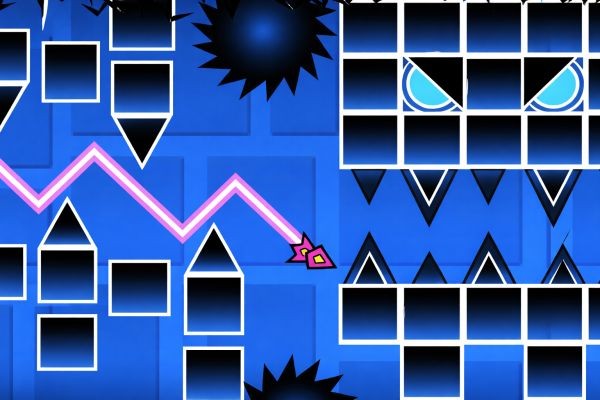
The “wave” mode in Geometry Dash is one of the most challenging and distinctive gameplay mechanics in the entire game, especially when it appears in harder custom or official levels. A level often referred to by players as “Bad 9 Easy” (likely a community nickname or shorthand for a specific easy-rated level with difficult wave sections) highlights an interesting contradiction in Geometry Dash: something labeled “easy” can still feel extremely difficult depending on the player’s skill set—especially when wave gameplay is involved.
To understand why the wave in such a level feels hard, even frustrating, it helps to first break down how the wave mechanic actually works. Unlike the cube, ship, or ball modes, the wave does not rely on gravity in the same way. Instead, it moves diagonally up and down in straight lines, forming a zigzag pattern. The player controls the direction by holding or releasing input: holding sends the wave upward diagonally, while releasing sends it downward. This creates a very fast, sharp movement style that requires precise timing and rhythm.
In theory, wave gameplay is simple. You only need one input. But in practice, it becomes one of the hardest modes because of how sensitive and unforgiving it is. Small mistakes—pressing too long or too briefly—can instantly cause failure. This is especially noticeable in tight corridors, which are common in many geometry dash levels that feature wave segments. Even in “easy” levels, a narrow passage can make the wave section feel like something from a much harder difficulty.
In a level like “Bad 9 Easy,” the challenge often comes from this mismatch between expectation and execution. Players go in expecting a relaxed experience, but suddenly encounter a wave section that demands sharp focus and quick reactions. This can feel unfair at first. However, it actually reflects a broader design pattern in Geometry Dash: difficulty is not always consistent across a level. A level might be easy overall but contain one or two tricky parts that raise its perceived difficulty.
Another reason the wave feels difficult is the speed. Wave sections are often paired with higher game speeds, which amplifies the challenge. At faster speeds, the zigzag motion becomes harder to control because everything happens more quickly. The player has less time to react, and muscle memory becomes more important than conscious decision-making. For newer players, this can feel overwhelming, especially if they are still learning how to control the wave smoothly.
There is also the issue of visual design. Many levels use decorations, flashing effects, or complex backgrounds that can make it harder to see the path clearly. In wave sections, where precision is everything, visual clarity is crucial. If the path is not easy to read, the difficulty increases significantly. In some “easy” levels, creators may unintentionally make the wave harder by adding too much visual clutter.
Despite these challenges, the wave is also one of the most rewarding mechanics to master. Once players become comfortable with it, they often find it enjoyable and satisfying. The key to improving is practice and consistency. Unlike some other modes, the wave relies heavily on rhythm and control. Players who develop a steady tapping pattern tend to perform better than those who react randomly.
One effective strategy is to practice in slower speeds or use practice mode frequently. By placing checkpoints before difficult wave sections, players can isolate the problem and improve more efficiently. Over time, what once felt impossible becomes manageable. This progression is a core part of the Geometry Dash experience.
Another helpful approach is to focus on staying calm. Many players fail wave sections not because they lack skill, but because they panic. The fast movement and tight spaces can create pressure, leading to overcorrection and mistakes. Learning to stay relaxed and maintain a steady rhythm can make a big difference.
It’s also worth noting that different players have different strengths. Some are naturally better at cube or ship sections, while others excel at wave. For someone who struggles with wave, a level like “Bad 9 Easy” might feel much harder than its rating suggests. This subjectivity is part of what makes Geometry Dash interesting: difficulty is not just about the level itself, but also about the player’s abilities.
In conclusion, the wave mechanic in Geometry Dash can make even “easy” levels feel challenging. Levels like “Bad 9 Easy” demonstrate how a single gameplay element can significantly impact the overall experience. While the wave may seem frustrating at first, it becomes more manageable with practice, patience, and the right mindset. Ultimately, mastering the wave is a rewarding achievement that enhances a player’s overall skill and enjoyment of the game.






