
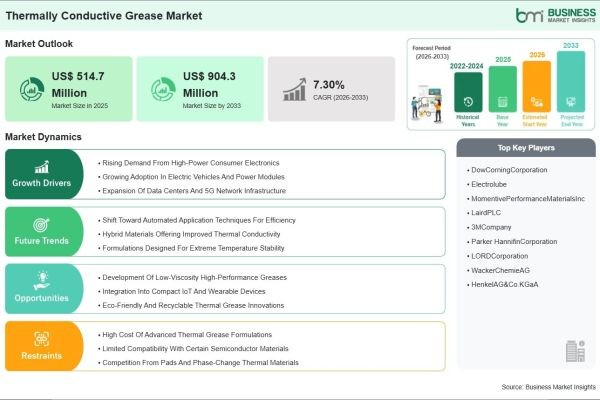
A profound operational scale-up is modernizing global electronics and computing pipelines, fueled by the critical technical necessity to deploy reliable thermal management solutions that can safely safeguard hyper-dense semiconductors, automated automotive systems, and expanding AI data centers.
Based on market intelligence from Business Market Insights, the global Thermally Conductive Grease Market is anticipated to reach US$ 904.3 million by 2033, mounting from its 2025 value of US$ 514.7 million at a projected CAGR of 7.30% from 2026 to 2033.
Recent breakthroughs in material science, particularly the integration of advanced ceramic and carbon-nanotube fillers into polymer matrices, are fundamentally altering the competitive dynamics of the market. Leading chemical and material science corporations are aggressively formulating non-reactive, long-life compounds that resist structural degradation, dry-out, and pump-out effects, meeting the stringent operational demands of enterprise servers, high-frequency 5G base stations, and aerospace systems.
Download Sample Report : https://www.businessmarketinsights.com/sample/BMIPUB00034516
What Is Thermally Conductive Grease?
Thermally conductive grease, commonly referred to as thermal paste, compound, or heat sink paste, is a highly viscous fluid substance formulated to enhance thermal coupling between heat-generating electronic components (such as CPUs, GPUs, and power transistors) and heat dissipation devices (such as heat sinks, cooling blocks, or liquid-cooling plates). While the mating surfaces of a microprocessor and a heat sink appear perfectly smooth to the naked eye, they contain microscopic air gaps and imperfections at a structural level. Since air is an exceptionally poor conductor of heat, these voids act as thermal barriers, leading to localized hot spots and rapid component degradation.
Thermally conductive grease is engineered to completely displace this trapped air, forming a continuous, low-resistance thermal bridge. The compound typically consists of a base oil fluid matrix—most commonly synthetic silicone or specialized hydrocarbons—heavily blended with high-density, micronized thermally conductive filler particles such as aluminum oxide, zinc oxide, boron nitride, or silver.
Market Drivers
The primary driver accelerating the Thermally Conductive Grease Market is the explosive global demand for hyperscale data centers and next-generation AI computing infrastructure. Modern machine learning accelerators and high-core-count enterprise processors generate intense thermal loads within highly compact server blades. Traditional cooling configurations are no longer sufficient to prevent thermal throttling. This has generated a massive demand for ultra-high-conductivity thermal greases capable of transferring heat efficiently to high-capacity liquid cooling setups.
Furthermore, the rapid transition toward electrification within the global automotive sector is acting as a powerful market catalyst. Modern Electric Vehicles (EVs) require advanced thermal management across their entire high-voltage powertrain, including battery management systems (BMS), onboard chargers, and power inverters. Thermally conductive greases are extensively applied during battery pack assembly to ensure uniform heat distribution across battery cells, preventing thermal runaway and maximizing battery life during ultra-fast charging cycles.
Additionally, the global deployment of 5G telecommunications equipment and advanced smart home infrastructure continues to propel market consumption. 5G macro stations and small cells utilize high-frequency millimeter-wave (mmWave) antennas and power amplifiers that generate significantly more heat than older 4G infrastructure. To ensure uninterrupted, weather-resistant outdoor operations, telecom OEMs rely heavily on high-durability thermal compounds to draw heat safely away from internal microchips.
Market Segmentation
By Base Type
- Silicone-Based Thermal Grease
- Non-Silicone Based Thermal Grease (Hydrocarbon, Synthetic Oils)
By Filler Material
- Ceramic-Filled (Aluminum Oxide, Zinc Oxide, Boron Nitride)
- Metal-Filled (Silver, Aluminum)
- Carbon / Graphite-Filled (Graphene, Carbon Nanotubes)
By End-User Industry
- Consumer Electronics & Home Appliances
- Automotive Electronics & EVs
- Telecommunications & IT Hardware
- Power Electronics & Industrial Systems
- LED Lighting Solutions
- Medical Devices & Aerospace
The Silicone-Based segment holds the largest portion of the global market share, highly favored for its exceptional thermal stability over broad temperature ranges (-50°C to over 200°C) and excellent cost-to-performance ratio. However, the Non-Silicone segment is projected to register the fastest growth rate due to its growing adoption in medical devices and optical infrastructure where silicone outgassing could cause severe component contamination. By end-user industry, Telecommunications & IT hardware currently accounts for the largest revenue stream, while Automotive Electronics is experiencing the fastest expansion rate.
Regional Insights
- Asia-Pacific commands the largest global market share and stands out as the core production and consumption hub. This dominance is driven by the unparalleled concentration of semiconductor foundries, consumer electronics assembly plants, and EV battery mega-factories in China, Taiwan, South Korea, Japan, and Vietnam. The region's aggressive push for domestic component manufacturing ensures a massive, recurring demand for bulk thermal materials.
- North America holds a highly mature, high-value market position. The region’s growth is fundamentally driven by a heavy concentration of hyperscale cloud service providers and pioneering AI hardware developers investing billions into high-performance computing centers. Rigorous defense, aerospace, and space exploration programs across the United States also contribute heavily to the demand for ultra-reliable, specialized military-grade thermal compounds.
- Europe maintains a critical market position characterized by its world-class automotive engineering sector. European environmental initiatives and strict fleet emission mandates are forcing massive investments in EV development across Germany, France, and Italy. This makes the region a highly lucrative market for automotive-certified, high-durability non-reactive thermal greases.
- Middle East & Africa and South America are witnessing steady, incremental growth. This expansion is tightly linked to state-level smart city initiatives, regional data center construction, and the gradual modernization of national telecommunication grids.
Top Players in the Thermally Conductive Grease Industry
The competitive landscape is characterized by a mix of massive global chemical giants and highly specialized electronic material converters. Leading organizations focus heavily on material purity, precise filler blending ratios, and expanding global delivery channels to match the rapid inventory cycles of electronics OEMs.
- Dow Inc.
- Henkel AG & Co. KGaA
- 3M Company
- Parker Hannifin Corporation (Chomerics Division)
- Wacker Chemie AG
- Shin-Etsu Chemical Co., Ltd.
- DuPont (Laird Performance Materials)
- Momentive Performance Materials Inc.
- Electrolube (MacDermid Alpha Electronics Solutions)
- Honeywell International Inc.
- AOS Thermal Compounds LLC
To retain and capture market share, these tier-one providers are continuously investing in chemical processing infrastructure to produce low-volatility formulations that minimize volatile organic compounds (VOCs) and offer advanced automated dispensing compatibility for high-speed manufacturing lines.
Technological Innovations
Technological innovations in Non-Silicone, Zero Pump-Out Formulations are solving a long-standing point of failure in modern high-power electronics. Traditional silicone thermal greases are prone to "pump-out"—a phenomenon where repeated thermal expansion and contraction cycles of the processor cause the grease to slowly migrate out of the interface gap, causing premature dry-out and failure. Next-generation hydrocarbon and synthetic polyol matrices are engineered to cross-link or maintain perfect physical cohesion during extreme thermal cycling, ensuring the grease remains locked in place for decades.
Furthermore, the integration of Nanomaterial Filler Matrixing is expanding the performance boundaries of thermal pastes. Chemical engineers are now utilizing customized multi-walled carbon nanotubes (MWCNTs) and monolayer graphene sheets as filler agents. These nanomaterials feature intrinsic thermal conductivities that are multiple times higher than standard metal oxides. When blended optimally, they allow manufacturers to produce ultra-high-conductivity greases exceeding 10 W/mK without increasing the physical thickness of the bond line, a critical breakthrough for next-generation computing architectures.
Future Market Outlook
The long-term outlook for the Thermally Conductive Grease Market is exceptionally positive, entirely intertwined with the broader global trends of hyper-automation, deep cloud computing reliance, and smart grid infrastructure. As processing chips move toward sub-2nm nodes and 3D stacked chip designs become standard, localized heat flux densities will continue to escalate exponentially.
Moving forward, the industry will see an intense focus on bio-degradable or circular-ready chemical compositions. As electronic device manufacturers face intense regulatory and consumer pressure to adopt greener manufacturing chains, thermal compound producers who successfully integrate bio-based synthetic oils or easily recyclable polymer bases while maintaining absolute high-frequency stability will dominate premium contract material streams over the next decade.
Frequently Asked Questions (FAQs)
What is the main function of thermally conductive grease?
Its primary function is to eliminate microscopic air gaps between a heat-generating component (like a CPU) and a cooling solution (like a heat sink). Since air is an incredibly poor conductor of heat, the grease fills these structural voids to form a highly efficient thermal interface that accelerates heat transfer.
What is the difference between silicone and non-silicone thermal grease?
Silicone-based greases offer excellent flexibility, cost efficiency, and performance over broad temperature ranges, but they can outgas or pump out over long operational periods. Non-silicone greases use synthetic hydrocarbon bases, eliminating the risk of silicone oil bleeding or evaporating, making them ideal for high-vulnerability environments like data center optics and medical hardware.
Does higher filler content make thermal grease better?
Not necessarily. While a higher volume of conductive fillers (like aluminum or ceramic particles) increases raw thermal conductivity, adding too much filler makes the paste dry, brittle, and difficult to spread. The most effective greases find a precise chemical balance, providing optimal conductivity while maintaining a smooth texture to achieve the thinnest possible bond line.
Can thermal grease conduct electricity?
Most standard thermal greases are formulated with ceramic or metal-oxide fillers (such as zinc oxide or boron nitride), making them electrically insulating (non-conductive) and safe if they accidentally spill onto surrounding circuit traces. However, specialized greases filled with pure silver, copper, or liquid metal composites are electrically conductive and require highly precise application to avoid short circuits.
Browse More Reports:
https://www.businessmarketinsights.com/reports/transparent-plastics-market
https://www.businessmarketinsights.com/reports/tunnel-automation-market
https://www.businessmarketinsights.com/reports/ultra-high-strength-steel-market
About Us
Business Market Insights is a market research platform that provides a comprehensive subscription service for targeted industry and company intelligence reports. Our research team has extensive professional expertise across dynamic industrial domains such as Electronics & Semiconductor; Aerospace & Defense; Automotive & Transportation; Energy & Power; Healthcare; Manufacturing & Construction; Food & Beverages; Chemicals & Materials; and Technology, Media, & Telecommunications.
Contact Us
If you have any questions about this report or would like further information, please contact us:
Contact person: Ankit Mathur
Email: sales@businessmarketinsights.com
Phone: +16467917070






