
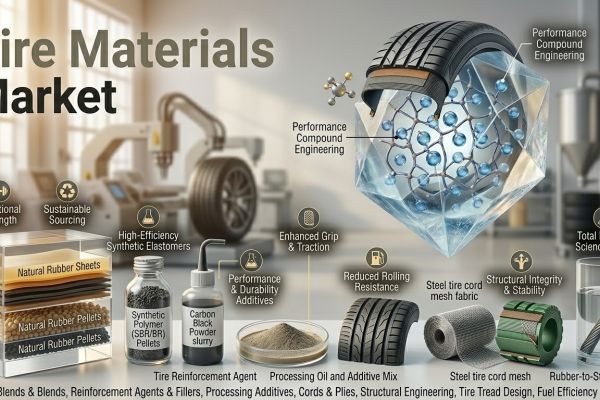
The global tire materials market [https://www.futuremarketinsights.com/reports/tire-materials-market] is set for consistent growth, with its valuation projected to rise from USD 86.44 billion in 2025 to USD 127.9 billion by 2035, registering a CAGR of 4.0% over the forecast period. Market expansion is driven by increasing demand for high-performance tires, rising automotive production, and continuous innovation in sustainable and advanced tire materials.
Tire materials—including natural rubber, synthetic rubber, fillers, and reinforcing chemicals—play a critical role in enhancing durability, fuel efficiency, and safety. Their application across passenger vehicles, commercial fleets, and off-highway equipment underscores their importance in modern mobility and transportation ecosystems.
Automotive Expansion and Sustainability Drive Market Growth
The tire materials market is closely aligned with global trends such as urbanization, electrification of mobility, and sustainability initiatives. Key growth drivers include:
- Rising global vehicle parc and increasing automotive production
• High tire replacement rates due to wear and tear across vehicle segments
• Growing demand for fuel-efficient and low rolling resistance tires
• Expansion of electric vehicle (EV) production requiring advanced materials
Natural rubber remains a dominant material segment, valued for its durability, abrasion resistance, and fatigue strength. Its renewable sourcing also supports sustainability goals, making it a preferred choice in green tire development.
Pneumatic tires account for the largest share of the market, driven by their superior shock absorption, ride comfort, and versatility across passenger and commercial applications.
Get detailed market forecasts, competitive benchmarking, and pricing trends: https://www.futuremarketinsights.com/reports/sample/rep-gb-9242
Key Trends Shaping the Competitive Landscape
As the market evolves, manufacturers are focusing on innovation, performance enhancement, and environmental compliance. Key trends include:
- Development of alternative natural rubber sources such as guayule and dandelion
• Increasing adoption of silica-based fillers to reduce rolling resistance and emissions
• Rising focus on recyclable and eco-friendly tire materials
• Growing R&D investments in high-performance compounds for EVs and heavy-duty vehicles
Regulatory developments—such as tire labeling standards and emission norms—are also pushing manufacturers to adopt advanced materials that enhance fuel efficiency and reduce environmental impact.
Regional Insights: Asia-Pacific at the Core of Growth
Asia-Pacific remains the fastest-growing region in the tire materials market, supported by strong automotive manufacturing and infrastructure development:
- China leads with large-scale automotive production and industrial expansion
• India emerges as a high-growth market driven by urbanization and rising vehicle ownership
• Regional growth is supported by increasing demand for passenger and commercial vehicles
Meanwhile:
• North America, led by the United States, benefits from a large vehicle fleet and strong aftermarket demand
• Europe focuses on sustainable tire materials and regulatory compliance, particularly in performance labeling and emissions reduction
Competitive Landscape: Innovation and Scale Define Leadership
The tire materials market is moderately consolidated, with leading players focusing on technological advancement, sustainability, and global expansion. Key companies include:
Bekaert, Birla Carbon, Cabot Corporation, Evonik Industries AG, Exxon Mobil Corporation, JSR Corporation, Kuraray Co., Ltd., Lanxess, PetroChina Company Limited, Solvay SA
These companies are strengthening their market positions through:
- Development of advanced and sustainable tire material solutions
• Strategic partnerships with tire manufacturers
• Expansion of production capacity and global footprint
• Investment in recycling and eco-friendly technologies
The ability to balance performance, cost efficiency, and environmental compliance is becoming a key competitive differentiator.
Analyst Outlook: A Market Driven by Performance and Sustainability
Industry analysts highlight that tire materials will remain central to the evolution of the automotive and mobility sectors.
“Tire materials are at the core of automotive performance and efficiency. As sustainability and electrification reshape the industry, demand for advanced, durable, and eco-friendly materials will continue to rise,” noted a senior industry analyst.
Future Opportunities: Expanding Role Across Mobility Ecosystems
Looking ahead, the tire materials market is expected to unlock new growth opportunities across:
- High-performance and green tires for passenger and commercial vehicles
• Electric vehicle-specific tire materials and compounds
• Sustainable and recyclable material innovations
• Off-highway and industrial vehicle applications
As global mobility demand rises and sustainability becomes a priority, tire materials will continue to play a crucial role in shaping the future of transportation and industrial performance.
Request Sample Report with Complete Market Breakdowns and Growth Estimates: https://www.futuremarketinsights.com/reports/tire-materials-market
Have a specific Requirements and Need Assistant on Report Pricing or Limited Budget please contact us – sales@futuremarketinsights.com
About Future Market Insights (FMI)
Future Market Insights, Inc. (FMI) is an ESOMAR-certified, ISO 9001:2015 market research and consulting organization, trusted by Fortune 500 clients and global enterprises. With operations in the U.S., UK, India, and Dubai, FMI provides data-backed insights and strategic intelligence across 30+ industries and 1200 markets worldwide.
Why Choose FMI: https://www.futuremarketinsights.com/why-fmi






