
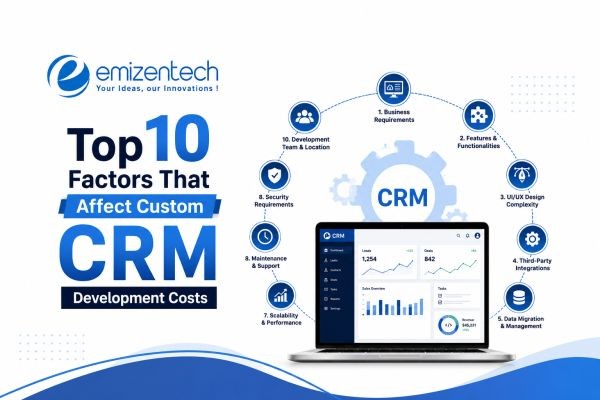
Every business has its own way of managing customers, sales, support, and internal workflows. While some organizations can rely on ready-made customer relationship management software, others require a custom solution designed around their specific operations. A custom CRM offers greater flexibility, improved automation, and better integration with existing business systems. However, one question always comes first: how much will it cost?
The answer is not straightforward because CRM development costs depend on several technical and business factors. Project size, feature requirements, integrations, design complexity, security needs, and future scalability all influence the final budget. Understanding these factors helps businesses make informed decisions, plan realistic budgets, and avoid unexpected development expenses.
Why Custom CRM Development Costs Differ for Every Business?
No two CRM projects are exactly alike. A small business may only need customer records and sales tracking, while a large enterprise may require automation, AI-powered analytics, third-party integrations, and role-based access for hundreds of users. The overall investment depends on what the system needs to accomplish rather than a fixed price. Businesses that carefully define their requirements before working with a CRM Development Company often gain a clearer understanding of project timelines, priorities, and expected development costs.
1. Business Requirements and Project Scope
The scope of a CRM project is one of the biggest factors affecting development costs. A system designed for a startup differs significantly from one built for a multinational company managing multiple departments and thousands of customers.
A detailed project scope includes business goals, user roles, workflows, reporting requirements, and future expansion plans. The more comprehensive the scope, the more planning, development, and testing are required.
Some common cost-driving elements include:
- Number of user roles and permission levels
- Sales, marketing, and customer support workflows
- Custom dashboards and reporting needs
- Multi-location or multi-branch management
- Future scalability for business growth
For example, a manufacturing company may require inventory tracking within the CRM, while a healthcare organization might prioritize appointment scheduling and patient communication.
2. CRM Features and Functionalities
Features directly determine the amount of development work involved. Basic CRM systems require fewer development hours than platforms containing advanced automation and analytics.
Businesses often begin with essential modules before gradually expanding functionality. Working with an experienced CRM Development Company during feature planning helps prioritize business-critical capabilities before adding advanced tools.
Common CRM features include:
- Customer and contact management
- Lead and opportunity tracking
- Sales pipeline management
- Marketing campaign management
- Customer support ticketing
- Workflow automation
- Email and SMS notifications
- Reporting dashboards
- AI-powered recommendations
- Predictive sales forecasting
For example, an eCommerce business may need abandoned cart tracking, while a real estate agency may require property inquiry management within the CRM.
3. UI/UX Design Complexity
User experience plays an important role in CRM adoption. Even the most feature-rich CRM may not be effective if employees find it difficult to navigate.
Simple layouts generally require less development effort, while customized dashboards, interactive reports, drag-and-drop functionality, and personalized user experiences increase design and frontend development costs.
Important design considerations include:
- Responsive interface for mobile and desktop devices
- Easy navigation across modules
- Personalized dashboards for different departments
- Interactive charts and reporting
- Accessibility for different user groups
For instance, sales managers often need performance dashboards, while customer support teams focus on ticket queues and communication history.
4. Third-Party Integrations
Modern businesses rarely operate using a single software platform. CRM systems often exchange information with accounting software, marketing tools, communication platforms, payment gateways, and enterprise resource planning systems.
Every additional integration requires API development, testing, data synchronization, and ongoing maintenance.
Typical CRM integrations include:
- ERP systems
- Accounting software
- Email platforms
- Payment gateways
- Video conferencing tools
- Customer support software
- Marketing automation platforms
- Inventory management systems
A retail business, for example, may connect its CRM with inventory software so sales representatives always have updated stock information while assisting customers.
5. Technology Stack Selection
The technologies selected for CRM development influence both development time and long-term maintenance costs. Programming languages, frameworks, databases, hosting infrastructure, and cloud services all contribute to the project's overall budget.
An experienced CRM Development Company typically recommends technologies that balance performance, scalability, security, and future maintenance requirements instead of focusing only on initial development costs.
Technology choices usually include:
- Frontend frameworks for responsive interfaces
- Backend programming languages
- Database management systems
- Cloud hosting platforms
- API architecture
- Security frameworks
Selecting scalable technologies from the beginning often reduces redevelopment expenses as the business grows.
6. Development Team Size and Location
Development costs also vary depending on the size, experience, and geographic location of the development team.
Larger projects typically involve multiple specialists, including:
- Business analysts
- UI/UX designers
- Frontend developers
- Backend developers
- QA engineers
- DevOps specialists
- Project managers
Development rates differ across countries because of regional labor costs and market demand. However, selecting a team based only on hourly pricing may not always reduce the overall project cost if additional revisions or delays occur.
7. Security and Compliance Requirements
CRM systems store valuable customer information, making security an essential part of development rather than an optional feature.
Industries such as healthcare, finance, and insurance often have strict compliance requirements that increase development complexity.
Important security measures include:
- Data encryption
- Multi-factor authentication
- Secure login management
- Role-based access control
- Regular security audits
- Backup and disaster recovery
- Compliance with industry regulations
For example, financial institutions often require detailed activity logs and strict user permissions to protect sensitive customer information.
8. Customization and Integration with Existing Systems
Many businesses already use legacy software that cannot be replaced immediately. Instead, the new CRM must work alongside existing systems while ensuring accurate data synchronization.
This process often requires custom APIs, data migration, and workflow mapping. Businesses partnering with a CRM Development Company usually invest additional effort in ensuring that existing business operations continue without disruption during implementation.
Customization may include:
- Legacy software integration
- Data migration
- Custom API development
- Workflow mapping
- Department-specific modules
- Automated synchronization
For example, a logistics company may integrate shipment tracking software directly into its CRM to provide customer service teams with real-time delivery updates.
9. Testing and Quality Assurance
Testing ensures the CRM performs reliably before deployment. Skipping this stage can lead to software bugs, security issues, and poor user experience that become more expensive to fix later.
Quality assurance generally covers multiple testing activities, including:
- Functional testing
- Performance testing
- Security testing
- Compatibility testing
- User acceptance testing
- Regression testing
For instance, testing helps verify that automated workflows trigger correctly, customer information remains secure, and reports display accurate business data under different usage conditions.
10. Maintenance and Future Enhancements
CRM development does not end after deployment. Businesses regularly update their software to improve performance, address security concerns, and introduce new features as operational requirements evolve.
Long-term maintenance commonly includes:
- Bug fixes
- Software updates
- Performance optimization
- Security patches
- Database maintenance
- Feature improvements
- Technical monitoring
Organizations that plan ongoing maintenance from the beginning often experience fewer operational disruptions and better long-term software performance.
Typical Cost Breakdown of Custom CRM Development
A custom CRM project consists of several development stages, each contributing to the overall investment. Proper planning across every phase helps businesses allocate budgets efficiently while maintaining quality, security, scalability, and long-term system reliability.
1. Planning and Requirement Analysis
This phase focuses on understanding business objectives, identifying workflows, documenting functional requirements, defining user roles, estimating timelines, evaluating risks, and creating a structured development roadmap before technical work begins.
2. UI/UX Design
Designers create wireframes, user journeys, interactive prototypes, responsive layouts, dashboard structures, and navigation systems that improve usability while ensuring employees can efficiently perform daily tasks across multiple devices.
3. Development
Developers build the frontend interface, backend architecture, databases, APIs, automation workflows, reporting modules, integrations, and security features while following coding standards that support future scalability and maintenance.
4. Testing and Deployment
Quality assurance teams validate system functionality, performance, compatibility, security, and usability before deploying the CRM into the production environment with minimal disruption to daily business operations.
5. Maintenance and Continuous Improvement
After deployment, businesses invest in monitoring, software updates, feature enhancements, security improvements, bug fixes, performance optimization, and compatibility updates to keep the CRM reliable and aligned with changing requirements.
Conclusion
Custom CRM development costs depend on much more than the number of features included in the final product. Business requirements, technology choices, integrations, security, testing, customization, and long-term maintenance all contribute to the overall investment. Understanding these factors helps organizations set realistic expectations, prioritize requirements, and make informed decisions throughout the development process. Businesses evaluating their options can use these considerations as a practical framework before selecting a technology partner such as EmizenTech for their CRM development journey.
FAQs
Q1. What affects custom CRM development costs the most?
Project scope, features, integrations, design, and security requirements have the biggest impact on development costs.
Q2. Can a custom CRM be expanded later?
Yes. Most custom CRMs are designed to support future features, users, and business growth.
Q3. Do third-party integrations increase CRM costs?
Yes. Connecting the CRM with external software requires additional development and testing.
Q4. Why is testing important in CRM development?
Testing helps identify bugs, improve performance, and ensure the CRM works reliably before deployment.






