
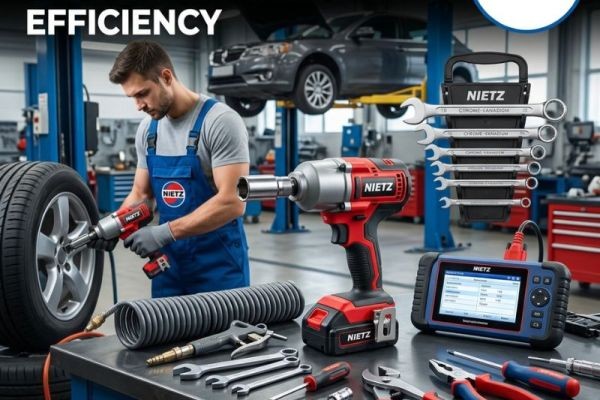
The right mechanic tools [https://nietz.com.my/product-category/hand-tools/mechanic-tools/] reduce repair time, improve torque accuracy, and help technicians work with greater consistency. A well-equipped workshop with quality hand tools — including socket sets, ratchets, and torque wrenches — can cut average job completion time by up to 30%, directly affecting throughput and customer satisfaction.
Why Tool Quality Directly Affects Workshop Output
Workshop managers in Malaysia often underestimate how much time is lost to inadequate tooling. A technician searching for the right socket, dealing with a slipping ratchet, or re-doing a fastener because of inaccurate torque application — each of these moments compounds into significant daily downtime.
According to the Department of Skills Development (JPK) Malaysia, skilled technicians are expected to demonstrate proficiency with calibrated hand tools as part of the National Occupational Skills Standard (NOSS). This means tool quality is not just a productivity issue — it is tied directly to compliance and workmanship standards.
Top 10 Mechanic Tools for a More Efficient Workshop
1. Socket Wrench Set
A complete socket wrench set is the backbone of any mechanical workshop. Look for sets that include both metric and imperial sizes, deep sockets, and magnetic extensions. A full-range set eliminates the need to stop mid-job to source a missing size — a common but avoidable interruption.
For workshops handling mixed vehicle brands, a set covering 8mm to 32mm metric and ¼" to 1½" imperial offers the broadest coverage without duplication.
2. Torque Wrench
Overtightening or undertightening fasteners is one of the top causes of repeat repairs. A calibrated torque wrench gives technicians precise control over fastener tension, which is especially critical for cylinder head bolts, wheel lug nuts, and suspension components.
Digital torque wrenches now offer audible and visual alerts when target torque is reached, reducing human error. For high-volume workshops, having dedicated torque wrenches for specific torque ranges (e.g., 5–25 Nm and 40–200 Nm) speeds up workflow significantly.
3. Ratchet Tools
A high-quality ratchet with a fine-tooth mechanism (72 teeth or more) allows operation in tight engine bays where swing arc is limited. Flex-head ratchets add another dimension — technicians can change angles without repositioning, saving several minutes per job.
Ratchet tools with ergonomic handles also reduce hand fatigue during extended use, which matters in a busy workshop handling 10 to 15 vehicles per day.
4. Combination Spanner Set
A combination spanner set — open-ended on one side, ring on the other — handles fasteners in areas where sockets cannot reach. Ratcheting combination spanners are especially useful, allowing directional tightening without removing the tool from the bolt head.
5. Breaker Bar
Seized bolts and corroded fasteners are a daily reality in Malaysian workshops, especially for vehicles exposed to humidity and salt-laden air. A long-handled breaker bar provides the leverage needed to break these loose without resorting to improvised methods that risk damaging the fastener or the technician.
6. Impact Wrench (Pneumatic or Electric)
For tyre changes and suspension work, an impact wrench dramatically reduces job time. A pneumatic impact wrench connected to a workshop air compressor can remove a full set of lug nuts in under 30 seconds. Cordless electric models offer mobility for workshops without centralised air supply.
7. Screwdriver Set (including Torx and Hex)
Modern vehicles use a range of fastener types beyond Phillips and flat-head. A professional screwdriver set including Torx, hex (Allen), and JIS variants covers the full range found in Japanese, European, and Korean vehicles — all common on Malaysian roads.
8. Pry Bar and Panel Removal Set
Trim and panel removal without scratching is a skill — but having the right plastic pry bars and trim tools makes it far easier. These tools protect both the vehicle and the technician's reputation. A dedicated panel removal set pays for itself after a single avoided repair claim.
9. Pliers Set (Needle-Nose, Locking, Circlip)
A well-rounded pliers set covers gripping, clamping, and circlip installation in tight spaces. Locking pliers (commonly known as Mole grips) are particularly valuable for holding components during assembly. Circlip pliers — both internal and external — are essential for gearbox and axle work.
10. Magnetic Parts Tray and Tool Organiser
This may seem minor, but tool organisation directly impacts efficiency. A magnetic parts tray prevents small fasteners from rolling away or getting mixed up. Foam tool organisers in drawers allow technicians to identify missing tools at a glance — important at shift changeover or during multi-technician jobs.
How to Evaluate Tool Quality Before You Buy
Not all tools are made equal. Workshop managers should assess the following before investing in new tooling:
- Material grade: Look for chrome vanadium steel (Cr-V) for hand tools and chrome molybdenum (Cr-Mo) for impact sockets.
- Finish quality: Polished chrome finish resists corrosion — important given Malaysia's humidity levels.
- Calibration certification: Torque wrenches should come with a calibration certificate, especially for workshops servicing commercial vehicles.
- Warranty terms: Professional-grade tools typically carry longer warranties. A lifetime warranty on hand tools is a strong signal of manufacturer confidence.
- Ergonomics: Handles should reduce grip fatigue. Look for bi-material grips and balanced weight distribution.
Building a Tiered Tool Investment Strategy
Not every tool needs to be top-of-the-range. A practical approach for workshop managers is to tier investments:
|
Tier |
Tool Category |
Investment Priority
|
|---|---|---|
|
High |
Torque wrenches, impact tools, socket sets |
Buy professional grade — accuracy and durability matter |
|
Medium |
Combination spanners, pliers, screwdrivers |
Mid-range chrome vanadium sets perform well |
|
Low |
Parts trays, organisers, panel tools |
Functional options work — focus on organisation |
This approach ensures your highest-use and accuracy-critical tools receive the investment they deserve, without overspending across the board.
Common Tooling Mistakes Workshop Managers Make
- Using adjustable wrenches as a substitute for proper spanners — this rounds fasteners and slows repairs.
- Ignoring torque wrench calibration schedules. Most manufacturers recommend recalibration every 5,000 cycles or annually.
- Buying undersized socket sets — missing sizes slow down every technician on the floor.
- Not replacing worn ratchets — a skipping ratchet mechanism is both a safety hazard and a time waster.
Where to Source Professional Mechanic Tools in Malaysia
For workshop managers looking to upgrade or expand their toolkit, sourcing from a specialist supplier ensures you get tools designed for professional use, not consumer-grade products repackaged for trade. Nietz offers a focused range of hand tools and mechanic tools suited for Malaysian workshops, with options across categories covered in this list. Browse the full range at Nietz [https://nietz.com.my] to find tools matched to your workshop's specific requirements.
FAQ
What are the most essential mechanic tools for a professional workshop?
The most essential tools include a socket wrench set, calibrated torque wrench, ratchet set, combination spanners, and an impact wrench. These cover the majority of fastener-related tasks in daily vehicle servicing and repair work, forming the core of any efficient, professional-grade workshop toolkit.
How often should a torque wrench be recalibrated?
Most manufacturers recommend recalibrating a torque wrench every 5,000 cycles or at least once per year, whichever comes first. Workshops servicing commercial vehicles or high volumes should calibrate more frequently to maintain accuracy and comply with workmanship standards under Malaysia's NOSS framework.
What is the difference between a breaker bar and a ratchet?
A breaker bar has no ratcheting mechanism — it is designed purely for applying maximum leverage to loosen seized fasteners. A ratchet allows directional tightening and loosening without removing the tool. Use a breaker bar to break a fastener free, then switch to a ratchet for speed.
Why do workshop managers need dedicated ratchet tools instead of standard wrenches?
Ratchet tools allow continuous rotation in one direction without repositioning, saving significant time on multi-fastener jobs. In confined engine bays, a flex-head ratchet operates where a standard wrench cannot. For workshops handling high daily vehicle volumes, the time savings across a full working day are measurable and consistent.
What steel grade should professional mechanic hand tools be made from?
Chrome vanadium steel (Cr-V) is the standard for professional hand tools due to its strength, toughness, and corrosion resistance. For impact sockets used with pneumatic or electric wrenches, chrome molybdenum (Cr-Mo) is preferred as it absorbs the high-impact forces without cracking or shattering under load.
How can workshop managers reduce tool-related downtime?
Invest in complete socket sets to eliminate missing-size delays, use foam tool organisers for fast visual inventory checks, and establish a regular maintenance schedule for ratchets and torque wrenches. Assigning dedicated tool sets per bay or technician also reduces time lost to shared tool searches during peak hours.






