
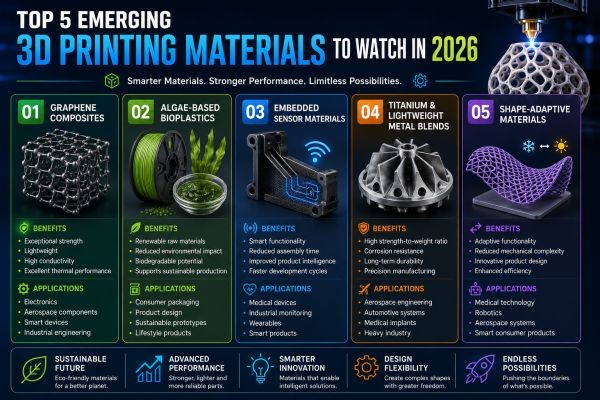
The world of 3D printing is changing rapidly, and material innovation is becoming the biggest driver of progress. In 2026, additive manufacturing is no longer limited to producing simple prototypes. Businesses are now using advanced materials to create stronger products, improve sustainability, and integrate smarter functionality directly into manufacturing.
As industries continue pushing the limits of design and performance, these five emerging 3D printing materials are expected to stand out.
1. Graphene Composite Materials
Graphene composites are attracting attention because of their remarkable combination of strength, conductivity, and lightweight performance. By adding graphene to printable materials, manufacturers can improve both mechanical and electrical properties.
Benefits
- Exceptional strength
- Lightweight design
- Improved conductivity
- Better thermal performance
Applications
- Electronics
- Aerospace components
- Smart devices
- Industrial engineering
Graphene materials are increasingly viewed as a breakthrough for advanced manufacturing applications.
2. Algae-Based Bioplastics
Sustainability continues shaping manufacturing trends, and algae-based bioplastics are emerging as an environmentally responsible alternative to traditional materials.
Derived from renewable biological sources, these materials support greener production while reducing reliance on fossil-based plastics.
Benefits
- Renewable raw materials
- Reduced environmental impact
- Biodegradable potential
- Sustainable production support
Applications
- Consumer packaging
- Product design
- Sustainable prototypes
- Lifestyle products
Businesses focused on environmental responsibility are paying close attention to bio-based materials.
Companies like Struxis recognize that sustainable innovation and advanced manufacturing must work together to support long-term industry growth.
3. Embedded Sensor Materials
3D printing is increasingly moving toward intelligent manufacturing, and embedded sensor materials are helping make that possible.
These materials allow products to monitor conditions such as pressure, movement, or temperature without requiring separate sensor installation.
Benefits
- Smart functionality
- Reduced assembly time
- Improved product intelligence
- Faster development cycles
Applications
- Medical devices
- Industrial monitoring
- Wearables
- Smart products
As connected systems become more common, sensor-enabled materials are expected to grow rapidly.
4. Titanium and Lightweight Metal Blends
Metal additive manufacturing is advancing with lighter and stronger alloy combinations that provide improved efficiency and durability.
Titanium and specialty metal blends are increasingly being used for high-performance applications requiring strength without excessive weight.
Benefits
- High strength-to-weight ratio
- Corrosion resistance
- Long-term durability
- Precision manufacturing
Applications
- Aerospace engineering
- Automotive systems
- Medical implants
- Heavy industry
Lightweight metal materials continue pushing 3D printing toward production-scale manufacturing.
5. Shape-Adaptive Materials
Shape-adaptive materials represent an exciting area of innovation often associated with smart manufacturing. These materials can respond to environmental conditions and alter their shape or performance after printing.
Benefits
- Adaptive functionality
- Reduced mechanical complexity
- Innovative product design
- Enhanced efficiency
Applications
- Medical technology
- Robotics
- Aerospace systems
- Smart consumer products
Shape-adaptive materials are opening the door to products that actively respond to their surroundings.
The Future of Additive Manufacturing
The next phase of 3D printing growth will depend heavily on advanced materials that offer more than simple structural capability. Manufacturers are increasingly seeking materials that support sustainability, smart functionality, and high-performance engineering.
Understanding these evolving options requires practical expertise. Forge Labs continues helping businesses explore additive manufacturing by supporting informed material selection and scalable production solutions tailored to modern industry demands.
In 2026, emerging materials will continue transforming 3D printing from a manufacturing tool into a platform for innovation.






