
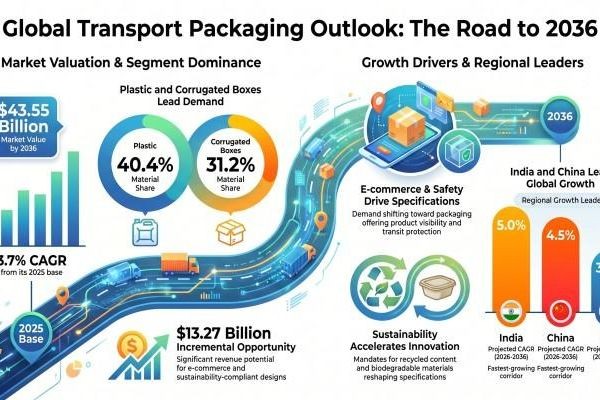
The global transport packaging market is entering a transformative growth cycle as industries increasingly prioritize sustainable logistics, regulatory compliance, and e-commerce-ready packaging solutions. Valued at USD 29.2 billion in 2025, the market is projected to reach USD 30.3 billion in 2026 and further expand to USD 43.5 billion by 2036, registering a CAGR of 3.7% during the forecast period.
As global trade networks become more interconnected and digital commerce accelerates worldwide, transport packaging is evolving from a basic shipping requirement into a strategic component of supply chain optimization. Businesses are increasingly investing in recyclable, lightweight, and performance-driven packaging systems designed to enhance product protection, reduce logistics costs, improve operational efficiency, and support corporate sustainability objectives.
Get detailed market forecasts, pricing analysis, and competitive intelligence:
https://www.futuremarketinsights.com/reports/sample/rep-gb-4482
Quick Insights: Transport Packaging Market
- Market Value (2025): USD 29.2 Billion
- Estimated Market Value (2026): USD 30.3 Billion
- Forecast Market Value (2036): USD 43.5 Billion
- CAGR (2026–2036): 3.7%
- Leading Growth Markets: India (5.0%), China (4.5%), Canada (3.6%)
Sustainability and E-Commerce Accelerate Market Expansion
The transport packaging industry is witnessing significant transformation as companies seek packaging formats that combine durability, sustainability, and logistics efficiency. Rapid growth in e-commerce, retail distribution, and omnichannel supply chains is driving demand for protective and lightweight packaging solutions capable of minimizing product damage during transit.
Organizations are increasingly emphasizing:
- Recyclable and reusable packaging materials
- Transportation and storage cost optimization
- Sustainable raw material sourcing
- E-commerce-compatible packaging formats
- Compliance with environmental and food safety regulations
Corrugated packaging, flexible protective materials, and recyclable plastic transport solutions are gaining strong adoption due to their compatibility with automated warehousing and distribution systems.
Raw Material Volatility and Evolving Pricing Strategies
Pricing dynamics within the transport packaging market are being reshaped by fluctuations in raw material costs, energy prices, and sustainability-driven regulations. Procurement decisions are no longer based solely on cost competitiveness. Instead, buyers are increasingly prioritizing:
- Lifecycle cost optimization
- Material recyclability and sustainability
- Supply chain reliability
- Lightweight packaging efficiency
- Regulatory and environmental compliance
Manufacturers investing in recycled material integration and circular economy initiatives are expected to strengthen their long-term competitive position.
E-Commerce Logistics Driving Packaging Innovation
The rapid expansion of online retail is redefining transport packaging specifications across global markets. Packaging manufacturers are developing solutions that improve product safety, optimize shipping dimensions, and reduce transportation expenses while supporting automated fulfillment systems.
Key innovation areas include:
- High-strength corrugated transport packaging
- Lightweight flexible packaging formats
- Smart dimensional optimization
- Sustainable protective packaging systems
- Automation-compatible transport packaging
Growth in warehouse automation and omnichannel retail logistics continues to accelerate packaging innovation across industries.
Replacement Demand and Infrastructure Modernization
Industries worldwide are replacing traditional packaging systems with modern, sustainability-compliant alternatives in response to:
- Tightening environmental regulations
- Food contact and safety compliance standards
- Increasing transportation efficiency requirements
- Rising adoption of automated logistics infrastructure
- Expanding retailer sustainability mandates
In addition, manufacturing investments across Asia-Pacific are supporting increased demand for high-volume transport packaging production capabilities.
Regional Growth and Manufacturing Trends
Regional market trends highlight changing global manufacturing and logistics dynamics:
- India remains the fastest-growing market, supported by industrial expansion and retail sector growth
- China continues to benefit from its strong export manufacturing ecosystem and advanced logistics infrastructure
- North America and Europe are witnessing demand growth driven by sustainability regulations and sophisticated supply chain systems
Companies combining sustainable material innovation, large-scale manufacturing capabilities, and global distribution networks are expected to strengthen market leadership.
Circular Economy Initiatives Reshaping Industry Priorities
Sustainability initiatives are becoming a central force within the transport packaging sector. Governments, retailers, and multinational brands are increasingly implementing:
- Recycled content mandates
- Plastic reduction initiatives
- Extended Producer Responsibility (EPR) regulations
- Recyclability standards
- Carbon emission reduction targets
These developments are accelerating investment in biodegradable materials, reusable transport packaging systems, and advanced recycling technologies.
Key End-Use Industries and Procurement Priorities
Major buyers within the transport packaging market include:
- Food and beverage manufacturers
- Retail and e-commerce companies
- Pharmaceutical producers
- Automotive component suppliers
- Industrial manufacturers
- Logistics and warehousing operators
Procurement teams are increasingly prioritizing:
- Certified sustainable suppliers
- Multi-regional manufacturing capabilities
- Long-term material availability
- Packaging durability and logistics performance
- Regulatory compliance expertise
Value-Added Services Strengthening Competitive Positioning
Transport packaging suppliers are increasingly differentiating themselves through integrated service offerings, including:
- Packaging design and optimization
- Inventory management support
- Recycling and recovery programs
- Smart packaging integration
- Warehouse automation compatibility
Companies offering end-to-end packaging and logistics support services are expected to achieve stronger customer retention and long-term partnerships.
Competitive Landscape
Leading companies such as Schoeller Allibert, ORBIS Corporation, PalletOne Inc., Greif, Inc., and Berry Global Group, Inc. are competing through:
- Sustainable packaging innovation
- Manufacturing automation and scale expansion
- Global distribution capabilities
- Recycled material integration
- Advanced logistics and supply chain solutions
The market is also witnessing increased mergers, regional expansion strategies, and investments in circular packaging technologies as competition intensifies across global markets.






