
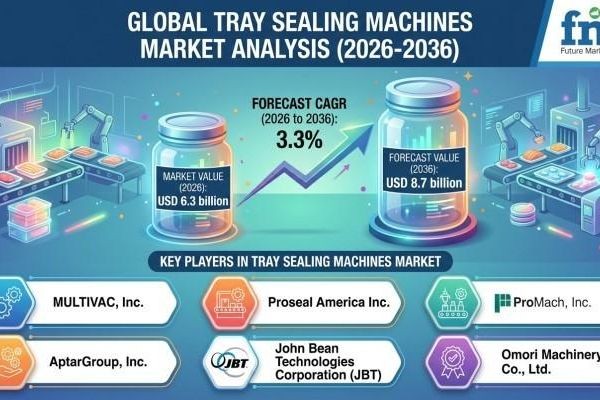
The global tray sealing machines market is experiencing consistent expansion as food manufacturers and foodservice operators increasingly prioritize automation, packaging efficiency, and stringent food safety compliance across production environments.
The global Tray Sealing Machines Market was valued at USD 6.1 billion in 2025 and is projected to reach USD 6.3 billion in 2026. Over the forecast period, the market is expected to grow to USD 8.7 billion by 2036, registering a CAGR of 3.3% between 2026 and 2036. Rising demand for automated, MAP-enabled, and high-throughput packaging solutions is accelerating investments across food processing and commercial foodservice sectors.
Get detailed market forecasts, competitive benchmarking, and pricing trends:
https://www.futuremarketinsights.com/reports/brochure/rep-gb-8464
Quick Market Insights: Tray Sealing Machines Market
- Market Value (2025): USD 6.1 Billion
- Estimated Market Value (2026): USD 6.3 Billion
- Forecast Market Value (2036): USD 8.7 Billion
- Forecast CAGR (2026–2036): 3.3%
- Fastest Growing Markets: China (5.8%), India (5.7%), GCC Countries (4.7%)
- Leading Technology Segment: Automatic Tray Sealing Systems (78.0% market share in 2026)
Automation Transforming Food Packaging Operations
Food packaging operations are rapidly transitioning toward automated tray sealing technologies designed to improve productivity, hygiene standards, and packaging consistency. Purchasing decisions are increasingly shifting beyond initial equipment pricing, with buyers focusing on long-term operational value and process optimization.
Key procurement priorities include:
- Higher throughput and operational efficiency
- Labor reduction and automation integration
- Compliance with food safety and hygiene regulations
- Reduced maintenance requirements and improved lifecycle performance
Automated tray sealing systems are helping manufacturers streamline production workflows while supporting compliance with HACCP, FDA, and European food packaging regulations.
Rising Adoption of MAP-Based Packaging Systems
Demand for Modified Atmosphere Packaging (MAP) solutions is increasing significantly across ready-to-eat meals, meat products, fresh produce, and food delivery packaging applications. MAP-compatible tray sealing systems are becoming essential for extending product freshness and improving retail shelf performance.
Major factors driving MAP equipment adoption include:
- Extended shelf life of packaged food products
- Reduction in food waste and spoilage
- Improved product freshness and visual presentation
- Enhanced packaging consistency and sealing reliability
Manufacturers offering advanced MAP-capable sealing systems with precision gas control, automated operations, and high-speed production capabilities are strengthening their competitive positioning.
Equipment Replacement and Modernization Trends
Food processors and commercial foodservice operators are increasingly replacing conventional sealing equipment with next-generation automated systems to improve efficiency and reduce contamination risks.
Key factors accelerating equipment upgrades include:
- Tightening food safety and packaging regulations
- Rising labor costs and workforce shortages
- Growing need for higher production throughput
- Increased emphasis on packaging consistency and contamination prevention
Large-scale food factories, institutional kitchens, catering operations, and restaurant chains are actively investing in modern tray sealing technologies to enhance operational performance.
Regional Market Dynamics and Growth Outlook
Regional investment trends continue to influence the competitive landscape of the tray sealing machines industry.
China and India
Rapid expansion of food processing infrastructure, growing organized food retail, and increasing packaged food consumption are driving strong market growth.
GCC Countries
The market is benefiting from rising hospitality investments, expanding tourism activity, and growing demand for packaged and convenience food products.
United States and Europe
Developed markets remain focused on advanced automation, regulatory compliance, sustainable packaging integration, and high-performance food safety systems.
Manufacturers with strong engineering capabilities, regulatory expertise, and extensive service networks are expected to strengthen their market presence throughout the forecast period.
Automation Expansion Across Food Processing Applications
Automation adoption continues to rise across multiple food packaging segments, including:
- Meat and seafood processing
- Ready meal and convenience food packaging
- Bakery and confectionery production
- Fresh produce packaging operations
Technologies such as automated tray handling, conveyor synchronization, smart monitoring systems, and high-speed sealing integration are significantly improving packaging line productivity and operational reliability.
Procurement Trends and Buyer Expectations
Key end users driving market demand include:
- Food processing companies
- Commercial foodservice operators
- Restaurant chains
- Packaging automation integrators
Modern buyers are increasingly prioritizing:
- Certified food-safe equipment
- Automated and high-speed packaging systems
- Lower labor dependency
- Strong technical service and maintenance support
- Compliance with global food packaging standards
Growing Importance of Aftermarket Services
Long-term equipment reliability and service support are becoming critical differentiators in procurement decisions. End users are increasingly seeking suppliers capable of providing comprehensive lifecycle management solutions.
Key service expectations include:
- Predictive maintenance capabilities
- Preventive maintenance contracts
- Remote diagnostics and technical support
- Reduced downtime and lower lifecycle costs
Manufacturers with strong aftermarket support infrastructure and responsive service networks are gaining stronger customer retention and long-term business opportunities.
Food Safety Regulations Driving Technology Adoption
Global food packaging regulations are becoming increasingly stringent, supporting demand for advanced tray sealing technologies engineered for compliance and contamination prevention.
Major regulatory focus areas include:
- HACCP food safety compliance
- FDA hygiene and packaging standards
- EU food packaging regulations
- Temperature control and contamination prevention requirements
Equipment suppliers capable of delivering compliance-ready packaging systems are gaining stronger specification advantages in industrial procurement contracts.
Competitive Landscape
Leading companies including MULTIVAC, Inc., Proseal America Inc., ProMach, Inc., AptarGroup, Inc., and John Bean Technologies Corporation are competing through:
- Advanced automation capabilities
- MAP technology integration
- Manufacturing scale and global service reach
- Food safety engineering expertise
- Distribution strength and technical support infrastructure
The market is also witnessing growing competition from regional manufacturers and niche automation providers targeting emerging food packaging applications and mid-scale processing operations.






