
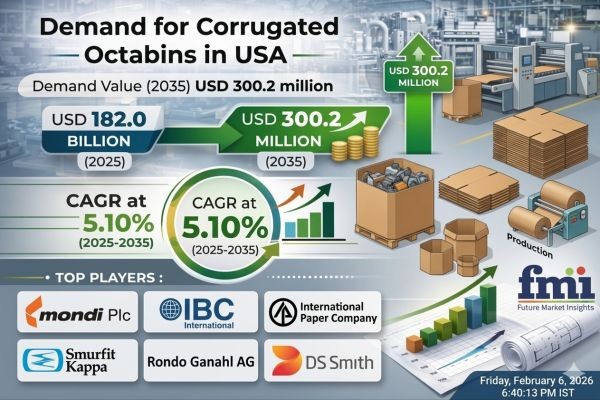
Demand for corrugated octabins in the U.S. [https://www.futuremarketinsights.com/reports/united-states-corrugated-octabins-market] is projected to increase from USD 182.0 million in 2025 to USD 300.2 million by 2035, expanding at a compound annual growth rate (CAGR) of 5.10%, according to the latest market analysis covering the 2025–2035 forecast period. The growth reflects structural changes in bulk packaging, logistics optimization, and the accelerating shift toward recyclable materials. Corrugated octabins large, octagonal, heavy-duty corrugated containers are increasingly used for bulk storage and transportation across industries including food and beverages, pharmaceuticals, chemicals, agriculture, and industrial manufacturing. Their stackability, lightweight structure, and recyclability position them as a viable alternative to wooden crates and plastic bins.
The expansion of U.S. e-commerce and retail distribution networks is a primary growth catalyst. As shipping volumes rise, companies require durable and scalable bulk packaging formats capable of handling high-volume goods while reducing transportation and warehousing costs. Corrugated octabins address these needs through:
- High load-bearing capacity
- Efficient cube utilization
- Collapsible designs for return logistics
- Compatibility with automated supply chains
Market Snapshot: Key Data Points
- Market Value (2025): USD 182.0 million
- Forecast Value (2035): USD 300.2 million
- Forecast CAGR (2025–2035): 5.10%
- Leading Wall Type: Single Wall (61% share)
- Top End-Use Industry: Food & Beverages (56.4% share)
- Fastest-Growing Region: West (5.9% CAGR)
Between 2025 and 2030, the market is expected to grow modestly from USD 182.0 million to USD 191.4 million. However, from 2030 to 2035, demand accelerates significantly, adding USD 108.8 million in value as sustainability mandates and logistics modernization intensify.
Request for Sample Report | Customize Report | Purchase Full Report - https://www.futuremarketinsights.com/reports/sample/rep-gb-28811
Why Corrugated Octabins Are Gaining Preference
The shift toward environmentally responsible packaging is reshaping procurement decisions across industries. Corrugated octabins are primarily manufactured from recyclable corrugated cardboard, making them aligned with circular economy initiatives and packaging waste regulations.
Industries are increasingly prioritizing:
- Reduction of plastic packaging waste
- Lower total cost of ownership
- Enhanced warehouse efficiency
- Improved transport safety for bulk materials
Octabins provide a cost-effective solution for storing and shipping bulk powders, ingredients, components, and finished goods while supporting waste-reduction targets.
Segment Analysis: Wall Type, Product Type, and End Use
Wall Type Leadership
Single-wall corrugated octabins account for 61% of total demand. Their balance of structural integrity, light weight, and affordability makes them suitable for food processing, pharmaceuticals, and general manufacturing applications. Multi-wall variants serve heavier-duty requirements but represent a smaller market share.
Product Type Breakdown
Standard corrugated octabins lead with 45.3% of demand, reflecting widespread adoption across bulk logistics operations. Other product types include:
- Discharge corrugated octabins
- Self-assembly corrugated octabins
- Telescopic corrugated octabins
- Free flow base corrugated octabins
Standard designs remain dominant due to simplicity, cost-efficiency, and broad applicability.
End-Use Dominance
The food and beverages industry accounts for 56.4% of total demand. Bulk storage of ingredients, agricultural produce, and processed goods requires containers that are lightweight yet durable. Corrugated octabins meet hygiene, transport, and storage requirements while supporting sustainability goals. Other contributing sectors include pharmaceuticals, building and construction, chemicals, and industrial manufacturing. The West region shows the strongest growth, supported by large agricultural and food-processing industries and major logistics hubs. The South benefits from expanding manufacturing and warehouse infrastructure. The Northeast maintains steady growth due to strong industrial networks, while the Midwest’s manufacturing modernization supports gradual expansion.
Technological Advancements Enhancing Adoption
Product innovation is strengthening the value proposition of corrugated octabins. Manufacturers are incorporating:
- Moisture-resistant coatings
- Improved stacking strength
- Integrated pallet bases
- RFID-enabled tracking features
- Enhanced assembly efficiency
These improvements allow octabins to integrate more seamlessly into automated warehouses and high-volume distribution environments.
Challenges and Market Constraints
Despite positive growth prospects, adoption may be limited by:
- Higher upfront costs compared to traditional wooden or plastic containers
- Performance constraints in extremely wet or heavy-load applications
- Recycling infrastructure variability for bulk corrugated materials
However, increasing regulatory pressure to reduce plastic waste and improve recyclability is expected to offset these barriers over time.
Competitive Landscape
The U.S. corrugated octabins market is characterized by the presence of established packaging suppliers. Mondi Plc holds an estimated 40.4% share of the demand landscape. Other key participants include:
- IBC International
- International Paper Company
- Smurfit Kappa
- Rondo Ganahl AG
- DS Smith
These companies are expanding product portfolios and investing in sustainable packaging technologies to align with evolving industry requirements.
Outlook Through 2035
The U.S. corrugated octabins market reflects broader structural shifts in supply chain optimization and sustainable packaging adoption. As bulk logistics volumes grow and environmental standards tighten, corrugated octabins are positioned as a scalable, recyclable, and cost-efficient packaging format. With consistent demand from food processing, chemicals, pharmaceuticals, and industrial sectors, the market is expected to maintain steady expansion through 2035, supported by regional logistics development and packaging innovation. For editors, analysts, and industry professionals, the data indicates that corrugated octabins are transitioning from a niche bulk container to a mainstream logistics solution within the U.S. packaging ecosystem.
Why Choose FMI: https://www.futuremarketinsights.com/why-fmi
Explore More Related Studies Published by FMI Research:
Demand for PET Color Shrink Label in UK: https://www.futuremarketinsights.com/reports/united-kingdom-pet-color-shrink-label-market
Demand for Collapsible Rigid Containers in USA: https://www.futuremarketinsights.com/reports/united-states-collapsible-rigid-containers-market
Demand for Filter Paper in Japan: https://www.futuremarketinsights.com/reports/japan-filter-paper-market
Contact Us:
Future Market Insights Inc.
Christiana Corporate, 200 Continental Drive,
Suite 401, Newark, Delaware - 19713, USA
T: +1-347-918-3531
For Sales Enquiries: sales@futuremarketinsights.com
Website: https://www.futuremarketinsights.com
About Future Market Insights (FMI)
Future Market Insights, Inc. (FMI) is an ESOMAR-certified, ISO 9001:2015 market research and consulting organization, trusted by Fortune 500 clients and global enterprises. With operations in the U.S., UK, India, and Dubai, FMI provides data-backed insights and strategic intelligence across 30+ industries and 1200 markets worldwide.






