
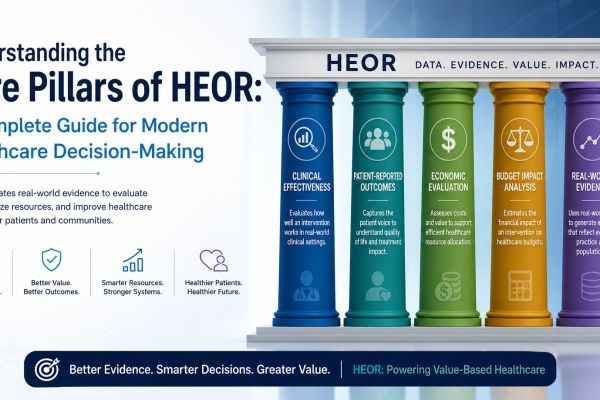
Health Economics and Outcomes Research (HEOR) has become an indispensable pillar of modern healthcare strategy. As pharmaceutical companies, biotech firms, and healthcare institutions face mounting pressure to demonstrate the value of their interventions, the tools and methodologies within HEOR have grown increasingly sophisticated. From understanding disease burdens to modeling economic outcomes, HEOR equips stakeholders with the evidence they need to make confident, data-driven decisions. This article explores the foundational concepts that every healthcare professional, researcher, and decision-maker should understand.
What Is HEOR and Why Does It Matter?
HEOR sits at the intersection of health economics, clinical research, and real-world evidence. Its primary goal is to evaluate not just whether a therapy works, but whether it delivers meaningful value — to patients, payers, and healthcare systems alike. In a world where every dollar spent on healthcare must be justified, HEOR provides the language and the data to make that justification.
At its most practical level, HEOR supports pricing negotiations, reimbursement submissions, and clinical guideline development. Without robust HEOR evidence, even the most clinically effective therapies can struggle to reach patients due to barriers at the payer level.
The Role of Payer Decision Analytics in Reimbursement Strategy
One of the most commercially critical applications of HEOR is payer decision analytics HEOR. Payers — including insurance companies, government health programs, and managed care organizations — rely on rigorous economic evidence to decide which treatments to cover and at what price point.
Payer decision analytics HEOR combines clinical data, cost-effectiveness analyses, and real-world evidence to model what a treatment means for a payer's budget and patient population. When manufacturers enter pricing negotiations armed with this evidence, they are far better positioned to secure favorable formulary placement. Without it, even genuinely superior therapies risk being deprioritized on formularies or subjected to restrictive access conditions.
HEOR Modeling Techniques: Building the Economic Case
The backbone of any HEOR submission is the economic model. HEOR modeling techniques encompass a wide range of analytical approaches designed to simulate how a disease progresses and how interventions alter that progression — and at what cost.
Common HEOR modeling techniques include Markov cohort models, decision tree models, microsimulation models, and discrete event simulations. Each is suited to different disease types and decision contexts. For example, Markov models are particularly well-suited for chronic progressive conditions, where patients move through distinct health states over time. Microsimulation, by contrast, tracks individual patients and is more appropriate for capturing heterogeneity in patient populations.
Selecting the right modeling approach requires deep expertise in both the clinical landscape and the methodological standards set by health technology assessment (HTA) bodies such as NICE in the UK, CADTH in Canada, or ICER in the United States.
Health Economic Modeling Services: From Data to Decision
Given the complexity of building robust economic models, many organizations turn to specialized health economic modeling services to support their submissions. These services bring together health economists, biostatisticians, clinical experts, and outcomes researchers to build models that are both scientifically defensible and strategically compelling.
Health economic modeling services typically cover the full spectrum of model development — from structuring the decision problem and populating the model with clinical trial and real-world data, to conducting sensitivity analyses and presenting results in formats aligned with specific HTA requirements. The goal is always the same: to present a credible, transparent, and impactful economic case.
Burden of Disease Analysis: Quantifying the Stakes
Before making the case for a new therapy, it is essential to understand the scope of the problem it is addressing. Burden of disease analysis quantifies the clinical, economic, and humanistic impact of a condition on patients, caregivers, and healthcare systems.
A well-executed burden of disease analysis examines direct costs (hospitalizations, medications, procedures), indirect costs (lost productivity, caregiver burden), and intangible costs (quality of life deterioration). This data forms the foundation upon which the value proposition of a new intervention is built. Payers and HTA bodies are far more receptive to reimbursement requests when the magnitude of an unmet need has been clearly quantified.
Epidemiology and Outcomes Analysis: Grounding Evidence in Reality
Complementing burden of disease work is epidemiology and outcomes analysis, which provides the population-level lens through which diseases are understood. This discipline examines disease prevalence, incidence, patient demographics, clinical outcomes, and treatment patterns using real-world data sources such as claims databases, electronic health records, and patient registries.
Epidemiology and outcomes analysis is critical for understanding how a disease behaves outside the controlled environment of a clinical trial. It informs model inputs, supports comparative effectiveness research, and helps identify unmet needs and gaps in current standards of care.
Conclusion
HEOR is not a single tool but a comprehensive framework — one that spans payer decision analytics HEOR, advanced HEOR modeling techniques, health economic modeling services, burden of disease analysis, and epidemiology and outcomes analysis. Together, these disciplines enable healthcare stakeholders to demonstrate real-world value, navigate complex reimbursement landscapes, and ultimately ensure that effective therapies reach the patients who need them most.






