
The United States hydro-processing catalysts market is expected to experience stable growth throughout the next decade, driven by increasing renewable diesel production, stringent fuel quality regulations, and continuous refinery modernization efforts. According to the latest insights by Future Market Insights, the market is projected to grow from approximately USD 0.82 billion in 2026 to nearly USD 1.04 billion by 2036, registering a CAGR of 2.4% during the forecast period.
Market momentum is being supported by tightening environmental mandates such as EPA Tier 3 gasoline sulfur standards and ultra-low sulfur diesel requirements, both of which require refiners to continuously invest in advanced hydro-processing catalyst technologies. In parallel, the rapid expansion of renewable diesel and sustainable aviation fuel (SAF) facilities across the United States is creating new long-term demand for specialized catalyst formulations optimized for bio-feedstock processing.
United States Hydro-processing Catalysts Market Snapshot (2026–2036)
- Market size in 2026: USD 0.82 billion
- Forecast market value by 2036: USD 1.04 billion
- Forecast CAGR (2026–2036): 2.4%
- Dominant product segment: Hydrotreating catalysts
- Leading ingredient category: Metals-based catalysts
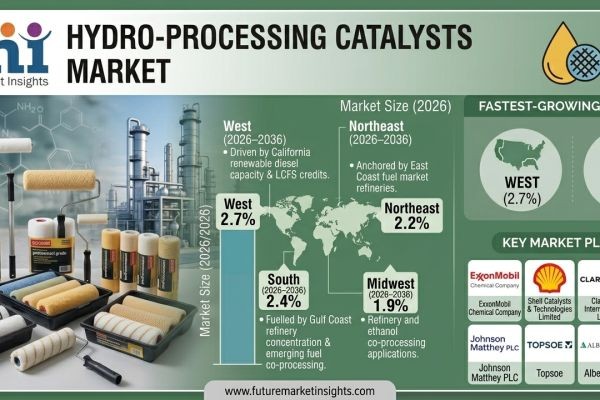
- Fastest-growing regional market: Western United States (2.7% CAGR)
- Key demand sectors: Petroleum refineries and renewable fuel facilities
Momentum in the Market
The United States hydro-processing catalysts industry is witnessing gradual but sustained expansion as refiners continue upgrading operations to meet evolving environmental and fuel efficiency standards. Between 2026 and 2036, catalyst demand is expected to rise steadily due to increasing processing complexity associated with heavier crude oils, renewable feedstocks, and stricter sulfur reduction requirements.
Hydro-processing catalysts play a crucial role in refining operations by facilitating hydrodesulfurization, hydrocracking, and hydrodenitrogenation processes that improve fuel quality while reducing harmful emissions. As the energy sector shifts toward cleaner fuels and lower-carbon alternatives, catalyst technologies are becoming increasingly important for operational efficiency and regulatory compliance.
The growing renewable diesel ecosystem in the United States is also transforming catalyst procurement dynamics. Renewable fuel facilities processing waste oils, vegetable oils, and animal fats require highly specialized hydrotreating catalysts capable of handling biological impurities and unique deactivation patterns.
The Reasons Behind the Market’s Growth
Several structural and technological developments are contributing to the long-term growth trajectory of the United States hydro-processing catalysts market.
Stringent Environmental Regulations
The implementation of EPA Tier 3 gasoline sulfur standards and ultra-low sulfur diesel mandates continues to drive demand for advanced hydro-processing catalysts capable of reducing sulfur content while maintaining refinery efficiency.
Expansion of Renewable Diesel Production
The rapid growth of renewable diesel and sustainable aviation fuel production facilities is creating incremental demand for specialized catalyst systems tailored for bio-feedstock hydrotreating applications.
Refinery Modernization Investments
Refineries across the United States are upgrading existing hydro-processing units to improve throughput, enhance efficiency, and process heavier crude oil feedstocks more effectively.
Rising Demand for Cleaner Fuels
Increasing consumer and industrial demand for cleaner transportation fuels is encouraging refiners to invest in advanced hydrocracking and hydrotreating technologies.
Technological Advancements in Catalysts
Continuous innovation in catalyst selectivity, longevity, regeneration technologies, and process optimization tools is improving refining performance while reducing operational costs.
Top Segment Analysis
Product Type Analysis
Hydrotreating Catalysts Lead the Market
Hydrotreating catalysts are expected to dominate the United States hydro-processing catalysts market, accounting for nearly 67.0% share in 2026. These catalysts remain essential for sulfur removal and fuel quality improvement across conventional refining and renewable fuel operations.
Hydrocracking Catalysts Gain Importance
Hydrocracking catalysts are witnessing growing demand due to rising refinery investments aimed at maximizing fuel conversion efficiency and processing heavier crude feedstocks.
Ingredient Analysis
Metals-Based Catalysts Dominate Industry Demand
Metals-based catalysts are projected to account for approximately 54.9% of the ingredient segment in 2026, supported by their superior catalytic activity, durability, and compatibility with stringent environmental standards.
Support materials and additive technologies are also evolving rapidly to improve catalyst lifespan and enhance resistance to contamination under severe processing conditions.
Regional Development: Western and Gulf Coast Regions Drive Expansion
Regional growth across the United States is strongly linked to refining capacity concentration and renewable fuel production investments.
Western United States
The West is forecast to lead the national market with a CAGR of 2.7% through 2036, primarily driven by California’s renewable diesel production capacity and Low Carbon Fuel Standard (LCFS) incentives.
Southern United States
The South is expected to register a CAGR of 2.4%, supported by the Gulf Coast’s extensive refinery infrastructure and emerging renewable fuel co-processing facilities.
Northeast United States
The Northeast market is projected to grow steadily at 2.2% CAGR as refinery modernization initiatives and clean fuel policies continue supporting catalyst adoption.
Midwest United States
The Midwest is expected to witness moderate growth at 1.9% CAGR, supported by refinery upgrades and ethanol co-processing applications.
Challenges, Trends, Opportunities, and Drivers
Drivers
- EPA sulfur compliance requirements
- Growth in renewable diesel production
- Increasing refining complexity
- Rising demand for low-emission fuels
- Expansion of SAF processing infrastructure
Opportunities
- Bio-feedstock optimized catalyst formulations
- Sustainable aviation fuel catalyst technologies
- Catalyst regeneration solutions
- Digital monitoring and refinery optimization tools
- Advanced long-cycle catalyst systems
Trends
- Increasing adoption of renewable fuel hydrotreating catalysts
- Focus on catalyst longevity and operational efficiency
- Development of advanced support materials and promoters
- Integration of digital refinery monitoring technologies
- Greater investment in sustainable refining technologies
Challenges
- High catalyst development and replacement costs
- Operational complexity in renewable fuel processing
- Catalyst deactivation under severe operating conditions
- Competition from alternative refining technologies
- Volatility in crude oil and renewable feedstock markets
Competitive Landscape
The United States hydro-processing catalysts market remains moderately consolidated, with major industry participants focusing on technological innovation, renewable fuel compatibility, and refinery optimization solutions.
Key companies operating in the market include:
- ExxonMobil Chemical Company
- Shell Catalysts & Technologies
- Clariant International Ltd.
- Chevron Phillips Chemical Company
- Johnson Matthey PLC
These companies are investing heavily in catalyst innovation, renewable diesel processing technologies, and refinery performance optimization to strengthen their competitive positioning.
Future Outlook: Transition Toward Cleaner and More Efficient Refining
The United States hydro-processing catalysts market is entering a transformative period shaped by energy transition goals, renewable fuel investments, and stricter environmental regulations. While conventional refinery catalyst demand is expected to remain stable, renewable diesel and sustainable aviation fuel production are emerging as major growth engines for the industry.
Future catalyst technologies are likely to focus on improved bio-feedstock compatibility, longer operational cycles, lower regeneration costs, and enhanced process efficiency. As refiners continue modernizing infrastructure and adapting to evolving fuel standards, hydro-processing catalysts will remain central to achieving cleaner, more sustainable refining operations across the United States.
For a comprehensive strategic outlook and detailed analysis of technological developments shaping the industry, readers can explore the full report on the official Future Market Insights website:
https://www.futuremarketinsights.com/reports/united-states-hydro-processing-catalysts-market






