
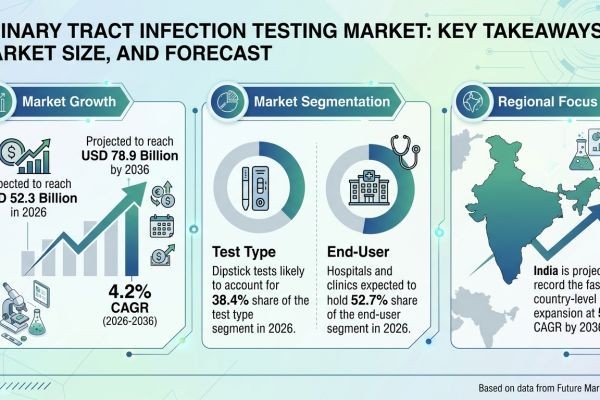
The global urinary tract infection (UTI) testing market is projected to witness strong expansion over the next decade, supported by widening diagnostic access and expanding healthcare infrastructures worldwide. The market is expected to grow steadily, reaching approximately USD 78.9 billion by 2036, up from USD 52.3 billion in 2026, registering a CAGR of 4.2%, according to the latest analysis by Future Market Insights (FMI).
Market growth is being shaped by increasing clinical demand for faster diagnostic decision support, growing focus on antimicrobial stewardship, and rapid adoption of advanced screening technologies. Diagnostic testing workflows are evolving from option-based laboratory confirmations into standardized regulatory protocols across primary and acute care settings. While conventional testing continues to hold a significant infrastructure share, providers are increasingly integrating rapid molecular platforms and automated tools to optimize patient care and improve treatment outcomes.
Urinary Tract Infection Testing Market Snapshot (2026–2036)
Market size outlook toward 2036: USD 78.9 billion
Forecast CAGR: 4.2%
Dominant test category: Dipstick tests (~38.4% share)
Fastest-growing country market: India (5.8% CAGR)
Key market segment: Hospitals & clinics (~52.7% share)
Primary demand channel: Diagnostic laboratories and clinical point-of-care
Momentum in the Market
Beginning from centralized, culture-dependent clinical protocols, the urinary tract infection testing market demonstrates accelerated growth throughout the forecast period as rapid point-of-care compliance becomes standard across multiple regions. Between 2026 and 2036, expanding diagnostic availability and rising healthcare spending are expected to significantly boost demand for digital home collection and connected systems.
Increasing geriatric population segments and structural shifts toward outpatient clinic models are encouraging healthcare networks to prioritize decentralized workflows. From 2036 onward, innovation in AI-driven point-of-care diagnostics and rapid pathogen identification is expected to further strengthen market expansion. Smart diagnostic platforms capable of streamlining evidence-based clinical insights are emerging as critical additions to next-generation healthcare models.
The Reasons Behind the Market’s Growth
Demand for urinary tract infection testing is rising due to multiple clinical and technological factors reshaping the healthcare ecosystem.
Need for Rapid Antibiotic Stewardship
Healthcare providers globally are executing strict diagnostic protocols to address antimicrobial resistance risks. Accelerated testing assists clinicians in confirming appropriate targeted therapies rather than broad empiric prescribing.
Expanding Point-of-Care Adoption
Rapid technological transitions from traditional 48-hour laboratory workflows to quick decentralized testing spaces are fueling real-time clinical assessment capabilities.
Rising Chronic Disease and Geriatric Populations
The swelling prevalence of diabetes, obesity, and age-related systemic vulnerabilities across global populations generates higher routine screening volumes.
Consumer-Driven Connected Health
Patients are actively adopting home-use diagnostic tools that offer app-enabled guidance, digital sample tracking, and rapid symptom analysis.
Top Segment Application Type
Hospitals and Clinics Lead Market Demand
Hospitals and clinics account for the majority of testing volume globally, supported by high inpatient admissions, emergency department screenings, and immediate therapeutic decision mandates.
Test Type Analysis
Dipstick tests: ~38.4% market share, leading point-of-care and primary care applications.
Culture tests: ~28.7% market share, supporting definitive laboratory diagnosis and resistance checking.
Molecular diagnostics: ~19.3% market share, expanding fast due to pathogen identification speed.
Regional Development: Diagnostic Ecosystems Drive Expansion
The global testing network is rapidly changing, heavily supported by local infrastructure modernizations and targeted clinical delivery changes.
United States: Leads institutional value driven by advanced clinical adoption, automated high-throughput workflows, and rapid urgent-care testing integration.
India: Anticipated to secure the fastest regional growth at a 5.8% CAGR, powered by scaling primary care availability and expanding diagnostics in rural zones.
Germany & United Kingdom: Steady expansion anchored by rigorous European laboratory quality mandates and localized public healthcare testing frameworks.
Japan: Strong demand growth backed by an extensive geriatric demographic requiring long-term care monitoring.
Challenges, Trends, Opportunities, and Drivers
Drivers
- High global incidence of urinary tract infections
- Transition to rapid molecular diagnostic testing
- Growing focus on diagnostic accuracy and antibiotic management
- Escalating deployment of automated laboratory instruments
Opportunities
- Digital home-care testing platforms with integrated apps
- AI-enabled pathogen and cell analysis systems
- Multi-pathogen molecular screening panels
- Low-cost multiplex strip designs for emerging economies
Trends
- Transition from culture-led methods to rapid point-of-care tools
- Heightened deployment of connected diagnostic software
- Expansion of direct-to-consumer healthcare platforms
- Integration of advanced microfluidic detection systems
Challenges
- Cost constraints regarding advanced molecular instruments
- Regional variances in lab infrastructure and training
- Fluctuations in pricing for highly specialized assay reagents
Country Growth Outlook (Global Economies)
The market’s overall expansion trajectory is tied closely to localized healthcare access improvements and diagnostic standard adoptions:
- India: Expanding clinical access paths (5.8% CAGR)
- USA: High-volume rapid testing infrastructure (4.6% CAGR)
- Germany: Strict clinical protocol application (4.3% CAGR)
- Japan: Elderly population monitoring needs (4.0% CAGR)
- United Kingdom: Primary care triage updates (3.7% CAGR)
The Competitive Environment
The urinary tract infection testing market is moderately consolidated, with primary diagnostic manufacturers competing via localized distribution networks, clinical validation data, and product diversification. Key industry operators focus heavily on automation, high-sensitivity point-of-care testing assays, and strategic supply alignments with large hospital networks to stabilize material access and capture expanding regional segments.
Future Outlook: Toward Intelligent and Faster Diagnostics
The urinary tract infection testing market is entering a transformative decade shaped by automation, molecular speed, and connected consumer data. Next-generation systems will operate as automated, data-driven platforms integrated directly into clinical tracking software. As diagnostic infrastructure matures and consumer interest rises, advanced testing methodologies will remain vital to creating smarter medical delivery architectures worldwide.
For a comprehensive strategic outlook and detailed analysis of technological developments shaping the industry, readers can explore the full report on the official Future Market Insights website: https://www.futuremarketinsights.com/reports/urinary-tract-infection-testing-market






