
When product developers need a handful of parts that look and feel like final production components, traditional manufacturing methods can present significant challenges. Injection moulding offers exceptional quality but requires expensive tooling, while 3D printing may not always deliver the cosmetic finish or material properties needed for customer-facing products.
Vacuum casting solves this problem by providing a fast, affordable, and highly effective manufacturing solution for low-volume production.
For businesses requiring between 1 and 50 parts, vacuum casting delivers production-quality results without the financial commitment of full-scale manufacturing. Companies across Australia rely on Forge Labs to produce cosmetic-grade polyurethane parts for testing, validation, product launches, and pilot production.
What Is Vacuum Casting?
Vacuum casting is a manufacturing process that creates small batches of parts using silicone moulds and polyurethane materials.
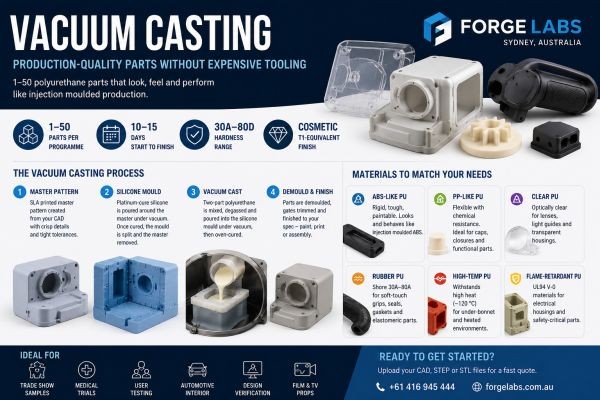
The process starts with a highly detailed master pattern, usually produced through SLA 3D printing. A silicone mould is then created around the master, capturing every detail and surface feature. Polyurethane resin is poured into the mould under vacuum conditions to eliminate air bubbles and ensure exceptional part quality.
The resulting components closely resemble injection moulded parts in appearance, feel, and performance.
Why Vacuum Casting Is Ideal for Small Production Runs
Not every project requires thousands of parts.
Many businesses need only a small number of components for:
- Product validation
- Customer testing
- Trade show demonstrations
- Investor presentations
- Clinical evaluations
- Pilot production
Vacuum casting provides a cost-effective way to manufacture these parts while maintaining professional quality standards.
Lower Tooling Costs
Unlike injection moulding, which requires costly metal tooling, vacuum casting uses silicone moulds that are significantly less expensive to produce.
This dramatically reduces upfront investment.
Faster Turnaround
Vacuum casting projects can often be completed within 10–15 days from approved CAD files.
This allows businesses to accelerate product development and reduce time-to-market.
Production-Like Results
Modern polyurethane materials replicate many common engineering plastics, enabling realistic testing before production begins.
The Vacuum Casting Manufacturing Process
CAD Design and Master Pattern Creation
The process begins with a 3D CAD model.
A master pattern is produced using SLA printing to achieve high dimensional accuracy and smooth surface finishes.
Silicone Mould Production
The master pattern is enclosed within a mould frame and surrounded by liquid platinum-cure silicone.
Once cured, the mould is carefully split open and the master removed.
Polyurethane Casting
Selected polyurethane material is mixed and poured into the silicone mould under vacuum.
The vacuum environment removes trapped air and ensures complete filling of intricate features.
Finishing and Inspection
Finished parts are removed from the mould, trimmed, inspected, and prepared for delivery.
Optional finishing services include:
- Painting
- Clear coating
- Pad printing
- Assembly
- Surface texturing
Material Options Available
One of the greatest strengths of vacuum casting is material versatility.
ABS-Like Polyurethane
Ideal for:
- Product enclosures
- Consumer goods
- Functional prototypes
- Engineering components
PP-Like Polyurethane
Suitable for:
- Caps
- Closures
- Packaging products
- Flexible components
Clear Polyurethane
Used for:
- Transparent housings
- Display products
- Lens prototypes
- Light guides
Rubber-Like Polyurethane
Perfect for:
- Gaskets
- Seals
- Soft-touch grips
- Flexible products
High-Temperature Polyurethane
Designed for applications exposed to elevated operating temperatures.
Flame-Retardant Polyurethane
Used for electrical and industrial products requiring improved fire resistance.
Industries Using Vacuum Casting
Consumer Product Development
Product designers use vacuum casting to create realistic samples before production tooling is commissioned.
Medical Devices
Vacuum casting supports:
- Clinical trials
- Design validation
- Regulatory submissions
- User testing
Automotive
Manufacturers produce:
- Interior trim components
- Dashboard elements
- Functional prototypes
- Design evaluation parts
Industrial Equipment
Engineers use vacuum casting to assess housings, covers, and control interfaces before production.
Film and Entertainment
Studios frequently use vacuum casting to create multiple identical props and display pieces.
Vacuum Casting vs 3D Printing
While 3D printing remains an excellent prototyping technology, vacuum casting offers significant advantages when multiple identical parts are required.
Choose 3D Printing When:
- You need a single prototype
- Design changes are frequent
- Internal geometries are complex
Choose Vacuum Casting When:
- You need 5–50 identical parts
- Cosmetic quality is important
- Production-like materials are required
- Consistency matters
For low-volume manufacturing, vacuum casting often delivers better value and appearance.
Vacuum Casting vs Injection Moulding
Injection moulding remains the preferred option for high-volume production, but vacuum casting offers advantages during product development.
Vacuum Casting Benefits
- Low tooling costs
- Faster setup
- Easy design changes
- Lower risk
Injection Moulding Benefits
- Lowest cost per part at high volumes
- Excellent repeatability
- Suitable for mass production
Many companies use vacuum casting to validate products before investing in injection mould tooling.
Why Choose Forge Labs for Vacuum Casting?
Australian businesses require manufacturing partners that can deliver quality, speed, and technical expertise.
Forge Labs provides professional vacuum casting services from its Sydney facility, helping businesses produce production-quality polyurethane parts quickly and efficiently.
Their capabilities include:
- SLA master pattern production
- Silicone mould manufacturing
- Vacuum-degassed polyurethane casting
- Over-moulded components
- Insert casting
- Cosmetic finishing
- Low-volume production
- Engineering support
Whether you require a single demonstration model or a batch of market-ready parts, Forge Labs provides a complete manufacturing solution.
Conclusion
Vacuum casting has become an essential manufacturing process for businesses that require production-quality parts without the expense and commitment of injection mould tooling.
By combining excellent surface finish, realistic material properties, and fast turnaround times, vacuum casting enables companies to validate products, reduce risk, and accelerate development.
For low-volume production runs, pilot manufacturing, and cosmetic-grade prototypes, vacuum casting remains one of the most efficient manufacturing methods available today.
For expert vacuum casting services in Australia, Forge Labs delivers high-quality polyurethane parts backed by engineering expertise and rapid turnaround times.
FAQs
How many parts can vacuum casting produce?
Most projects range from 1 to 50 parts, with each silicone mould typically producing 15–25 components.
How long does vacuum casting take?
Most vacuum casting projects are completed within 10–15 working days.
Can vacuum cast parts be painted?
Yes. Parts can be painted, coated, textured, and finished to production standards.
Are transparent materials available?
Yes. Clear polyurethane materials are available for lenses, displays, and transparent housings.
Can flexible parts be produced?
Absolutely. Rubber-like polyurethane materials are available in a wide range of Shore hardness values.
Is vacuum casting suitable for functional testing?
Yes. Many polyurethane materials closely mimic engineering plastics used in production.
Is vacuum casting cheaper than injection moulding?
For low-volume production, vacuum casting is significantly more affordable because it eliminates metal tooling costs.
What industries commonly use vacuum casting?
Consumer products, medical devices, automotive, industrial equipment, electronics, and entertainment industries frequently use vacuum casting.
Can inserts be cast into parts?
Yes. Threaded inserts, magnets, bushings, and other components can be integrated during casting.
Why choose Forge Labs?
Forge Labs combines advanced SLA printing, precision silicone moulding, polyurethane casting expertise, and fast Australian-based manufacturing to deliver production-quality parts with minimal lead times.






