
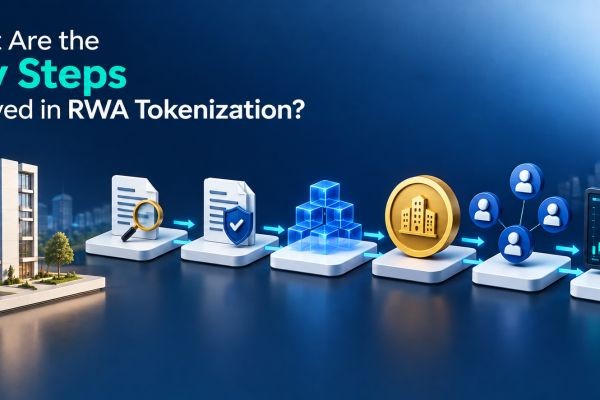
Real-world asset (RWA) tokenization is the process of representing ownership rights or claims over physical or traditional financial assets as digital tokens on a programmable blockchain or distributed ledger. The assets can include real estate, government securities, private credit, commodities, funds, artwork, and other forms of value. Unlike a conventional digital record, a token can combine information about an asset with rules governing how ownership or transfer occurs. The Bank for International Settlements (BIS) describes tokenization as recording claims on real or financial assets on a programmable platform, allowing asset information and transfer logic to work together.
The idea is gaining practical relevance because financial institutions are moving beyond experiments toward production systems. For example, Franklin Templeton's Franklin OnChain U.S. Government Money Fund uses blockchain technology to record share ownership and process transactions. By April 2026, the fund's BENJI token represented more than $650 million in value on Stellar, while the wider BENJI suite had $1.98 billion in assets under management.
However, tokenization is not simply a matter of creating a cryptocurrency that represents an asset. A successful project must connect the physical or financial asset to enforceable ownership rights, legal structures, compliance procedures, reliable data, secure smart contracts, investor infrastructure, and appropriate trading or settlement mechanisms. The following steps explain how that process generally works.
1. Select and Assess the Real-World Asset
The first step is determining what asset should be tokenized and whether it is suitable for a blockchain-based structure. This involves more than calculating the asset's market value. The issuer must establish who owns the asset, what rights investors will receive, how the asset generates value, and whether those rights can legally be represented through tokens.
Different assets create different requirements. A commercial property, for example, may generate rental income and therefore require a structure for distributing that income to token holders. A government security may require a regulated fund or securities structure. Private credit may require detailed borrower information, repayment terms, collateral arrangements, and servicing procedures.
Asset due diligence should therefore cover ownership documentation, valuation, existing liens, contractual obligations, income generation, transfer restrictions, jurisdiction, and regulatory classification. This stage determines whether tokenization creates a practical improvement rather than simply adding blockchain technology to an existing process.
2. Establish the Legal and Regulatory Structure
The second segment is one of the most important because blockchain technology does not automatically establish legal ownership. The token must have a clearly defined relationship with the underlying asset.
For example, a property token might represent shares in a special purpose vehicle (SPV) that owns a building rather than giving every token holder direct title to the property. The legal documents must specify what investors actually own, what rights they have, how distributions work, and what happens if the underlying asset is sold.
This is also where regulatory requirements become central. Depending on the asset and jurisdiction, the offering may involve securities laws, investment regulations, KYC and AML requirements, tax obligations, investor eligibility rules, custody requirements, and restrictions on secondary trading.
The BIS notes that tokenization faces economic, legal, and technical challenges, and that the potential benefits are greater for applications that also present more complex legal and governance questions.
Businesses developing RWA tokenization development services therefore need to coordinate technology with legal and compliance specialists rather than treating regulation as an afterthought. RWA tokenization services may involve smart contracts, investor onboarding, wallet integration, compliance automation, asset management, and secondary-market infrastructure, but the precise architecture depends on the asset and jurisdiction.
3. Create the Ownership and Token Economics Model
Once the legal structure is established, the issuer needs to determine exactly what each token represents.
A token can represent direct ownership, an economic interest, a debt claim, fund units, revenue rights, or an interest in an entity that owns the underlying asset. The distinction matters because it affects investor rights, transferability, taxation, and regulatory treatment.
Suppose a property is valued at $10 million and an issuer creates 1 million tokens. A simple model might associate each token with a proportional economic interest in the underlying structure. But the economics must also account for management fees, maintenance expenses, taxes, distributions, redemption mechanisms, voting rights, and potential changes in the asset's value.
Token supply should therefore be designed around the legal and financial structure rather than selected purely for marketing purposes.
4. Perform Asset Valuation and Verification
Before tokens are issued, the underlying asset needs reliable verification and valuation. Investors must be able to understand what supports the token and how that asset is valued.
For real estate, verification may include title records, property inspections, independent valuations, rental agreements, insurance records, and financial statements. For financial assets, relevant evidence may include custody records, fund documentation, issuer information, and transaction records.
This stage is particularly important because blockchain records can prove what happened to a token, but they cannot automatically prove that an off-chain asset exists or that its stated value is accurate. The connection between blockchain data and real-world information often depends on legal entities, custodians, auditors, valuation providers, and trusted data sources.
5. Choose the Blockchain and Technical Architecture
The next step is selecting the blockchain infrastructure that will support issuance, ownership records, transfers, compliance rules, and potentially secondary trading.
The choice may involve public blockchains, permissioned networks, or hybrid architectures. Key considerations include transaction costs, scalability, security, interoperability, wallet support, privacy, settlement speed, ecosystem availability, and regulatory requirements.
The technical architecture should also consider how off-chain systems interact with blockchain records. An RWA platform may need integrations with banking systems, custodians, property databases, KYC providers, payment systems, identity platforms, and accounting software.
BIS research highlights that tokenization can combine asset records with programmable rules, enabling processes such as automated transfers and delivery-versus-payment arrangements.
6. Develop and Audit Smart Contracts
Smart contracts provide the programmable layer of an RWA tokenization system. They can define token issuance, transfers, investor restrictions, distributions, redemptions, voting mechanisms, and other business rules.
For regulated assets, smart contracts may also need controls that restrict transfers to eligible investors. For example, a token could prevent transfers to wallets that have not completed required verification.
Security testing is essential because smart-contract vulnerabilities can create financial and operational risks. The Financial Stability Board has identified smart-contract errors, private-key management, governance weaknesses, and operational vulnerabilities among the risks associated with DLT-based tokenization.
A robust development process should therefore include code review, automated testing, penetration testing where appropriate, independent smart-contract audits, access-control testing, and procedures for responding to discovered vulnerabilities.
7. Connect the Token to Verified Asset Data
Tokenization requires an ongoing connection between the blockchain and the underlying asset. This becomes especially important when the asset's value, income, status, or performance changes over time.
Oracles and other data infrastructure can provide information such as asset prices, interest rates, property values, or payment events. But these systems introduce another trust layer. Incorrect or manipulated data can affect the token even if the smart contract itself functions correctly.
For this reason, projects often combine multiple sources of information with legal and operational controls. The objective is to maintain confidence that the token continues to represent the rights and economic value described in its documentation.
8. Complete KYC, AML, Custody, and Investor Onboarding
Before investors receive tokens, the platform must determine who is allowed to participate. This can involve identity verification, sanctions screening, investor classification, jurisdiction checks, source-of-funds procedures, and other compliance requirements.
Wallet management is equally important. Some RWA platforms may use custodial wallets, while others allow investors to connect their own wallets subject to compliance controls.
The onboarding process should make the relationship between identity and token ownership clear while protecting personal information. The technical design also needs procedures for lost credentials, wallet recovery, blocked accounts, transfers, and regulatory requests.
9. Mint and Issue the Tokens
After the legal, financial, compliance, and technical structures are ready, the tokens can be minted.
Minting creates the digital representation according to the previously established token model. At this stage, the issuer should have documented the total supply, ownership structure, issuance conditions, investor rights, transfer restrictions, and asset backing.
The launch may occur through a private offering, regulated investment platform, institutional distribution channel, or another permitted structure. The distribution mechanism depends heavily on the asset and applicable regulations.
Franklin Templeton's BENJI provides a practical example. One share of its Franklin OnChain U.S. Government Money Fund corresponds to one BENJI token, while the fund's transfer agent maintains the official ownership record through its blockchain-integrated system.
10. Enable Trading, Transfers, and Ongoing Asset Management
Tokenization does not end when the tokens are issued. The platform must support the asset throughout its lifecycle.
Depending on the legal structure, investors may be able to transfer tokens between approved wallets, receive income distributions, redeem holdings, or trade through a compliant secondary market.
This is where tokenization can potentially produce some of its most meaningful operational benefits. Smart contracts can automate certain transactions, while blockchain records can reduce reconciliation between multiple parties. BIS research notes that tokenization can integrate messaging, reconciliation, and asset transfer, potentially reducing manual processes.
Real-world implementations already demonstrate some of these capabilities. Franklin Templeton reported that BENJI supported peer-to-peer transfers and had accumulated more than $211 million in such transfer volume by March 2026.
11. Maintain Transparency, Compliance, and Asset Reporting
An RWA platform must continuously demonstrate that the token remains connected to the underlying asset and contractual rights.
This may require periodic valuations, financial reporting, proof of reserves or assets, investor statements, regulatory reporting, audits, compliance monitoring, and updates to legal documentation.
Ongoing governance is particularly important because tokenization introduces new operational relationships between issuers, investors, custodians, blockchain networks, smart contracts, and service providers. The BIS has emphasized that potential efficiency gains need to be considered alongside governance, risk management, interoperability, and regulatory requirements.
Real-World Example: Tokenized Money Market Funds
Tokenized funds demonstrate how RWA tokenization can work beyond theoretical use cases. Franklin Templeton launched its Franklin OnChain U.S. Government Money Fund in 2021, using blockchain technology to process transactions and record share ownership. By April 2026, Franklin Templeton reported $1.98 billion in assets across the BENJI suite.
The example also illustrates an important point: tokenization is not simply about putting an existing asset on a blockchain. The technology can become part of the asset's operating infrastructure, supporting ownership records, transfers, yield distribution, and access across blockchain networks.
Key Benefits and Remaining Challenges
When properly designed, RWA tokenization can provide fractional ownership, programmable transactions, faster settlement, transparent ownership records, automated distributions, and potentially broader market access. For assets that are traditionally difficult to transfer, tokenization may also create new mechanisms for controlled secondary-market activity.
However, these benefits are not guaranteed. The FSB notes that many potential benefits remain unproven at scale and identifies challenges including regulatory uncertainty, limited interoperability, operational vulnerabilities, and liquidity risks.
The most important challenge is therefore not creating the token itself. It is building a trustworthy connection between the digital token, the legal claim, the underlying asset, and the systems responsible for managing that asset.
Conclusion
RWA tokenization involves a complete lifecycle rather than a single blockchain transaction. The process begins with selecting and verifying a suitable asset, establishing legal ownership, designing token economics, choosing the technical infrastructure, developing and auditing smart contracts, completing compliance procedures, minting tokens, and maintaining the asset and investor ecosystem after launch. As institutional projects such as Franklin Templeton's BENJI demonstrate, blockchain can become part of the operational infrastructure for traditional assets rather than merely serving as a speculative layer. Blockchain App Factory provides best services for businesses exploring RWA tokenization by combining blockchain development with platform architecture, smart contracts, investor infrastructure, and other components required for a practical tokenization ecosystem.






