
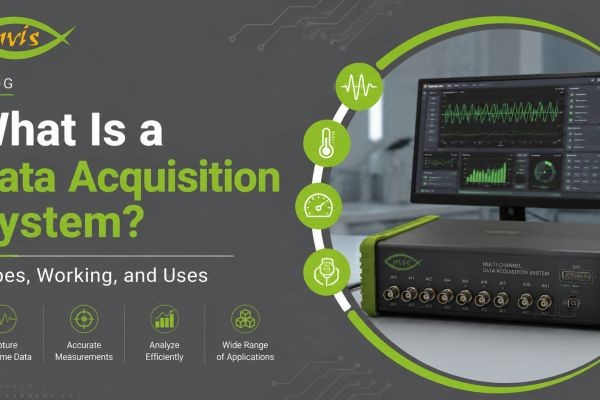
If you've ever wondered how a factory floor knows the exact temperature of a furnace, or how a research lab tracks vibration in a bridge over months, the answer usually comes down to one thing: data acquisition [https://www.nvistech.com/product-category/industry/data-acquisition-card/]. It's one of those terms that sounds technical and intimidating until you realize it's simply the process of turning real-world signals into numbers a computer can understand and act on.
Whether you're a student trying to get your head around instrumentation basics, an engineer evaluating hardware for a new project, or a business owner exploring automation, understanding data acquisition is genuinely useful knowledge. It sits quietly behind almost every measurement-driven industry, from manufacturing and energy to healthcare and environmental monitoring.
In this guide, we'll break down what a data acquisition system [https://www.nvistech.com/product-category/industry/data-acquisition-card/] actually is, how it works, the different types you'll come across, and where these systems are used in the real world. We'll also look at specific building blocks like the data acquisition card and how modern data acquisition solutions are shaping industrial and scientific work today.
What Is Data Acquisition?
Data acquisition [https://www.nvistech.com/product-category/industry/data-acquisition-card/], often shortened to DAQ, is the process of sampling signals from the physical world and converting them into digital values that a computer or processor can store, analyze, and display. Those signals could be almost anything measurable: temperature, pressure, voltage, sound, light, strain, or flow rate.
Think of it this way. A sensor senses. It picks up a physical change and turns it into an electrical signal. But that raw signal on its own doesn't mean much to a computer. Data acquisition is the bridge that takes that electrical signal, cleans it up, converts it, and hands it over in a form software can actually use. Without this bridge, all the clever analytics and automation we rely on today simply wouldn't be possible.
What Is a Data Acquisition System?
A data acquisition system is the complete setup that makes this conversion happen. It typically combines sensors, signal conditioning circuitry, an analog-to-digital converter (ADC), and software running on a computer or embedded controller. Together, these pieces capture physical phenomena, digitize them, and present the data in a usable format, whether that's a live dashboard, a stored log file, or an input feeding a control loop.
You'll sometimes see this referred to by its acronym, DAQ system, and the term covers everything from a simple USB-based unit measuring a single voltage to a large, distributed setup monitoring hundreds of channels across an industrial plant. The scale changes, but the underlying purpose stays the same: capture real-world data accurately and make it available for analysis or decision-making.
How Does a Data Acquisition System Work?
At a basic level, a data acquisition system follows a fairly consistent sequence of steps, regardless of what it's measuring.
Sensing the physical quantity. A sensor or transducer detects a physical parameter, say, temperature or pressure, and converts it into an electrical signal, usually voltage or current.
Signal conditioning. Raw sensor output is rarely ready for direct use. It often needs amplification, filtering, or isolation to remove noise and bring the signal into a range the system can process reliably.
Analog-to-digital conversion. This is the heart of the process. The conditioned analog signal passes through an ADC, which samples it at regular intervals and converts each sample into a digital value.
Data processing and storage. The digitized data is transferred, often through a data acquisition card or interface, into a computer or controller, where software processes it, applies calibration, and stores or displays it.
Analysis and action. Once the data is available digitally, it can be visualized on a screen, logged for later study, or used to trigger an automated response, like shutting off a valve when pressure exceeds a set threshold.
It's a straightforward flow on paper, but the engineering that goes into doing it accurately, at speed, and without introducing errors is where a lot of the real skill in DAQ system design lives.
Types of Data Acquisition Systems
Data acquisition systems aren't one-size-fits-all. They're generally categorized based on how they connect to a computer, how the signal is handled, and how they're deployed.
Based on Connectivity
PC-based DAQ systems rely on an external computer to process and display data. The DAQ hardware itself, often a card installed inside the PC or connected externally via USB, handles the signal conversion, while the computer runs the software layer.
Standalone DAQ systems don't need a dedicated external computer for basic operation. They come with built-in processing and display capabilities, which makes them useful in field conditions or remote monitoring where a full PC setup isn't practical.
Modular DAQ systems are built around a chassis that accepts interchangeable modules for different signal types, voltage, current, temperature, and so on. This modularity makes them flexible for labs and facilities that need to reconfigure their measurement setup frequently.
Based on Signal Type
Analog data acquisition systems deal directly with continuous analog signals before conversion, and are common in applications involving fine-grained voltage or current measurements.
Digital data acquisition systems work with signals that are already digital or convert analog inputs early in the chain, offering better noise immunity and easier integration with modern digital control systems. Digital data acquisition has become the default choice in most new industrial and educational installations because of its accuracy, repeatability, and compatibility with networked systems.
Based on Application Scale
Small, single-channel systems suit classroom experiments or hobbyist projects. Mid-range multi-channel systems handle typical industrial monitoring tasks. Large-scale distributed systems, often spanning multiple locations, are used in power grids, environmental monitoring networks, and process industries where thousands of data points need continuous tracking.
Understanding the Data Acquisition Card
A data acquisition card [https://www.nvistech.com/product/data-acquisition-card-3/], often just called a DAQ card, is the hardware component that physically bridges sensors and the computer. It typically plugs into a PC via a slot (like PCI or PCIe) or connects externally through USB or Ethernet.
The card's job is to receive analog or digital input signals, perform the analog-to-digital conversion (or handle digital I/O directly), and pass the resulting data to the computer for processing. Good DAQ cards are evaluated on a few key specifications:
- Sampling rate: How many samples per second the card can capture, which determines how accurately fast-changing signals are recorded.
- Resolution: Measured in bits, this affects how finely the card can distinguish between different signal levels.
- Number of channels: How many separate signals the card can measure simultaneously.
- Input range and accuracy: How well the card handles varying voltage levels without distortion or drift.
In educational and training environments, data acquisition cards [https://www.nvistech.com/product/data-acquisition-card-2/] are especially valuable because they let students work hands-on with real sensor data, bridging the gap between theoretical instrumentation concepts and practical measurement skills. In industrial contexts, they form the backbone of automated monitoring and control systems, quietly capturing thousands of readings a second without anyone needing to think twice about it.
Digital Data Acquisition Explained
Digital data acquisition [https://www.nvistech.com/product/digital-data-acquisitions/] refers specifically to systems designed around digital signal processing rather than purely analog handling. In practice, most modern DAQ systems, even ones that start with analog sensors, convert signals to digital form as early in the chain as possible, because digital data is easier to transmit over long distances without degradation, easier to store, and far more resistant to electrical noise.
There's also a practical, everyday advantage: digital data integrates cleanly with modern software, cloud platforms, and networked control systems. A digital data acquisition setup can feed information directly into a database, a SCADA system, or an analytics dashboard without the extra conversion steps older analog-heavy setups required.
This shift toward digital-first architectures is one reason DAQ hardware manufacturers have moved toward high-resolution ADCs and built-in digital communication protocols like USB, Ethernet, and CAN bus, rather than relying on older analog interfaces alone.
Choosing the Right Data Acquisition Solution
Not every data acquisition solution [https://www.nvistech.com/product/data-acquisitions-solutions/] fits every problem, and picking the wrong one usually shows up later as either wasted budget or a system that can't keep up with what you actually need to measure. A few practical questions help narrow things down:
What are you measuring, and how many channels do you need? A single-sensor lab experiment has very different requirements than a plant-wide monitoring rollout.
How fast does the signal change? Slow processes like temperature monitoring tolerate lower sampling rates, while vibration analysis or electrical transient studies demand much higher speeds.
Where will the system operate? Harsh industrial environments call for ruggedized hardware, while a controlled lab setting has more flexibility.
Do you need standalone operation or PC connectivity? Remote or field deployments often favor standalone systems, while lab and R&D work tends to lean on PC-based setups for their flexibility.
What's your budget, and how much room do you need for future expansion? Modular systems cost more upfront but scale far more gracefully than fixed-configuration hardware.
A well-matched data acquisition solution accounts for both current requirements and where the project is headed over the next few years. It's a common mistake to buy for today's problem and outgrow the system within a year.
Benefits of Using a Data Acquisition System
The value of a well-designed DAQ system goes beyond simply "getting the numbers." It brings measurable operational advantages:
- Accuracy and consistency: Automated capture removes the human error that comes with manual readings.
- Real-time monitoring: Issues get flagged as they happen, not discovered hours or days later.
- Historical data logging: Long-term trends become visible, which supports predictive maintenance and better planning.
- Scalability: Modern systems, especially modular ones, grow with your needs.
- Integration with automation: DAQ data can trigger alarms, control actuators, or feed machine learning models without manual intervention.
Conclusion
Data acquisition [https://www.nvistech.com/product-category/industry/data-acquisition-card/] might not be the flashiest topic in engineering, but it's genuinely foundational. Every automated factory, every research lab tracking experimental results, every smart grid balancing power loads, all of it depends on systems quietly converting physical signals into digital data that people and machines can actually use.
Understanding the building blocks, sensors feeding into signal conditioning, conversion happening through a data acquisition card [https://www.nvistech.com/product-category/industry/data-acquisition-card/], and the resulting digital data acquisition flowing into software for analysis, makes it much easier to evaluate what a project actually needs. And with the range of data acquisition solutions available today, from compact standalone units to fully modular, multi-channel systems, there's rarely a case where the right fit doesn't exist. The real work lies in matching the system to the measurement problem in front of you, rather than assuming bigger or more expensive automatically means better.
For students, educators, and engineers working hands-on with instrumentation, getting comfortable with these fundamentals pays off well beyond a single project. It's a skill set that carries across industries, and one that only becomes more relevant as measurement and automation continue to shape how things get built, monitored, and improved.






