
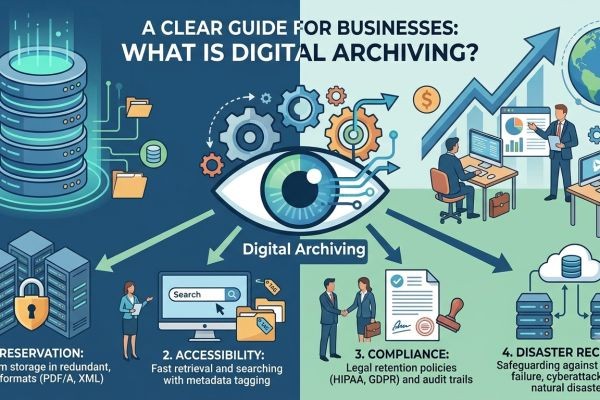
Most explanations of digital archiving fail businesses in the same way: they describe a technology when the reader needs a decision. So here is the working definition first. Digital archiving is the practice of keeping your business records electronically, in an organized, protected form, so they remain findable, readable, and provable for as long as the law or the business requires. And here is the more useful truth behind it: implementing digital archiving is not one big project. It is four specific decisions, and a business that answers them clearly has done most of the work before touching any technology.
This guide walks through the four, in the order they should be taken.
Decision One: Which Records Actually Need Archiving
The instinct is to say everything, and the instinct is wrong in both directions. Archiving everything buries the important records under the trivial ones and turns retention compliance into an impossible task. Archiving nothing, the accidental default, leaves the business exposed.
The workable test is consequence. A record needs archiving if its loss, alteration, or unfindability would cost the business something real:
- Contracts and agreements, because they define enforceable rights
- Financial records, because tax authorities will ask for them
- HR and personnel files, because employment disputes reach back years
- Licenses, permits, and regulatory filings, because they prove you may operate
- Records containing commitments: quotes honored, terms promised, consents given
Everything else, working drafts, routine correspondence, internal chatter, is ordinary file management, not archiving. Most businesses discover the archive-worthy set is perhaps a tenth of what they store. That discovery alone brings enormous clarity: the problem just became ten times smaller.
Decision Two: How Long Each Record Type Must Live
Retention is where archiving stops being opinion and becomes law. Nearly every archive-worthy record carries a legally defined lifespan, and these vary by record type, industry, and country: financial records often seven to ten years, employment records for years past the employment itself, some insurance and medical records for decades.
Two rules make this decision manageable. First, assign retention by record type, not by individual document, so the policy scales. Second, treat the end of retention as seriously as the beginning. Privacy regulation, GDPR most prominently, expects personal data to be deleted when its purpose and legal period expire. A business that keeps everything forever is not being careful. It is accumulating violations with a long fuse.
The output of this decision is a simple retention schedule: each record type, its required lifespan, and its legal basis. One page, usually. That page is the constitution of the archive.
Decision Three: What Form Protection Should Take
Not every archived record needs the same strength of protection, and paying maximum protection for everything wastes money while under-protecting the records that matter most. Three tiers cover nearly every business.
Organized retention suits records that must simply exist and be findable: routine invoices, standard correspondence with retention duties. Proper structure, metadata, and controlled storage suffice.
Provable integrity suits records that may face challenge: contracts, signed agreements, consents. These need preservation that can demonstrate the record has not been altered, with trusted timestamps and audit trails, because in a dispute, an unprovable record is barely a record at all.
Qualified preservation suits records with the longest lives and highest legal stakes, common in finance, insurance, healthcare, and the public sector. Here, European frameworks like eIDAS define standards where preservation itself carries legal presumption, and specialist providers such as Docbyte operate at exactly this level.
The tiering decision is a mapping exercise: each record type from Decision One gets a tier, guided by its consequence and lifespan from Decision Two. The pattern is consistent: most records land in tier one, the critical minority in tiers two and three, and the budget finally matches the stakes.
Decision Four: Who Owns the Archive
The most commonly skipped decision, and the reason many well-designed archives decay. An archive without an owner drifts: new record types go unclassified, departing employees leave gaps, retention schedules fall behind changing law.
Ownership does not mean a full-time role in most businesses. It means a named person or function accountable for four recurring duties: keeping the retention schedule current, ensuring new records enter the archive properly, authorizing disposals when retention expires, and answering for the archive during audits. In smaller companies this sits naturally with finance or operations; in regulated ones, with compliance.
The test of this decision is a single question asked a year later: when a record type changed or a law updated, did anyone notice? If yes, the archive has an owner. If no, it has a countdown.
The Four Decisions in Motion
A distribution business of sixty people ran this exact sequence. Decision One reduced their fifteen years of accumulated files to nine record types worth archiving. Decision Two produced a one-page retention schedule, and with it the awkward discovery that personnel records from long-departed employees should have been deleted years ago. Decision Three placed supplier contracts and signed customer agreements into provable-integrity preservation and left routine invoices in organized retention. Decision Four gave the archive to the finance director, with a yearly review on the calendar.
Elapsed time from start to functioning archive: about six weeks, most of it Decision One. No drama, no grand system migration, because the decisions did the heavy lifting and the technology merely implemented them.
Conclusion
Digital archiving, cleanly defined, is keeping the records that matter findable, readable, and provable for exactly as long as they must be, and disposing of them properly afterward. Getting there is four decisions: which records, how long, what strength of protection, and whose responsibility.
Businesses that take the decisions in order find the topic loses its fog almost immediately, because each answer shrinks and shapes the next. Start with Decision One this week, a list of your record types and their consequences, and the rest of the guide follows on its own schedule. Clarity, it turns out, was never about understanding the technology. It was about making the choices the technology exists to serve.






